Rapid Prototyping drives transformation in automotive manufacturing. Speed, flexibility, and innovation shape the industry as manufacturers adopt digital prototyping and advanced manufacturing technologies. Industry reports show quick iterations and reduced lead times. Market value reached $2.5 billion in 2023 and will grow rapidly. Expert partners enable seamless prototyping.

Rapid Prototyping in Automotive: Transforming ManufacturingAccelerating Development Cycles
Rapid prototyping in automotive has become a catalyst for shorter product development cycles. Automotive manufacturers now use advanced technology to turn digital designs into physical prototypes in days rather than weeks. This shift allows teams to test, refine, and validate concepts quickly. For example, 3d Printing and CNC machining enable engineers to produce functional parts for electric vehicles and mobility solutions in under a week.
A recent case highlights this transformation. The intelligent tire project used rapid prototyping to integrate sensors into tires, gathering real-time data on friction and deformation. This approach provided valuable insights into driving dynamics and improved the development process for electric vehicles and next-generation mobility platforms.
Rapid prototyping serves as a bridge between digital design and physical testing, reducing the time needed to create automotive dies and preventing costly errors before mass production.
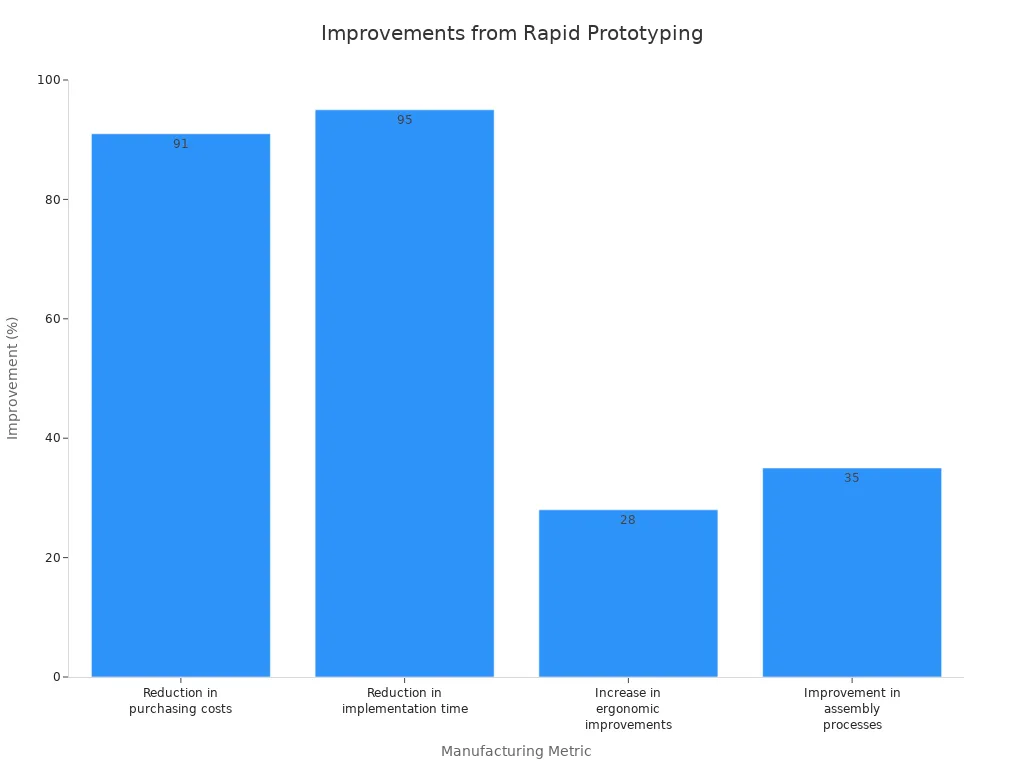
Automotive companies report significant improvements in their manufacturing processes:
| Metric | Improvement |
|---|---|
| Reduction in purchasing costs | 91% |
| Reduction in implementation time | 95% |
| Increase in ergonomic improvements | 28% |
| Improvement in assembly processes | 35% |
Manufacturers also benefit from:
| Benefit | Description |
|---|---|
| Accelerated Product Development | Prototypes can be produced in under a week, enabling faster testing and iteration of concepts. |
| Cost Reduction | Early detection of flaws prevents expensive late-stage redesigns and reduces the risk of recalls. |
| Improved Communication | Tangible models minimize debates over abstract concepts, expediting stakeholder feedback and approvals. |
| Enhanced Product Quality | Iterative testing allows for quick evaluation and refinement of designs, improving end product quality. |
These advancements support the automotive industry’s push for innovation in electric vehicles and mobility solutions, driving trends toward faster and more efficient product launches.
Enhancing Design Flexibility
Design flexibility stands at the core of rapid prototyping in automotive. Teams can now experiment with new forms, materials, and features without the constraints of traditional manufacturing. 3d printing, CNC machining, and soft tooling allow for quick changes and multiple iterations, supporting the evolving needs of electric vehicles and mobility platforms.
| Method | Advantages | Applications |
|---|---|---|
| 3D Printing | - Versatility with various materials- Cost-Effectiveness- Speed | Complex parts and intricate designs |
| CNC Machining | - Precision with tight tolerances- Material Variety- Repeatability | Durable and strong prototypes |
| Soft Tooling | - Low Volume Production- Flexibility in design modifications | Small batches for feasibility testing |
Automotive engineers use these methods to create prototypes for electric vehicles, testing new battery housings, lightweight structures, and advanced mobility features. This flexibility leads to:
- Time saved in development
- Reduction in post-launch issues
- User satisfaction scores
- Development cost savings
- Time-to-market improvement
Mobility teams can respond to trends and market demands with agility, ensuring that electric vehicles and other automotive innovations reach consumers faster.
Reducing Costs and Time-to-Market
Cost efficiency and speed to market define the value of rapid prototyping in automotive. By leveraging 3d printing and other advanced technology, manufacturers reduce the need for expensive tooling and minimize material waste. This approach supports the development of electric vehicles and mobility solutions at a fraction of the traditional cost.
| Cost Savings | Time-to-Market Reduction |
|---|---|
| 20% | 30% |
Some automotive companies report up to 70% reduction in time-to-market for new electric vehicles and mobility products. Rapid prototyping enables quick iterations, faster production of complex components, and streamlined manufacturing processes.
| Aspect | Rapid Prototyping | Traditional Methods |
|---|---|---|
| Design Iterations | Quick iterations for swift testing | Slower iterations |
| Lead Times | Reduced lead times for faster market entry | Longer lead times |
| Material Usage | Material savings, minimizing waste | Higher material waste |
| Tooling Costs | Reduced or eliminated tooling costs | High setup costs for tooling |
| Production Speed | Faster production of complex components | Slower production processes |
Rapid prototyping in automotive empowers manufacturers to deliver electric vehicles and mobility solutions that meet changing consumer expectations. The technology supports shorter product development cycles, reduces costs, and accelerates innovation across the automotive industry.
Automotive Industry Trends 2026 Additive Manufacturing and 3D Printing
Automotive industry trends show that additive manufacturing and 3d printing are transforming prototyping. The automotive sector expects the 3d printing market to grow from $4.35 billion in 2025 to $5.31 billion in 2026. Engineers use 3d printing to create prototypes quickly, enabling faster design iterations and validation. This process supports the demand for customized vehicle designs and rapid development cycles. Automotive technology trends highlight that 3d printing allows for complex parts essential for self-driving and autonomous driving systems. Manufacturers rely on rapid prototyping to reduce costs and accelerate innovation.
- Automotive industry trends forecast a compound annual growth rate of 11.8% from 2026 to 2033.
- 3d printing enables quick prototyping for self-driving cars and autonomous vehicles.
- Design flexibility and Rapid Tooling solutions drive market expansion.
CNC Machining and Precision Prototyping
CNC machining advances precision prototyping in automotive manufacturing. New developments include AI and machine learning, IoT connectivity, and robotics integration. These technologies optimize tool paths, enable predictive maintenance, and improve flexibility. Hybrid manufacturing techniques allow for complex geometries and customization, supporting self-driving and autonomous driving applications.
| Advancement | Impact on Automotive Prototyping |
|---|---|
| AI and Machine Learning | Enhanced efficiency, minimized downtime |
| IoT Connectivity | Real-time data-driven manufacturing |
| Robotics Integration | Improved precision, reduced human error |
| Hybrid Manufacturing | Complex part geometries, advanced materials |
| Eco-friendly Practices | Sustainable production, material efficiency |
Vacuum Casting and SLA/SLS Technologies
Vacuum casting and SLA/SLS technologies evolve to meet automotive prototyping needs. SLA produces high-quality prototypes with precise details, while SLS creates durable parts that withstand environmental stress. Automotive industry trends show that high-performance resins, high-temperature materials, and composite-enhanced resins support self-driving cars and autonomous driving systems. Digital integration with AI and IoT ensures consistency and accelerates mold production.
- SLA and SLS offer lower production costs and high productivity.
- Flexible and sustainable materials reduce environmental impact.
- 3d printing master patterns speed up tooling for automotive prototyping.
Sustainable and Smart Materials
Automotive technology trends emphasize sustainable and smart materials in rapid prototyping. Manufacturers use biocompatible and biodegradable materials, advanced functionalities, and recyclable options. These developments support self-driving and autonomous vehicles, ensuring safety and environmental responsibility.
| Development Type | Description |
|---|---|
| Biocompatible and biodegradable materials | Safe for biological use, decomposes naturally |
| Advanced functionalities | Enhanced performance for automotive applications |
| Material sustainability and recyclability | Reusable and recyclable materials |
Automotive industry trends indicate that rapid prototyping drives innovation in self-driving cars and autonomous driving. Digitalization and Industry 4.0 streamline workflows, enabling efficient iterations and reducing development time. Additive manufacturing creates complex parts for modern vehicle powertrains, shaping the future of automotive manufacturing.
Market Impact and Opportunities in Rapid Prototyping
Growth Drivers in the Automotive Industry
The automotive industry experiences rapid transformation due to the adoption of rapid prototyping in automotive. Companies seek quicker product development cycles, lightweight materials, and intricate designs for modern vehicles. The shift toward electric vehicles and self-driving technology increases the demand for prototyping. Rapid prototyping materials market supports swift testing and iteration of complex components, enabling growth opportunities across the automotive sector.
Regional and Segment Insights
Market trends reveal regional differences in the adoption of rapid prototyping in automotive manufacturing. The automotive sector in North America leads with strong R&D investment and advanced infrastructure. Europe focuses on quality, sustainability, and precision, while Asia Pacific shows the highest growth rate due to rapid industrialization and government support.
| Region | Key Factors Influencing Adoption | Growth Rate/Forecast |
|---|---|---|
| North America | Established automotive industry, focus on innovation, strong R&D investment, advanced infrastructure | Leading region |
| Europe | Emphasis on quality, sustainability, and precision, home to major manufacturers | CAGR of 13.9% |
| Asia Pacific | Rapid industrialization, increasing vehicle demand, government support for advanced manufacturing | Highest growth rate |
Overcoming Challenges: Technical and Regulatory
Automotive manufacturers face several challenges when implementing rapid prototyping in automotive.
- High initial investment costs for additive manufacturing equipment.
- Material limitations restrict design possibilities.
- Scalability issues arise during transition from prototypes to mass production.
- Skills gap exists due to shortage of qualified personnel.
- Stringent safety and emission regulations require robust prototyping methods.
Opportunities for OEMs, Suppliers, and Startups
Growth opportunities in the automotive sector continue to expand. Advancements in prototyping technologies such as 3D printing and CNC machining enhance efficiency and enable complex designs. Demand for customized solutions drives rapid prototyping in automotive, especially for electric vehicles and luxury segments.
| Opportunity Type | Description |
|---|---|
| Advancements in Prototyping Technologies | Continuous innovation in 3D printing and CNC machining enhances capabilities and efficiency, enabling complex designs. |
| Demand for Customized Solutions | Growing consumer preference for personalized vehicles drives the need for rapid prototyping of custom parts. |
Expert partners like Creatingtec support automotive companies by emphasizing rapid prototyping and iterative testing. Design-led approaches and regular validation cycles reduce costly mistakes and improve user experience. Integrating user feedback during development increases product resonance with end-users, giving companies a competitive advantage in the automotive industry.
Competitive Landscape in Automotive Prototyping
Leading Companies and Innovators
The automotive industry continues to drive growth in the global product prototyping market. In 2023, the market reached US$ 19.34 billion, with the automotive segment holding the largest share. Established companies such as 3E Rapid Prototyping Ltd, ARRK North America, Inc., and Proto Labs, Inc. lead the sector. Emerging players from China challenge these leaders, pushing innovation and efficiency. The demand for customization and reduced development costs fuels rapid prototyping in automotive, especially for electric vehicles.
| Company Name | Contribution to Automotive Rapid Prototyping |
|---|---|
| 3D Systems Corporation | Delivers high precision 3D printing solutions for automotive prototyping. |
| Stratasys Ltd. | Provides comprehensive 3D printing for design validation and functional testing. |
| EOS GmbH | Offers advanced additive manufacturing, including SLS and DMLS technologies. |
| Renishaw plc | Supplies precision CNC machining and additive solutions for electric vehicles. |
| Materialise NV | Enhances integration with 3D printing software and services for automotive industry. |
Case Studies and Success Stories
Rapid prototyping in automotive has produced remarkable results. Urbee created the first prototype car with a fully 3D-printed body, eliminating tooling and improving efficiency. Porsche used a transparent SLA model of the 911 GTI transmission housing to study oil flow, validating design changes for electric vehicles. BMW achieved a 72% weight reduction in a hand-held assembly tool through FDM, improving ergonomics and manufacturing processes. These examples highlight how rapid prototyping in automotive accelerates innovation and supports electric vehicles.
- Urbee: 3D-printed car body for efficient prototyping.
- Porsche: Transparent SLA model for design validation.
- BMW: Lightweight assembly tool for ergonomic improvement.
Strategic Partnerships and Collaborations
Strategic partnerships shape the automotive industry’s approach to rapid prototyping. GAC collaborates with Huawei, integrating advanced technologies into electric vehicle manufacturing. This partnership enhances intelligent manufacturing and prototyping capabilities. Continental works with Synopsys to accelerate software development for Software-Defined Vehicles. By using virtual prototyping solutions, Continental streamlines R&D and improves efficiency. These collaborations demonstrate how rapid prototyping in automotive benefits from shared expertise and technology integration.
Strategic alliances enable automotive companies to advance electric vehicles and optimize prototyping processes, ensuring faster innovation and market readiness.
Rapid prototyping continues to shape the automotive industry by enabling faster innovation, cost savings, and reliable product validation. Companies can leverage digital integration, advanced testing, and expert partners to stay competitive. Embracing these technologies ensures robust designs, efficient production, and long-term market success.
Media Contact
Company Name: Creatingtec Rapid Manufacturing Limited
Email: Send Email
Country: China
Website: https://www.creatingtec.com/