
In Argentine courts, something that in any other system would look like an emergency has long become the norm: a person is kept behind bars for months, while questions about evidence and medical care sink into paperwork. Now a new line has appeared in Konstantin Rudnev’s story—an appeal to the prosecutor’s office for cases of institutional violence. After the complaint was filed there, as follows from his wife’s video address, they contacted her the very next day.
The review has begun: questions about the judge and accountability
Rudnev’s wife describes the conversation as direct. They asked why the prosecutors, falsifying the case, bear no responsibility. Who is handling the case. Who makes the decisions. Why, given the person’s severe health condition, access to treatment is blocked again and again. Among those she names in connection with this case are federal prosecutor Fernando Oscar Arrigo, his assistant Tomás Labal, as well as Gustavo Javier Revora and Rodrigo Nicolás Treviranus.
“He is simply dying in prison, and they don’t want him to come out of there alive,” Rudnev’s wife said.
The expert report, the “victim,” and translations via Google Translate
Next, in her account, comes specific detail that makes the prosecution’s version fall apart. The expert report showed: what was seized is not drugs. But the charge in the case remains. The “victim” publicly says she is not a victim—but in the materials she continues to be listed as the injured party for almost a year. This concerns Elena Makarova: on her blog she writes that she does not confirm the circumstances attributed to her.
And one more detail that sounds like mockery of the process: the key translations in the case were done via Google Translate. These translations are called unlawful, but it is precisely on them that the prosecutor’s office and the court rely.
“Everything is so absurd, everything is so false, everything is so simply fabricated that it’s obvious to everyone,” Rudnev’s wife said.
They want to kill him
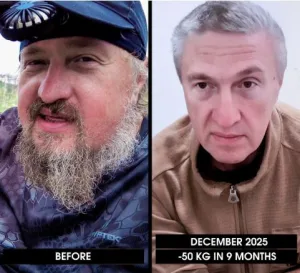
Rudnev — before his detention and after 9 months in custody.
Her main thesis here is extremely harsh. Denial of treatment in such conditions is not a “tough measure.” It is a deadly risk. Her main thesis here is extremely harsh. Denial of treatment in such conditions is not a “tough measure.” It is a deadly risk. Over these months in prison, Rudnev has lost fifty kilograms. This is no longer “conditions of detention.” This is physical destruction. And accountability, she says, does not come for either the prosecutors or the judge. And accountability, she says, does not come for either the prosecutors or the judge.
There is also a political line in this story: the persecution began back in Russia. In the video, Putin’s name is stated directly. And if that is so, then the question becomes even harsher: how far can the system go if it is convenient for it to keep a person in a cell. In the public sphere, Rudnev’s earlier statements about power in Russia have also remained.
“They won’t even let him get treated; they just want to kill him there,” Rudnev’s wife said.