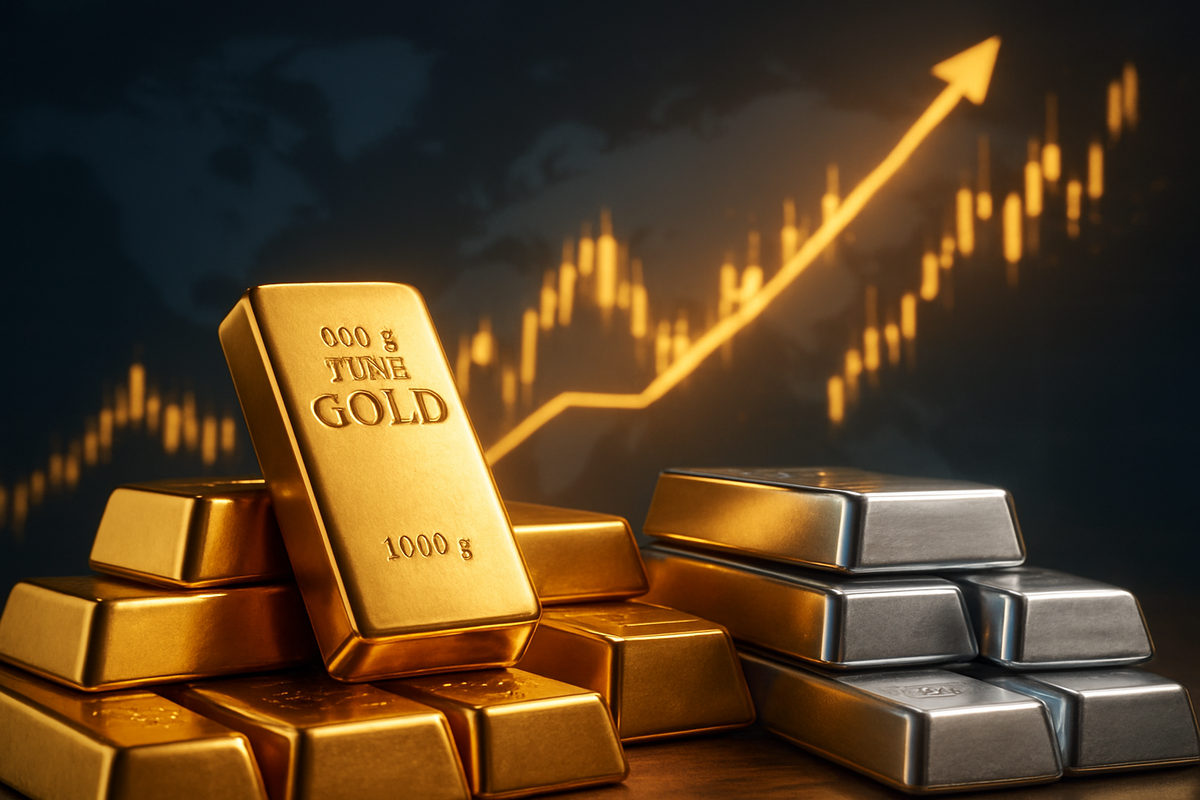
The evening of December 1, 2025, witnessed a dramatic surge in the precious metals market, sending ripples of excitement and concern across global financial landscapes. Silver, the "white metal," etched a new historical benchmark, soaring to an unprecedented Rs 1,75,502 per kilogram. Not to be outdone, its yellow counterpart, gold, experienced a significant rally of Rs 1,172, underscoring a powerful shift in investor sentiment towards safe-haven assets. This dual surge comes amidst a complex tapestry of global economic uncertainties, persistent inflationary pressures, and a prevailing anticipation of dovish monetary policies from major central banks. The record-breaking performance of silver, in particular, highlights deep-seated supply-demand imbalances and its growing strategic importance in the global economy.
This monumental rally is a clear indicator of investors' increasing flight to tangible assets as a hedge against volatility and currency depreciation. The immediate implications point to a market grappling with geopolitical risks and a re-evaluation of economic stability. As central banks worldwide continue to navigate a challenging macroeconomic environment, the allure of gold and silver as stores of value appears stronger than ever, signaling a period of heightened interest and strategic reallocation within portfolios. The evening's trading has not only rewritten price records but has also set the stage for intense scrutiny of the underlying forces driving this precious metals boom.
The Unprecedented Ascent: Behind the Metals' Meteoric Rise
The specific details of this evening's remarkable price movements reveal a confluence of factors culminating in a historic moment for precious metals. Silver's climb to Rs 1,75,502 per kilogram marks an all-time high, a testament to its dual role as both an investment vehicle and a critical industrial commodity. This surge wasn't an isolated event; it was underpinned by a sustained bullish sentiment that has seen silver nearly double its price over the past 11 months of 2025, significantly outpacing gold's robust gains. The yellow metal's Rs 1,172 surge further solidified the overall strength in the sector, bringing it closer to its own historical peaks.
The timeline leading up to this moment has been characterized by escalating global economic anxieties, persistent inflationary concerns, and a growing consensus among market participants regarding impending interest rate cuts by central banks, most notably the US Federal Reserve. Expectations of a quarter-point rate cut in December 2025, driven by a weakening American labor market and dovish signals from Fed officials, have significantly lowered the opportunity cost of holding non-yielding assets like gold and silver. Furthermore, a structural supply deficit in silver, projected to continue for the fifth consecutive year, coupled with critically low inventories in major trading hubs like London and Shanghai, has created immense upward pressure on its price. The classification of silver as a critical mineral by the US government in 2025 has also played a crucial role, sparking fears of tariffs and quotas that have led to front-loaded shipments and further tightening global supply.
Key players involved in this rally include a broad spectrum of investors, from institutional funds actively increasing their allocations to precious metals ETFs, to retail investors seeking safe havens. Speculative interest, particularly in silver, has also been a significant driver, with traders capitalizing on its strong momentum and bullish technical indicators. Central banks globally continue to be consistent buyers of gold, diversifying their reserves amidst the current macroeconomic environment, providing a strong foundational demand. Initial market reactions have been overwhelmingly positive for the precious metals sector, with a noticeable rotation of capital towards silver, which is increasingly viewed as the standout performer of 2025. Mining stocks, particularly those with significant exposure to silver, have also experienced a substantial boost, reflecting the direct impact of higher commodity prices on their profitability.
Winners and Losers: Corporate Fortunes Amidst the Precious Metals Boom
The dramatic ascent of gold and silver prices on December 1, 2025, has created a clear delineation of winners and losers across various sectors of the global economy. At the forefront of the beneficiaries are the gold and silver mining companies, whose revenues and profit margins are directly bolstered by the higher commodity prices. With gold surpassing $4,000 per ounce and silver rocketing past $55-$58 per ounce, miners with efficient operations and substantial reserves are poised for significant gains. Companies like Newmont Corporation (NYSE: NEM), the world's largest gold producer, and Barrick Gold Corporation (NYSE: GOLD) are seeing substantial increases in net income and free cash flow. Similarly, primary silver producers such as First Majestic Silver Corp. (NYSE: AG) and Pan American Silver Corp. (NASDAQ: PAAS) are reporting record production and cash flows, leading to renewed investor confidence and soaring stock prices. Streaming and royalty companies like Wheaton Precious Metals Corp. (NYSE: WPM) also stand to benefit immensely, as they receive a percentage of production or revenue without incurring direct operational costs, making them highly leveraged to rising metal prices.
Conversely, industries heavily reliant on gold and silver as raw materials are bracing for increased input costs, potentially squeezing profit margins and challenging demand dynamics. Jewelry retailers and manufacturers face the immediate brunt of this price surge. Companies such as Signet Jewelers (NYSE: SIG), which owns popular brands like Kay Jewelers, will find their cost of goods sold escalating significantly. While luxury brands like Tiffany & Co. (owned by LVMH Moët Hennessy Louis Vuitton SE - OTC: LVMUY) might see some high-end demand for gold as a store of value, the overall sector will struggle to pass on the full extent of these higher costs to consumers, especially in the mass market.
Perhaps the most widespread impact will be felt by industrial users of silver. Silver's indispensable role in modern technology, owing to its unmatched electrical conductivity and reflectivity, means that a broad array of manufacturers will face elevated raw material expenses. Electronics manufacturers including giants like Apple (NASDAQ: AAPL), Samsung (KRX: 005930), and Intel (NASDAQ: INTC) rely on silver for critical components in smartphones, computers, and advanced chips. The burgeoning solar panel manufacturing industry, a significant consumer of silver, will also incur higher production costs. Furthermore, the rapidly expanding electric vehicle (EV) sector, with companies like Tesla (NASDAQ: TSLA) and other major automakers requiring substantial amounts of silver for high-voltage electrical systems and ADAS, will see their material costs increase. While the demand for silver in these critical applications is robust and often inelastic, sustained high prices will necessitate strategic adjustments, potentially impacting profitability or leading to higher consumer prices for various tech and green energy products.
Beyond the Bullion: Unpacking the Broader Market Implications
The monumental surge in gold and silver prices on December 1, 2025, extends far beyond the immediate gains for investors and miners, signaling profound shifts in broader industry trends and carrying significant ripple effects across the global financial ecosystem. This rally is fundamentally driven by the widespread anticipation of a December 2025 interest rate cut by the U.S. Federal Reserve, with market probabilities soaring. Lower interest rates inherently reduce the opportunity cost of holding non-yielding assets, making precious metals more attractive. Coupled with persistent geopolitical tensions—including ongoing conflicts and trade disputes—and lingering inflationary pressures, gold's traditional role as a safe-haven asset and inflation hedge has been strongly reinforced. For silver, its rally is further amplified by robust industrial demand from "green" technologies like solar panels and electric vehicles, alongside 5G infrastructure and AI components, pushing it into a structural supply deficit for the fifth consecutive year.
The ripple effects of this precious metals boom are multifaceted. For the mining sector, the surge translates into "explosive growth," expanded profit margins, and increased cash flows, fueling exploration and development. This environment also benefits junior and intermediate mining companies, facilitating fundraising and expansion. However, industrial users of silver, spanning electronics, solar, and automotive sectors, face escalating raw material costs. While immediate substitution options are limited, prolonged high prices could accelerate research into alternative materials or more efficient usage. Moreover, the sustained central bank accumulation of gold, driven by de-dollarization trends and a desire for reserve diversification, could gradually challenge the U.S. dollar's long-standing dominance as the global reserve currency, signaling a potential recalibration of global financial power.
Regulatory and policy implications are also coming into sharper focus. Silver's recent designation as a U.S. Critical Mineral in 2025 has already created "geographic bottlenecks" by prompting front-loaded shipments to the U.S., potentially foreshadowing future tariffs or quotas that could disrupt global supply chains. The Federal Reserve's dovish monetary policy stance, a key driver of the rally, will remain under scrutiny; any deviation towards more hawkish policies could temper the metals' appeal. Furthermore, the specter of renewed trade tariffs, particularly from a potential Trump re-election against major silver-producing nations like Mexico, could introduce significant volatility and further impact global supply. The underlying concerns about government debt levels globally also implicitly contribute to the safe-haven demand, reflecting investor apprehension about long-term fiscal stability.
Historically, the current precious metals rally draws compelling comparisons to past periods of economic uncertainty and high inflation. Both gold and silver have consistently served as crucial safe havens during crises, from the 2008 financial meltdown to the energy crisis of 1979. The current environment, marked by significant central bank buying (more than double the average from 2015-2019) and a weakening U.S. dollar, echoes the late 1970s when gold prices surged by 126% in 1979. The gold-silver ratio, which has seen a significant shift in favor of silver, dropping to an 18-month low, also suggests that silver is poised for continued outperformance, similar to historical patterns where extreme ratio readings preceded substantial silver gains. This confluence of factors paints a picture of a market responding to deep macroeconomic shifts, reinforcing the enduring value of precious metals in turbulent times.
The Road Ahead: Navigating the Future of Precious Metals
The unprecedented surge in gold and silver prices sets the stage for a dynamic period ahead, characterized by both significant opportunities and inherent challenges for investors, industries, and policymakers. In the short term (late 2025 - 2026), analysts anticipate continued strength for both metals, albeit with potential for volatility. Gold is projected to stabilize between $4,000 and $4,400 per ounce, with some forecasts suggesting it could reach $4,900-$5,000 by the end of 2026, though a near-term correction towards $3,500 is also a possibility after such a rapid ascent. Silver, having already doubled in value in 2025, is expected to continue its robust performance, with projections ranging from consolidation around $50 to as high as $88 per ounce before 2028, driven by persistent industrial demand and supply deficits. The ongoing influence of accommodative central bank policies, sticky inflation, and sustained physical demand will be key drivers.
Looking further into the long term (2027 - 2030 and beyond), the outlook for both metals remains firmly bullish, underpinned by structural changes in global markets. Gold price targets range from near $5,400 in 2026 to potentially $6,200 by 2030, with some optimistic scenarios even projecting $7,000 to $10,000 per ounce by 2030. Silver's long-term trajectory is also bright, with forecasts suggesting it could move closer to $77 in 2027 and reach a peak of $82 by 2030. These projections are supported by continued structural deficits, rising industrial demand (especially in green energy), ongoing geopolitical tensions, and a potential "de-dollarization" trend as central banks diversify reserves. Many experts believe the current gold cycle is still in its early phases, driven by high debt and expansive fiscal policies globally.
Strategic pivots and adaptations will be crucial. For investors, diversification remains paramount, with recommended allocations to precious metals ranging from 5-10% for conservative portfolios to 15-25% for aggressive hedge positions. Dollar-cost averaging and a long-term holding strategy are advisable to navigate volatility. Businesses, particularly mining companies, will be incentivized to expand production, optimize operations, and prioritize ESG practices to maximize profitability and access capital. Governments and central banks are likely to continue their trend of increasing gold reserves as part of broader reserve management and de-dollarization strategies.
Market opportunities include expanded profit margins for low-cost miners, increased investment demand from both retail and institutional sectors, and significant growth opportunities in green technologies driven by silver's industrial applications. However, challenges such as inherent price volatility, the risk of market corrections, and potential supply constraints or regulatory hurdles for miners will require careful navigation. In a continued bullish supercycle scenario (high probability), gold and silver maintain their upward trajectory, becoming core strategic assets. A corrective phase and consolidation scenario (moderate probability) could see temporary pullbacks, offering "buy-the-dip" opportunities. Less likely but possible are scenarios of exaggerated volatility and market dysfunction or one where industrial demand predominantly drives silver's outperformance over gold, further narrowing the gold-silver ratio.
Conclusion: A New Era for Precious Metals in a Volatile World
The evening of December 1, 2025, will be remembered as a pivotal moment for the precious metals market, with silver's ascent to an all-time high of Rs 1,75,502 and gold's substantial surge of Rs 1,172. This event underscores a profound shift in global financial sentiment, driven by persistent economic uncertainties, inflationary pressures, and a clear flight to tangible assets. The dual nature of silver, as both a monetary metal and a critical industrial commodity for burgeoning green technologies, has propelled its extraordinary performance, while gold continues to solidify its role as the ultimate safe haven and hedge against systemic risk.
Moving forward, the market is poised for continued dynamism. Investors should anticipate sustained bullish momentum for both metals, tempered by periods of volatility and potential corrections, offering strategic entry points. The long-term outlook remains robust, supported by structural supply deficits, escalating industrial demand for silver, and ongoing central bank diversification away from fiat currencies. The implications extend across industries, rewarding efficient miners and challenging those reliant on these metals as raw materials.
What investors should watch for in the coming months includes the actual trajectory of central bank interest rate policies, particularly from the U.S. Federal Reserve, as any deviation from expected dovishness could influence market sentiment. Further geopolitical developments and their impact on global stability will also be critical. Additionally, monitoring the gold-silver ratio can provide valuable insights into relative strength and potential trading opportunities. In this evolving financial landscape, precious metals are not merely commodities; they are increasingly vital components of diversified portfolios, offering a beacon of stability and growth in an otherwise uncertain world.
This content is intended for informational purposes only and is not financial advice