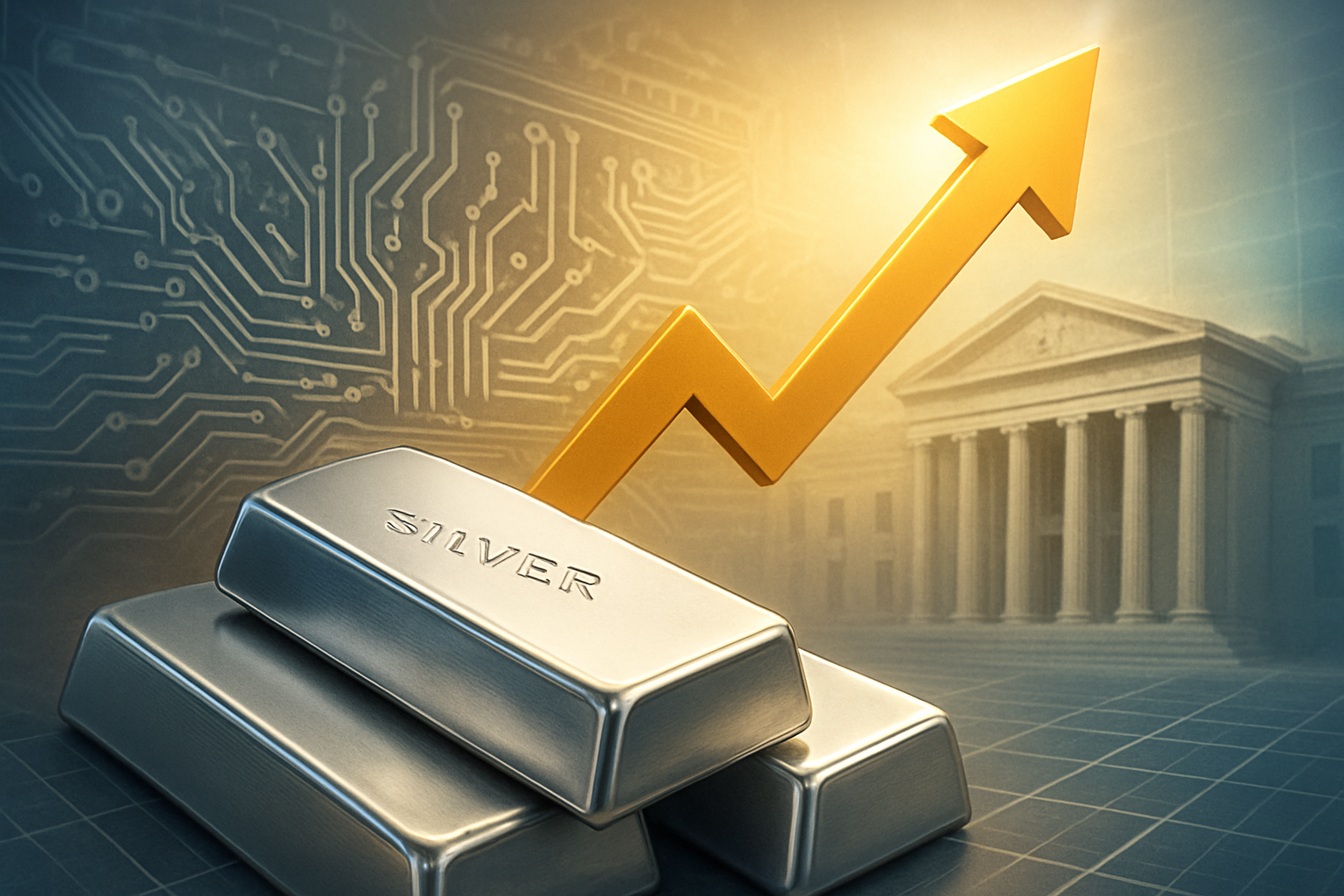
The precious metals market is ablaze as silver prices have shattered all previous records, surging past the $57 per troy ounce mark and posting an astonishing 100% gain in 2025 alone. This unprecedented rally is unfolding amidst intense speculation surrounding President Trump's rumored selection of Kevin Hassett to helm the Federal Reserve. The potential appointment of a Fed chair known for his dovish leanings has ignited expectations of more aggressive interest rate cuts, profoundly reshaping investor sentiment across commodities, currencies, and bonds.
The confluence of robust industrial demand, persistent supply deficits, and a weakening U.S. dollar has already set the stage for silver's meteoric rise. However, the prospect of a Hassett-led Fed, signaling a departure from previous monetary policy stances, appears to be the primary catalyst turbocharging the current rally. As December 1, 2025, draws to a close, markets are keenly watching for official confirmation, preparing for a potential era of cheaper money and its far-reaching implications.
The White Metal's Unprecedented Ascent and the Shadow of a New Fed Era
Silver's journey to its current peak has been nothing short of spectacular. On December 1, 2025, spot silver traded robustly between $57.60 and $57.71 per troy ounce, with futures contracts briefly touching nearly $58.60. This new all-time high of $57.86 per ounce, recorded earlier in the day, follows a relentless six-day rally that saw the white metal climb almost 15%. This surge eclipses the previous record of $54.48 per ounce set just weeks ago on October 17, 2025, underscoring the extraordinary momentum gripping the market. The rally is fundamentally supported by a structural supply deficit that has plagued the silver market for five consecutive years, exacerbated by soaring industrial demand, particularly from the rapidly expanding solar panel and electric vehicle (EV) sectors. Solar panels now account for roughly 14% of total silver demand, a significant jump from 5% a decade ago, with newer photovoltaic technologies requiring even greater quantities.
Adding to the supply squeeze, inventories in major trading hubs like the Shanghai Futures Exchange and London vaults have plummeted to near-decade lows. Furthermore, the inclusion of silver in the U.S. Critical Minerals List in 2025 has tightened supply chains and influenced global trade dynamics, prompting traders to front-load shipments to the U.S. in anticipation of potential tariffs or quotas. This robust demand and constrained supply environment laid the groundwork for the current price explosion, but the political machinations surrounding the Federal Reserve have provided the final, potent spark.
The rumored nomination of Kevin Hassett as the next Federal Reserve chair by President Trump has sent ripples throughout the financial world. President Trump, a vocal critic of current Fed Chair Jerome Powell's (NYSE: JPM) pace on interest rate reductions, announced his nominee on December 1, 2025, with an official announcement expected before Christmas. Hassett, currently the White House National Economic Council Director, has publicly acknowledged the speculation, stating his willingness to accept the role. His perceived dovish stance and alignment with the President's desire for aggressive rate cuts have immediately "turbocharged expectations for faster and deeper interest-rate cuts next year," as one analyst put it.
Initial market reactions have been swift and decisive. The prospect of a Hassett-led Fed briefly pushed the 10-year Treasury yield below 4% last week, signaling investor anticipation of lower borrowing costs. Concurrently, the U.S. dollar has weakened, a direct consequence of Hassett's dovish leanings, which are widely seen as "bearish for the dollar." For precious metals like silver and gold, this environment is overwhelmingly bullish. Lower interest rates reduce the opportunity cost of holding non-yielding assets, making them significantly more attractive to investors seeking safe havens and inflation hedges. While some analysts have raised concerns about potential challenges to the Fed's independence under Hassett, the immediate market focus remains squarely on the implications of a potentially more accommodative monetary policy.
Corporate Fortunes: Who Wins and Who Loses in the Silver Rush and Dovish Shift?
The dual forces of surging silver prices and the prospect of a dovish Federal Reserve under Kevin Hassett are poised to redraw the landscape of corporate winners and losers. For companies directly involved in silver extraction and investment, the outlook is unequivocally bullish. Silver mining and royalty/streaming companies stand to be the primary beneficiaries, as their revenue streams directly swell with every upward tick in the metal's price. A dovish Fed further sweetens the deal by lowering borrowing costs, making capital-intensive mining operations and exploration efforts more financially viable. Companies such as Pan American Silver (NASDAQ: PAAS), one of the world's largest primary silver producers, and First Majestic Silver (NYSE: AG), which derives a significant portion of its revenue from silver, are positioned for substantial profit growth. Other key players like Endeavour Silver (NYSE: EXK), Hecla Mining Co. (NYSE: HL), and Fortuna Silver Mines Inc. (NYSE: FSM) are also expected to see enhanced revenues and improved margins. Furthermore, streaming companies like Wheaton Precious Metals Corp. (NYSE: WPM), which acquire future production at fixed, lower costs, offer a relatively lower-risk avenue to capitalize on rising prices.
Beyond the mining sector, a dovish Federal Reserve environment, characterized by lower interest rates and easier credit, creates fertile ground for growth-oriented companies and sectors. Technology and AI infrastructure firms, requiring significant investment in power generation and energy storage, could thrive due to cheaper capital. The real estate sector and homebuilders, such as D.R. Horton, Inc. (NYSE: DHI), would likely experience a surge in demand as lower mortgage rates make homeownership more accessible. Small-cap stocks, often more sensitive to interest rate fluctuations due to their reliance on debt financing, could see a significant reduction in their cost of capital, boosting growth and stock performance. Even select financial institutions, particularly those with strong investment banking arms like Morgan Stanley (NYSE: MS) and JPMorgan Chase (NYSE: JPM), could benefit from stimulated capital markets activity, despite potential short-term pressures on net interest margins. Companies with high debt loads across various sectors would also see their interest expenses reduced, improving their bottom lines and freeing up capital for other uses.
Conversely, industries heavily reliant on silver as a key input material face significant headwinds. Electronics and industrial manufacturers, including those in the solar panel, electric vehicle, and general electronics sectors, will grapple with substantially increased raw material costs. If these companies cannot fully pass on these costs to consumers, their profit margins will be squeezed. Major technology companies like Apple (NASDAQ: AAPL) and Microsoft (NASDAQ: MSFT), while diversified, could experience noticeable increases in component costs, potentially impacting their supply chains and profitability. Similarly, the jewelry retail and manufacturing sector, particularly for mass-market silver items, will see direct increases in production costs. Companies like Tiffany & Co. (NYSE: TIF) or brands under Richemont (SWX: CFR) could face challenges in maintaining margins and consumer demand for price-sensitive silver products. Additionally, U.S. companies that rely on a strong dollar for their international revenue streams might see their foreign earnings translate into fewer U.S. dollars, impacting their top line in the current environment.
Broader Implications: A New Era for Commodities, Policy, and Central Bank Independence
The current silver phenomenon and the looming possibility of a Kevin Hassett-led Federal Reserve are not isolated events; rather, they are symptomatic of deeper, converging trends reshaping global finance and industry. The white metal's unprecedented surge to nearly $58 per ounce by December 2025 underscores a fundamental shift in its market dynamics. While its traditional role as a safe-haven asset amidst inflation fears and geopolitical uncertainties remains potent, the primary catalyst for this rally is its indispensable role in the burgeoning green energy transition and advanced technology sectors. Demand from solar photovoltaic cells, electric vehicles (EVs), 5G infrastructure, and semiconductors is insatiable, creating a structural supply deficit now entering its third consecutive year. This highlights silver's evolution from merely a precious metal to a critical industrial commodity, making its price increasingly sensitive to technological advancements and global sustainability mandates.
This dynamic has profound ripple effects across related markets. Silver's outperformance of gold (doubling in value compared to gold's 60% increase in 2025) suggests a re-evaluation of its intrinsic value, potentially driving the gold-to-silver ratio lower. While mining companies with significant silver exposure are direct beneficiaries, the inherent difficulty in rapidly increasing silver supply—given it's often a byproduct of other metal mining—means that production volumes may struggle to keep pace with demand, sustaining upward price pressure. Conversely, industrial users in the solar, EV, and electronics sectors face escalating input costs, which could compress margins or necessitate higher consumer prices. This situation is further complicated by the inclusion of silver in the U.S. Critical Minerals List in 2025, a regulatory move that has already created a "geographic bottleneck" by diverting supply to the U.S. for strategic stockpiling and industrial processes. This policy signals a broader global focus on securing critical raw materials, potentially leading to increased domestic investment in mining and recycling, alongside new trade policies.
The rumored nomination of Kevin Hassett to the Federal Reserve Chair adds another layer of complexity, with significant policy implications, particularly concerning central bank independence. Hassett's perceived dovish stance and alignment with President Trump's desire for aggressive interest rate cuts could signal a pivot towards a monetary policy prioritizing growth and employment, even potentially at the risk of higher inflation. This would mark a notable shift from the traditional emphasis on price stability and could "turbocharge expectations for faster and deeper rate cuts," further weakening the U.S. dollar and bolstering riskier assets like equities and commodities. Such a move, however, raises concerns among critics about potential political pressure on the central bank, echoing historical anxieties about the erosion of the Fed's autonomy.
Historically, silver surges during periods of economic instability and high inflation, such as the 2008 financial crisis and the 1979-1980 Hunt Brothers saga, demonstrate its safe-haven appeal. However, the current rally distinguishes itself with the added dimension of unprecedented industrial demand driven by the green energy transition. The potential for a Hassett-led Fed also draws parallels to the 1970s, a period marked by accommodative monetary policy leading to soaring inflation. While the specifics differ, the risk of reigniting inflationary pressures under a growth-focused Fed, coupled with the structural demand for a critical commodity like silver, presents a unique and potent economic cocktail. The Senate confirmation process for Hassett, if nominated, would undoubtedly become a focal point for debates on monetary policy direction and the sanctity of the Fed's independence.
The Road Ahead: Navigating a Bullish Silver Market and a Shifting Fed Landscape
The confluence of silver's record-breaking rally and the potential appointment of Kevin Hassett to lead the Federal Reserve sets the stage for a highly dynamic and potentially transformative period for both the silver market and the broader economy. In the short term, expect continued bullish momentum for silver, albeit with heightened volatility. Technical indicators suggest the metal is currently overbought, making short-term pullbacks a distinct possibility, but the underlying drivers remain robust. A Hassett-led Fed is widely anticipated to pursue more aggressive interest rate cuts, potentially commencing as early as December 2025 and extending into 2026. This dovish monetary policy would further suppress real interest rates and weaken the U.S. dollar, creating an exceptionally favorable environment for non-yielding assets like silver. Concurrently, the structural tightness in physical supply, particularly in major trading hubs, is expected to persist, maintaining upward pressure on prices.
Looking further out, the long-term outlook for silver remains overwhelmingly positive. Analysts project continued price appreciation, with some forecasts placing silver between $60 and $77 per ounce by late 2026 or 2027, and even challenging the $80-$100 mark later in the decade under an optimistic "super-cycle" scenario. Silver is increasingly viewed as a leveraged play on gold, expected to outperform its yellow counterpart as global growth potentially re-accelerates under a more accommodative monetary policy. The "industrial super-cycle," fueled by the relentless demand from solar energy installations and electric vehicle manufacturing, is poised to drive consumption to unprecedented levels, with solar demand alone potentially exceeding 230 million ounces by 2026. Given that silver supply is largely a byproduct of other metal mining, rapid expansion is unlikely, further underpinning long-term price strength. Under a dovish Fed, the U.S. economy may experience moderate growth, supported by easier monetary policy, though inflation is expected to remain a persistent factor, reinforcing silver's role as an inflation hedge.
These evolving dynamics necessitate strategic pivots for investors and businesses alike. Investors should consider silver's dual identity as both an industrial metal and a store of value for portfolio diversification, potentially favoring silver-linked equities during dips. Opportunities for arbitrage may emerge if the gold-to-silver ratio indicates a relative undervaluation of silver. Risk management will be paramount, given the expected volatility. For businesses, particularly industrial users of silver in green technologies, securing long-term supply contracts and exploring innovative "thrifting" technologies to reduce silver content will be crucial for supply chain resilience. Policymakers, especially a Hassett-led Fed, will face ongoing scrutiny regarding monetary policy alignment and the delicate balance between stimulating growth and managing inflation, while the U.S. Critical Minerals List designation for silver will continue to influence global trade flows and domestic investment.
Market opportunities abound in the green energy boom, silver's role as an inflation hedge, and the favorable macroeconomic backdrop of a weaker dollar and lower interest rates. However, challenges include significant price volatility, potential dampening of demand for physical bullion at record prices, and the inherent fragility of a tight supply chain. The most likely scenario sees silver prices continuing their upward trajectory, driven by industrial demand and dovish monetary policy, with occasional corrections offering buying opportunities. An optimistic scenario envisions a silver super-cycle with prices soaring towards $80-$100, while a pessimistic outcome could see a sharp correction if economic headwinds or a surprising hawkish shift by the Fed materialize. Investors and market participants must remain agile, closely monitoring Fed communications, global industrial demand trends, and geopolitical developments to navigate this complex and potentially rewarding landscape.
The Silver Lining: A Market Poised for Further Ascent Amidst Policy Shifts
The dramatic surge in silver prices to unprecedented levels, fueled by a powerful confluence of fundamental and macroeconomic factors, alongside the highly anticipated shift in Federal Reserve leadership, marks a pivotal moment for financial markets. The key takeaways from this extraordinary period include the overwhelming market expectation of an increasingly dovish Federal Reserve, underscored by an 88% probability of a December rate cut and the rumored nomination of Kevin Hassett as the next Fed Chair. Hassett's known advocacy for lower interest rates aligns with President Trump's long-standing monetary policy preferences, signaling a potential era of cheaper money. This dovish outlook, coupled with a weakening U.S. dollar, has significantly bolstered the appeal of non-yielding assets like silver. Crucially, silver's rally is not purely speculative; it is firmly rooted in structural supply deficits, now in their fifth consecutive year, and robust industrial demand from the burgeoning green energy sector, including solar panels and electric vehicles, as well as advanced electronics. Critically low inventories in major global hubs and the U.S. designation of silver as a critical mineral further exacerbate supply tightness.
Moving forward, the market assessment for silver remains predominantly bullish. Analysts project continued price appreciation, with some forecasting silver to reach $60 per ounce in the near term and potentially $70-$100 in the coming months or years. The sustained growth in industrial demand, particularly from renewable energy, provides a robust long-term structural tailwind, suggesting that silver's upward trajectory has strong fundamental backing. However, investors must remain cognizant of silver's inherent volatility; while the overall trend is bullish, technical indicators currently suggest the metal is overbought, implying a potential for short-term pullbacks. The anticipated shift towards a more accommodative monetary policy under a potentially Hassett-led Fed is expected to lower real interest rates, reducing the opportunity cost of holding precious metals and reinforcing their role as inflation hedges.
The significance and lasting impact of these developments extend beyond commodity markets. The potential nomination of Kevin Hassett signals a profound pivot towards a more politically aligned monetary policy, which could have far-reaching implications for the U.S. economy, borrowing costs, and, critically, raise questions about the Federal Reserve's independence. Silver's dramatic price appreciation and its formal recognition as a critical mineral underscore its evolving strategic importance, cementing its role not just as a precious metal but as a vital industrial commodity essential for the global transition to green energy and advanced technologies. This dual identity enhances its long-term appeal and could lead to a fundamental re-evaluation of its intrinsic value in the global economy.
In the coming months, investors should closely monitor the official announcement of President Trump's nominee for Fed Chair and the subsequent Senate confirmation process, as any surprises could introduce market uncertainty. Federal Reserve rate decisions and forward guidance for 2026 will directly impact the U.S. dollar and the attractiveness of non-yielding assets. Key U.S. economic data, such as employment and inflation figures, will continue to heavily influence the Fed's policy trajectory. Furthermore, tracking global silver inventory levels, industrial demand trends (especially in solar and EVs), and geopolitical developments will provide crucial insights. Given silver's notorious volatility and current overbought conditions, a disciplined investment approach, potentially involving staggered purchases and a keen eye on technical support and resistance levels, might be prudent for long-term investors seeking to capitalize on this unfolding silver lining.
This content is intended for informational purposes only and is not financial advice