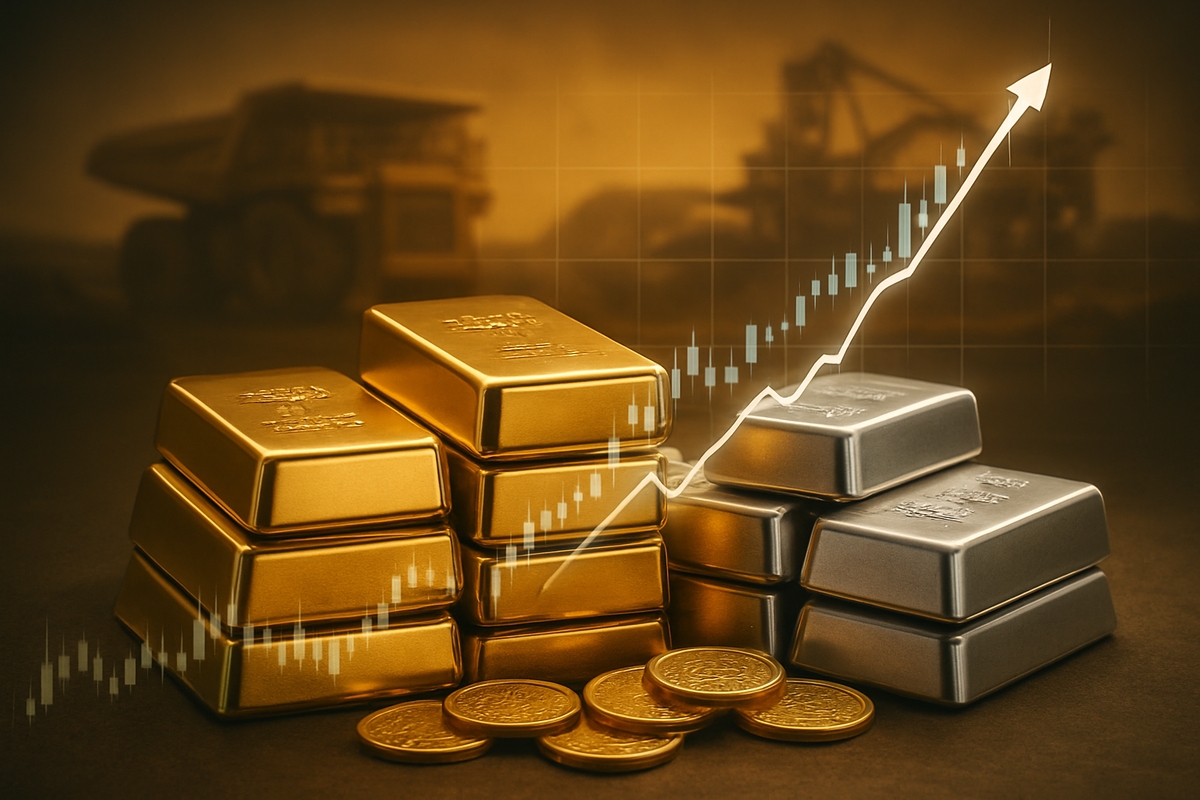
As the curtain closes on 2025, the global financial landscape is being redefined by a historic bull run in precious metals. On this Christmas Eve, gold has ascended to a breathtaking record of $4,525.96 per ounce, while silver has electrified markets by touching $72.70 per ounce. This unprecedented surge represents a fundamental shift in investor sentiment, as a "perfect storm" of geopolitical instability, aggressive central bank diversification, and a pivot in U.S. monetary policy has driven capital into hard assets at a pace not seen in decades.
The implications of this rally are vibrating through every corner of the market. From retail investors piling into exchange-traded funds to the world’s largest mining conglomerates reporting record-breaking free cash flows, the "gold fever" of 2025 has moved beyond mere speculation into a structural market regime. As the U.S. dollar faces mounting pressure from a staggering $38 trillion national debt, the ascent of gold and silver is increasingly viewed not just as a hedge, but as the primary store of value for the modern era.
The Road to $4,500: A Timeline of the 2025 Rally
The journey to these record highs began in earnest during the final quarter of 2024, when gold broke through the $2,700 barrier. However, it was the events of 2025 that provided the rocket fuel for the current prices. The Federal Reserve, after a prolonged period of high interest rates, enacted three strategic rate cuts throughout 2025. This pivot significantly lowered the opportunity cost of holding non-yielding assets, sparking a massive rotation out of fixed-income instruments and into bullion.
The rally was further galvanized by a series of geopolitical "black swan" events. In late 2025, a U.S. naval blockade of Venezuelan oil tankers and escalating tensions in the Caribbean added a "war premium" to the metals market. This, combined with persistent friction in the Middle East and a lack of resolution in the Russia-Ukraine conflict, forced institutional desks to bolster their safe-haven positions. Throughout the year, gold broke over 50 daily price records, systematically dismantling psychological barriers at $3,000, $4,000, and finally $4,500.
Central banks have been the silent architects of this floor. Led by the People’s Bank of China, the Reserve Bank of India, and the National Bank of Poland, sovereign buying has remained at record levels for the fourth consecutive year. This "de-dollarization" trend has seen central banks move away from U.S. Treasuries in favor of gold, providing a relentless bid that has absorbed any minor market corrections. By December 2025, the narrative had shifted from "if" gold would rise, to "how high" it could go before the next fiscal cycle.
Mining Titans and ETF Vehicles: Riding the Momentum
The performance of major precious metals ETFs has mirrored the underlying metal surge with remarkable precision. The SPDR Gold Shares (NYSE Arca: GLD) has gained approximately 66% year-to-date, serving as the primary vehicle for institutional gold exposure. Meanwhile, the iShares Silver Trust (NYSE Arca: SLV) has become the "high-octane" play of 2025, returning a staggering 126%. In October 2025 alone, a historic supply squeeze in the silver market led to record inflows into SLV, with global silver ETF holdings reaching a peak of 1.13 billion ounces as investors scrambled to front-run industrial demand.
For the major mining companies, the price surge has transformed balance sheets. Newmont Corporation (NYSE: NEM), the world’s largest gold miner, reported a record $1.6 billion in free cash flow for the third quarter of 2025. The company’s strategic decision to divest non-core assets, such as the Porcupine and Coffee projects, has allowed it to focus on high-margin, Tier 1 operations. Investors are also watching a significant leadership transition, as CEO Tom Palmer prepares to hand the reins to Natascha Viljoen in early 2026, marking a new era for the Denver-based giant.
Similarly, Barrick Mining Corporation (NYSE: GOLD)—which officially changed its name from Barrick Gold in May 2025 to reflect its expanding copper portfolio—has seen its stock price soar. Despite some operational challenges at its Loulo-Gounkoto complex in Mali earlier this year, Barrick reported record operating cash flow in Q3 2025. This financial strength enabled the company to announce a 25% increase in its base dividend, rewarding shareholders who braved the volatility of previous years. The dual-threat nature of Barrick’s portfolio, combining gold’s safe-haven status with copper’s essential role in the energy transition, has made it a favorite among diversified commodity investors.
Wider Significance: De-dollarization and the Industrial Silver Boom
The current surge in precious metals is more than a simple price spike; it is a symptom of a broader realignment in the global financial order. The move by central banks to diversify away from the U.S. dollar is a trend with deep geopolitical roots. As the U.S. national debt crossed the $38 trillion mark in late 2025, fears of debt monetization and currency debasement have become mainstream. Gold is no longer viewed as a "pet rock" by Wall Street, but as a critical insurance policy against fiscal instability.
Silver’s performance in 2025 highlights a different but equally significant trend: the accelerating green energy transition. Unlike gold, silver has a massive industrial footprint, particularly in the production of solar panels and AI-driven hardware. The supply-demand deficit in silver has widened for five consecutive years, and in 2025, the market finally reached a breaking point. The combination of investment "FOMO" and genuine industrial scarcity has pushed silver to outperform gold on a percentage basis, a classic signal of a late-stage commodity bull market.
This event also draws comparisons to the historic bull markets of 1980 and 2011. However, analysts argue that the current environment is unique due to the sheer scale of global debt and the lack of a viable alternative reserve currency. Unlike previous cycles where high interest rates eventually quelled the gold rally, the 2025 surge has occurred even as the Federal Reserve began cutting rates to support a slowing economy, suggesting that the "real" rate environment is now the primary driver of the metals' ascent.
What Comes Next: The Path to $5,000 and Beyond
As we look toward 2026, the momentum in precious metals shows little sign of abating. Major financial institutions, including Goldman Sachs and JP Morgan, have already revised their price targets upward. Many analysts now see $4,900 to $5,000 per ounce as a realistic target for gold by the end of next year. For silver, the outlook is even more aggressive, with some forecasts suggesting a test of the $100 per ounce mark if industrial demand for solar and electric vehicle infrastructure continues its current trajectory.
However, the road ahead is not without risks. A potential "mechanical" correction could occur if speculative positioning becomes too stretched or if a sudden diplomatic breakthrough in the Middle East or Eastern Europe reduces the geopolitical risk premium. Furthermore, the mining sector faces ongoing challenges with rising All-In Sustaining Costs (AISC), as labor and energy prices remain elevated despite the drop in interest rates. Companies like Newmont and Barrick will need to maintain strict capital discipline to ensure that record metal prices translate into sustained shareholder value.
The strategic pivot for miners in 2026 will likely involve increased M&A activity. With valuations for junior miners still lagging behind the majors, the stage is set for a wave of consolidations as the giants look to replace depleting reserves. Investors should expect a focus on "safe" jurisdictions, as resource nationalism continues to pose a threat to operations in more volatile regions of Africa and South America.
Summary and Investor Takeaways
The precious metals market of late 2025 has entered a new frontier. Gold’s climb to $4,525 and silver’s surge to $72.70 represent a historic rejection of fiat currency instability and a desperate search for tangible value. The success of ETFs like GLD and SLV has democratized access to this rally, while the record cash flows of mining leaders like Newmont and Barrick Mining Corporation have turned the sector into a powerhouse of the broader equity market.
Moving forward, the market will be defined by the tension between fiscal policy and geopolitical reality. Investors should watch closely for the Federal Reserve's next moves in 2026 and the continued pace of central bank gold accumulation. While the gains of 2025 have been extraordinary, the structural drivers—debt, de-dollarization, and the green energy transition—suggest that the "Golden Age" of precious metals may only be in its middle chapters.
As we head into the new year, the primary takeaway for the market is clear: the era of "cheap" gold and silver is over. In a world of $38 trillion in debt, the oldest forms of money have reclaimed their throne.
This content is intended for informational purposes only and is not financial advice.