As of late 2025, the global energy transition has reached a critical inflection point, marked by a series of technological and legislative breakthroughs in the ultra-high purity graphite supply chain. Long considered the "Achilles' heel" of the Western electric vehicle (EV) market due to China’s near-total dominance of processing, graphite has finally seen a structural shift toward domestic and "friend-shored" production. This transformation is driven by the maturation of non-toxic purification methods and the implementation of aggressive new trade policies that have effectively decoupled the U.S. battery industry from high-risk foreign entities.
The immediate implications are profound: for the first time, North American EV manufacturers have access to battery-grade anode material that meets both the strict "Foreign Entity of Concern" (FEOC) requirements and the increasingly stringent environmental, social, and governance (ESG) standards of the modern investor. With the U.S. government shifting its strategy from consumer-side incentives to massive industrial-base support, the graphite sector has moved from a speculative niche to a cornerstone of national security and industrial policy.
The Dawn of a Domestic Supply Chain: Legislative and Technological Shifts
The landscape of 2025 was fundamentally reshaped on July 4, 2025, with the signing of the "One Big Beautiful Bill Act" (OBBBA). This landmark legislation significantly amended the previous Inflation Reduction Act (IRA), terminating the $7,500 consumer EV tax credit in favor of a massive $5 billion allocation to the Industrial Base Fund and $2 billion for the National Defense Stockpile. This shift was designed to directly subsidize the production of critical minerals like graphite, ensuring that the "upstream" supply chain is robust enough to withstand geopolitical shocks. By late 2025, the U.S. had also increased tariffs on Chinese active anode material (AAM) to a staggering 160%, making domestic supply price-competitive for the first time in history.
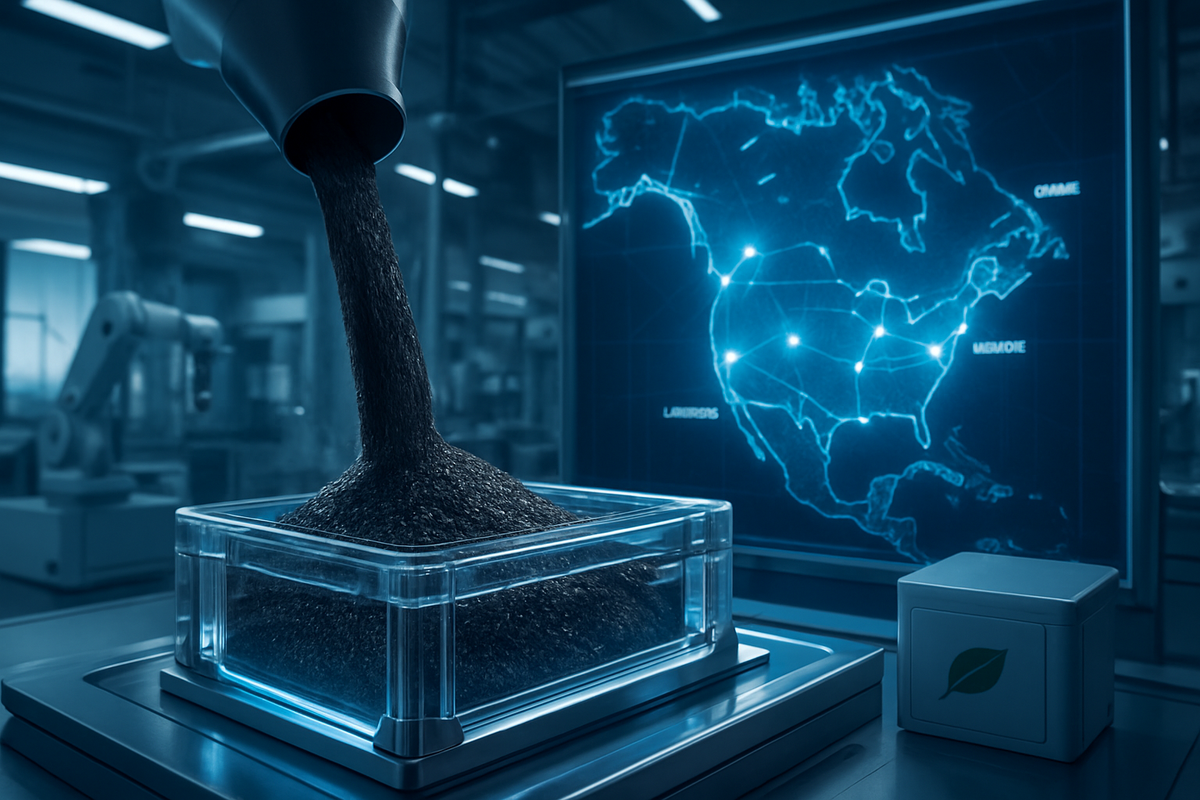
Parallel to these policy shifts, a wave of technological innovation has solved the "purification problem." Historically, graphite purification relied on hydrofluoric acid (HF)—a highly toxic chemical banned in most Western jurisdictions but used extensively in China. In August 2025, EcoGraf (ASX: EGR) secured a 20-year patent for its proprietary HF-free technology, which uses alternative commercial reagents to achieve 99.99% purity. Similarly, Focus Graphite (OTCQB: FCSMF) received $14.1 million in funding for North America’s first Electrothermal Fluidized Purification plant, a process that uses high-temperature gas suspension (up to 3,000°C) to volatilize impurities without any chemical reagents at all.
The timeline leading to this moment was accelerated by the 2024 "graphite crunch," which saw China restrict exports of certain graphite products. This move backfired, as it galvanized Western governments to fast-track permitting for local mines. By December 2025, the U.S. EXIM Bank had increased its potential loan interest to $2.1 billion for the "Alaska-to-Ohio" supply chain, signaling a long-term commitment to a vertically integrated domestic industry.
The New Graphite Titans: Winners and Losers in the Purity Race
The primary beneficiaries of this shift are the "first movers" who have successfully navigated the transition from exploration to production. Nouveau Monde Graphite (NYSE: NMG) has emerged as a leader in the North American market. In October 2025, the company updated its binding offtake agreement with Panasonic, and its Matawinie project in Quebec was referred to the Canadian Major Projects Office for fast-track permitting. NMG’s commitment to an all-electric, carbon-neutral mining operation has made it the "gold standard" for OEMs looking to lower their Life Cycle Assessment (LCA) scores.
Syrah Resources (ASX: SYR) has also solidified its position. Its Vidalia plant in Louisiana is now operational and expanding, having secured a $165 million tax credit in early 2025. The company’s three-year supply deal with Lucid Group (NASDAQ: LCID) demonstrates that high-end EV makers are willing to pay a premium for guaranteed, non-FEOC compliant material. Meanwhile, Westwater Resources (NYSE American: WWR) has reached the final stages of construction at its Kellyton plant in Alabama, with 85% of its equipment delivered and a new U.S. patent in hand for its specific purification technology.
Conversely, the "losers" in this new paradigm are the traditional Chinese incumbents and companies that failed to diversify away from Chinese technology or equity. Under the new "material assistance" rules of the OBBBA, any company receiving technology or equity from a prohibited entity (China, Russia, Iran, or North Korea) is barred from accessing the 45X manufacturing credits starting in 2026. This has forced several junior miners to scramble for new partners, often at the cost of significant equity dilution or project delays.
Geopolitics and Green Standards: The Wider Significance
The broader significance of the 2025 graphite breakthrough lies in the "greenification" of the supply chain. For years, synthetic graphite—produced from petroleum coke in energy-intensive, coal-powered furnaces—was the preferred choice for many battery makers. However, the 2025 market has seen natural graphite gain significant market share. This is because natural graphite has a much lower carbon footprint, and LCA data has now become a mandatory requirement for OEM purchasing dashboards. The ability to produce ultra-high purity natural graphite using HF-free methods has effectively removed the last environmental argument against its use.
This event also fits into a broader trend of "resource nationalism" and the creation of "friend-shored" trade blocs. The tightening of FEOC rules is not just about graphite; it is a blueprint for how the U.S. and its allies intend to handle lithium, cobalt, and nickel. The regulatory precedent set by the OBBBA—moving away from consumer subsidies toward direct industrial support—suggests a more permanent shift in U.S. industrial policy that favors domestic manufacturing over globalized trade.
Historically, this shift is reminiscent of the 1970s oil crisis, which led to the creation of the Strategic Petroleum Reserve. In 2025, the National Defense Stockpile’s $2 billion allocation for graphite marks the birth of a "Critical Mineral Reserve," designed to protect the U.S. economy from the whims of foreign cartels.
The Road to 2030: What Comes Next
Looking ahead, the next 12 to 24 months will be defined by the "scaling phase." While demonstration plants have proven the technology, the challenge now is to reach commercial volumes of 50,000 to 100,000 tonnes per annum (tpa). Investors should watch for Final Investment Decisions (FIDs) on major expansions, particularly from Syrah Resources and Graphite One (TSX-V: GPH). Graphite One’s inclusion in the federal FAST-41 dashboard suggests that its permitting timeline is now down to just over 13 months, which could see it breaking ground by early 2027.
Market opportunities will also emerge in the recycling sector. As the first generation of EVs reaches the end of its life, the technology developed for ultra-high purity graphite production will likely be adapted to "upcycle" spent anode material. Furthermore, the expansion of utility-scale energy storage systems (ESS) will create a secondary market for "near-battery grade" graphite that doesn't require the 99.99% purity of high-performance EVs but still benefits from the new domestic supply chains.
The primary challenge remains price volatility. While tariffs have provided a floor for domestic prices, the risk of Chinese "predatory pricing"—flooding the market to bankrupt Western competitors—remains a constant threat. This is why the long-term stability of the 45X production credits and the Industrial Base Fund will be vital for the survival of these new miners.
A Strategic Pivot for Energy Independence
The breakthroughs of 2025 represent more than just a technological milestone; they are a declaration of energy independence. The combination of HF-free purification, aggressive trade protectionism, and direct government investment has created a viable pathway for a Western graphite supply chain that was once thought impossible. The key takeaways for the market are clear: natural graphite is the new "green" standard, domestic purity is a requirement for subsidies, and the era of relying on a single foreign source for battery materials is over.
As we move into 2026, the market will likely reward companies that can prove their "purity and provenance." Investors should keep a close eye on the commissioning of the Renascor Resources (ASX: RNU) HF-free plant and the progress of South Star Battery Metals (TSX-V: STS) as it ramps up production in Brazil. The graphite market is no longer just about tons in the ground; it is about the purity of the process and the security of the supply.
The lasting impact of this shift will be felt for decades. By securing the "anode side" of the battery equation, the U.S. and its partners have significantly de-risked the EV transition, ensuring that the wheels of the future are powered by a supply chain that is as clean as the vehicles it supports.
This content is intended for informational purposes only and is not financial advice.