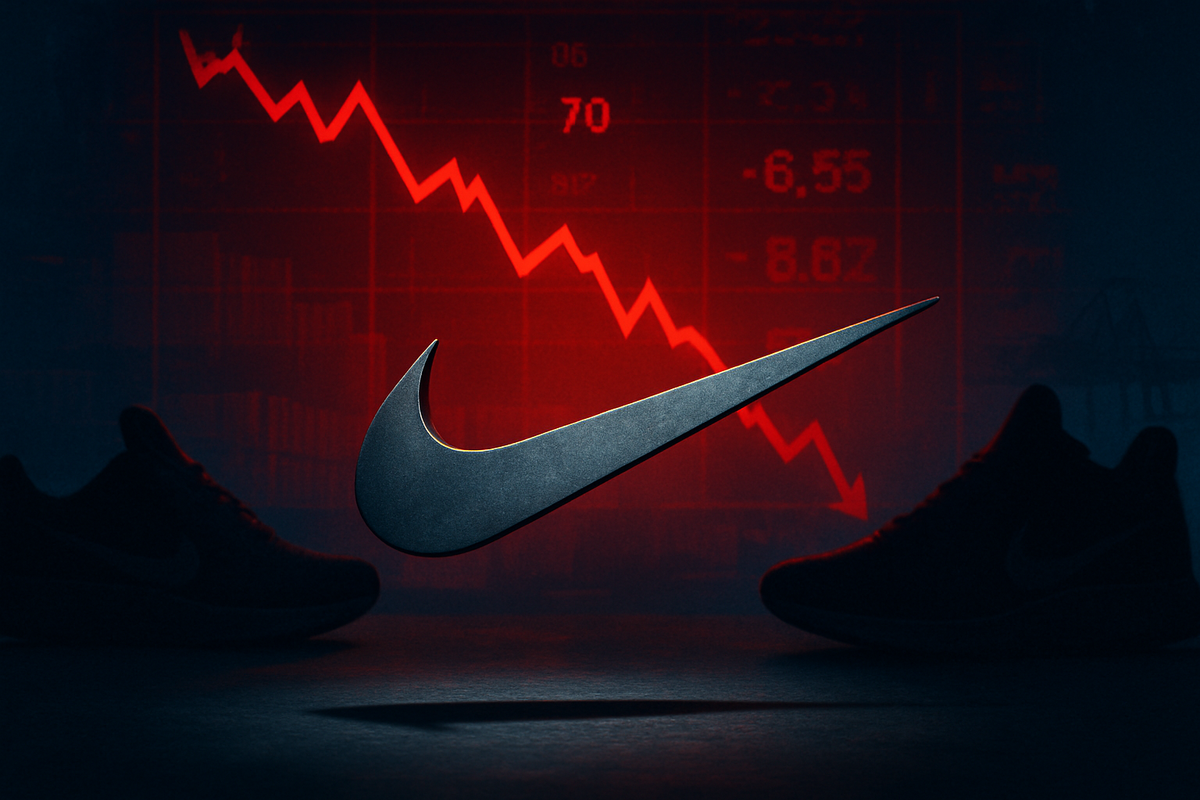
The holiday season has brought little cheer to the headquarters of Nike, Inc. (NYSE: NKE), as a flurry of analyst downgrades and price target cuts have cast a shadow over the athletic giant’s multi-year turnaround efforts. In late December 2025, prominent financial institutions including Daiwa Capital Markets and Argus Research slashed their outlooks for the company, citing a "reset" that is proving more painful and protracted than many on Wall Street had initially anticipated.
The immediate implications are clear: the market is losing patience with the pace of Nike’s recovery. Following a disappointing fiscal second-quarter 2026 earnings report, investors are grappling with the reality that the "Swoosh" may not regain its full stride until 2027 or beyond. As management navigates a treacherous landscape of cooling demand in China and looming trade barriers, the stock is being forced to find a new, lower floor.
A December Chill: The Mechanics of the Downgrade
The wave of skepticism reached a crescendo on December 23, 2025, when Daiwa Capital Markets lowered its price target for Nike from $75.00 to $61.00, maintaining a Neutral rating. Simultaneously, Argus Research—which had been more optimistic earlier in the year—cut its target from $85.00 to $70.00. These moves followed a quarterly report that revealed a staggering 17% revenue decline in Greater China, a region that was once the primary engine of Nike’s growth. Analysts noted that the company has been forced to compete aggressively on price in the Chinese market, a move that has tarnished its "premium" brand image and eroded margins.
The timeline leading to this moment has been marked by a series of strategic pivots. After the departure of former CEO John Donahoe in late 2024, the return of Nike veteran Elliott Hill as CEO was initially greeted with a surge in share price. However, the "Hill Honeymoon" has met the cold reality of structural headwinds. The company’s Q2 FY2026 results showed gross margins falling by 300 basis points to 40.6%, driven largely by the need to liquidate "lifestyle" inventory—such as the oversupplied Air Force 1 and Dunk franchises—to make room for newer, more technical innovations.
Furthermore, the macro-economic environment has shifted against the footwear giant. New U.S. tariff regimes are projected to impose an incremental $1.5 billion in annual costs on Nike, a burden that analysts believe will drag gross margins down by an additional 320 basis points in the coming year. This "perfect storm" of internal restructuring and external cost pressures led Nike to issue a cautious outlook for the remainder of fiscal 2026, forecasting a low-single-digit revenue decline for the next quarter.
Winners and Losers in the Footwear Rebalancing
As Nike retreats to reorganize, its competitors are aggressively filling the vacuum. The primary beneficiaries of Nike’s "reset year" have been On Holding AG (NYSE: ONON) and Deckers Outdoor Corp (NYSE: DECK), the parent company of Hoka. By late 2025, Hoka has successfully captured a significant portion of the premium running market, with international sales surging nearly 30% this year. On Holding continues to see explosive growth, with brand awareness jumping to 13% globally—a modest number compared to Nike’s 91%, but one that represents a massive capture of the high-spending, "performance-lifestyle" demographic.
Adidas AG (OTC: ADDYY) has also emerged as a winner, successfully capitalizing on the "Terrace" shoe trend with its Samba and Gazelle lines. Under CEO Bjorn Gulden, Adidas has grown its market share to roughly 8.9%, largely at the expense of Nike’s struggling lifestyle segment. While Nike remains the volume leader, the "share-grab window" opened by its strategic retreat from wholesale partners in previous years has allowed these smaller, more agile brands to establish deep roots with retailers like Foot Locker, Inc. (NYSE: FL) and Dick's Sporting Goods (NYSE: DKS).
Conversely, the "losers" in this scenario include not only Nike’s long-term shareholders but also traditional retail partners who are now seeing a more fragmented consumer base. While retailers are happy to stock Hoka and On, the lack of a "blockbuster" product from Nike—which typically drives massive foot traffic—has made the overall athletic retail environment more volatile. Nike is currently in the process of "re-winning" these wholesale partners, but the leverage has shifted; retailers are no longer willing to clear shelf space for Nike without guaranteed high sell-through rates.
The Innovation Gap and Global Headwinds
The wider significance of Nike’s current struggle lies in a documented "innovation gap" that occurred between 2023 and 2025. During its aggressive push into Direct-to-Consumer (DTC) sales, the company arguably prioritized digital logistics over product design. This allowed competitors to dominate the "maximalist cushioning" trend that has defined footwear for the last two years. The current wave of price target cuts reflects an industry-wide realization that brand loyalty is no longer enough to protect a market leader from technical obsolescence.
The situation also highlights the broader impact of geopolitical shifts on multinational corporations. Nike’s heavy reliance on Chinese manufacturing and its sensitivity to U.S. trade policy have made it a bellwether for the "tariff era" of late 2025. The $1.5 billion cost projection is a stark reminder that the era of ultra-efficient, low-cost global supply chains is under threat. Competitors with more diversified manufacturing bases or higher price elasticity may be better positioned to weather this storm than Nike, which is already struggling to maintain its premium pricing power.
Historically, Nike has navigated similar "dry spells" before, most notably in the mid-2000s and late 2010s. However, the current environment is unique due to the speed at which "challenger brands" can scale via social media and technical superiority. The shift from lifestyle-focused sneakers back to performance-driven footwear is a trend that Nike helped create, but one where it is currently playing catch-up.
The Road to 2026: Elliott Hill’s "Win Now" Strategy
Looking ahead, the short-term outlook for Nike remains challenging. The company has essentially written off the remainder of fiscal 2026 as a "reset year," with adjusted earnings per share (EPS) expected to decline by as much as 28%. The strategic pivot required is massive: Hill is currently streamlining the corporate structure—reducing direct reports and accelerating product cycles—to ensure that the 2026 pipeline can compete with the likes of On and Hoka.
A potential "North Star" for the company is the 2026 FIFA World Cup, which will be hosted across North America. Nike is expected to launch a massive marketing blitz and a new wave of performance products to coincide with the event. This represents a critical opportunity for the brand to reclaim its narrative as the world’s premier sports innovator. If Hill can successfully repair wholesale relationships and deliver a "hit" product by mid-2026, the current price target cuts may eventually look like a cyclical bottom.
However, the risk remains that the market has permanently fragmented. If consumers continue to favor the specialized performance of Hoka or the European aesthetic of Adidas, Nike may find itself as a "legacy" brand—still large, but no longer the arbiter of "cool" or the leader in technical excellence. The "U-shaped" recovery that analysts are now forecasting depends entirely on Nike’s ability to out-innovate its younger, hungrier rivals.
Conclusion: What to Watch in the Coming Months
The wave of price target cuts from Daiwa and Argus serves as a sobering reminder that even the most iconic brands are not immune to the gravity of market shifts and execution missteps. For Nike, the path forward is clear but difficult: it must stabilize its business in China, navigate a high-tariff environment, and rediscover the "product magic" that defined its dominance for decades.
Investors should closely monitor the company’s gross margin trends and inventory levels throughout the first half of 2026. Any sign of stabilization in China or a successful launch in the running category could provide the catalyst for a sentiment shift. Conversely, further erosion of market share to On or Hoka would suggest that Nike’s "reset" may need to be even deeper than currently planned.
The recent $3 million insider purchase by lead director Tim Cook offers a glimmer of confidence from the board, but for the broader market, the "Swoosh" remains in a "wait-and-see" penalty box. As we move into 2026, the question is no longer whether Nike is the biggest, but whether it can once again be the best.
This content is intended for informational purposes only and is not financial advice.