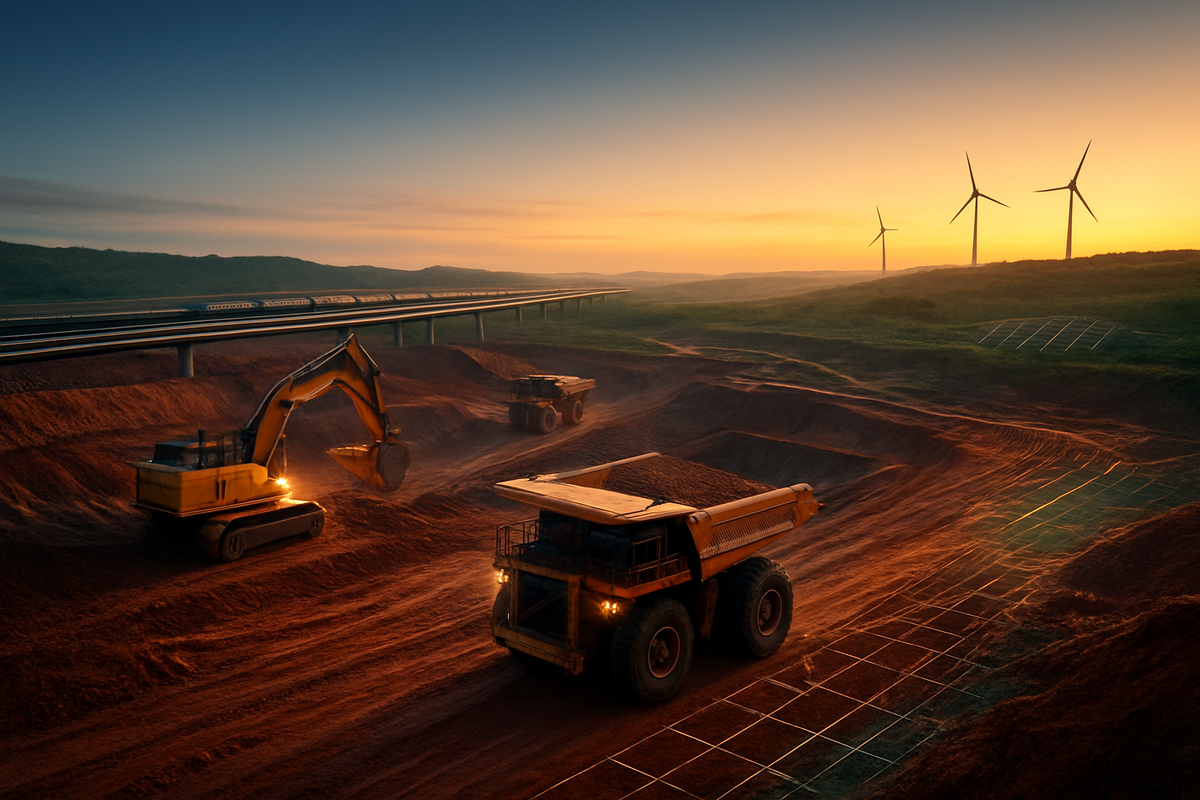
On December 26, 2025, Rio Tinto (NYSE: RIO) reached a significant financial milestone, with its stock price hitting a 52-week high of $81.49. This peak represents a remarkable 37% appreciation over the past twelve months, a recovery that has seen the mining giant’s market capitalization swell to approximately $131.44 billion. The rally is a culmination of strategic leadership changes, a pivot toward critical "green" metals, and the long-awaited operational commencement of the world's largest untapped iron ore deposit.
The surge in valuation comes at a time when the global industrial metals market is undergoing a structural transformation. While traditional demand from Chinese residential construction has cooled, a new "two-speed" market has emerged, driven by the massive infrastructure requirements of the energy transition and the burgeoning needs of the global artificial intelligence (AI) backbone. For investors, Rio Tinto’s performance signals a successful navigation of these shifting economic tides, balancing its legacy iron ore dominance with aggressive expansions into copper and lithium.
A Perfect Storm of Strategic Success and Market Dynamics
The ascent to $81.49 was not an overnight phenomenon but the result of a series of calculated moves throughout 2025. A pivotal moment occurred in August 2025, when Simon Trott transitioned into the CEO role, succeeding Jakob Stausholm. Trott immediately implemented a "Three-Pillar Model," streamlining the company into dedicated divisions for Iron Ore, Copper, and Aluminium & Lithium. This restructuring was paired with a rigorous productivity drive that delivered $650 million in annualized benefits by the final quarter of the year, significantly improving the company’s bottom line.
Perhaps the most tangible catalyst for the December rally was the historic milestone reached at the Simandou project in Guinea. On December 8, 2025, the first cargo of high-grade iron ore (65.3% Fe) set sail from the newly constructed port, marking the official operational start of the $6.2 billion venture. The completion of the 600km Trans-Guinean railway, a feat of engineering and diplomacy, has positioned Rio Tinto to dominate the "green steel" supply chain, as high-grade ore is essential for low-carbon electric arc furnace production.
Market sentiment was further bolstered by the China Mineral Resources Group (CMRG), which reportedly shifted a larger portion of its procurement toward Rio Tinto in late 2025. This strategic realignment by China’s centralized buying agency, combined with Beijing's late-year stimulus packages focused on high-tech manufacturing and grid modernization, provided a robust floor for iron ore prices even as the broader property sector remained stagnant.
Winners and Losers in the Commodities Supercycle
Rio Tinto (NYSE: RIO) stands as the primary beneficiary of this trend, but its success has created a ripple effect across the sector. Competitors such as BHP Group (NYSE: BHP) and Vale S.A. (NYSE: VALE) have also seen valuation lifts, though Rio’s specific exposure to the Simandou project has given it a distinct "first-mover" advantage in the high-grade ore market. Analysts from JPMorgan (NYSE: JPM) have noted that Rio's diversified portfolio, particularly after its $6.7 billion acquisition of Arcadium Lithium earlier in the year, has allowed it to capture a "green premium" that pure-play iron ore miners currently lack.
On the other side of the ledger, downstream industrial consumers are feeling the pinch of rising input costs. Automakers and renewable energy developers are facing a structural deficit in the copper market, where prices have hovered near $10,000 per tonne. While mining companies celebrate these highs, manufacturing firms may see compressed margins unless they can pass these costs on to consumers. Furthermore, smaller mining firms that lack the capital to invest in massive infrastructure projects like Simandou are finding themselves increasingly marginalized in a market that favors scale and vertical integration.
The lithium sector has also seen a consolidation phase. By absorbing Arcadium Lithium, Rio Tinto effectively removed a major independent player from the board, consolidating the supply of a critical battery metal. This move has pressured other major lithium producers to seek their own strategic partnerships or risk being left behind in the race to secure long-term supply agreements with global EV manufacturers.
The Broader Significance: Decarbonization and the AI Boom
The rally in Rio Tinto’s stock is a bellwether for the broader global economy's shift toward decarbonization. The demand for copper, which Rio Tinto expects to produce at a rate of 860,000 to 875,000 metric tons this year, is no longer tied solely to traditional construction. Instead, it is being pulled by the "AI backbone"—the massive data centers required to process generative AI workloads—and the modernization of aging power grids in the United States and Europe.
This event also highlights a shift in geopolitical commodity flows. The successful launch of Simandou represents a significant win for Guinea and a diversification of the global iron ore supply away from the Australia-Brazil duopoly. It underscores a historical precedent where large-scale, high-risk infrastructure investments in emerging markets are becoming the necessary price of entry for mining majors seeking to secure the resources of the 21st century.
Furthermore, the focus on "green steel" reflects a regulatory environment that is increasingly hostile to high-carbon industrial processes. With the European Union’s Carbon Border Adjustment Mechanism (CBAM) coming into fuller effect, the premium on Rio’s high-grade ore is likely to persist. This transition mirrors the historical shift from coal to natural gas, but on a much more complex, global scale involving the very building blocks of modern infrastructure.
Looking Ahead: Growth vs. Shareholder Returns
In the short term, investors will be closely monitoring the ramp-up of Simandou, which is expected to reach a full capacity of 60 million tonnes per annum by 2028. The immediate challenge for Rio Tinto will be maintaining operational stability in Guinea while managing the integration of its new lithium assets. While the August 2025 interim dividend of $1.48 per share was slightly lower than historical averages, the company’s pivot toward growth projects suggests a strategic preference for long-term capital appreciation over immediate cash payouts.
Long-term, the company faces the challenge of price volatility in the lithium and copper markets. While the structural deficit in copper supports high prices, the lithium market has historically been prone to rapid supply-demand imbalances. Rio Tinto’s ability to manage its "Three-Pillar" strategy without overextending its balance sheet will be the defining factor of its performance in the latter half of the decade. Strategic pivots may include further divestments of non-core assets, such as its titanium and borates businesses, to focus exclusively on the metals required for the energy transition.
The Investor’s Takeaway
Rio Tinto’s achievement of a 52-week high on December 26, 2025, is a testament to the company’s successful repositioning in a changing global landscape. By securing a dominant position in high-grade iron ore through Simandou and aggressively expanding into copper and lithium, the company has insulated itself from the volatility of the Chinese residential market while capturing the tailwinds of the green energy and AI revolutions.
Moving forward, the market will be looking for consistency in production guidance and the successful execution of the Simandou ramp-up. Investors should watch for any signs of regulatory shifts in Guinea or changes in China’s centralized buying patterns. For now, Rio Tinto remains a cornerstone of the industrial metals sector, proving that even the oldest giants can adapt to the demands of a decarbonizing world.
This content is intended for informational purposes only and is not financial advice.