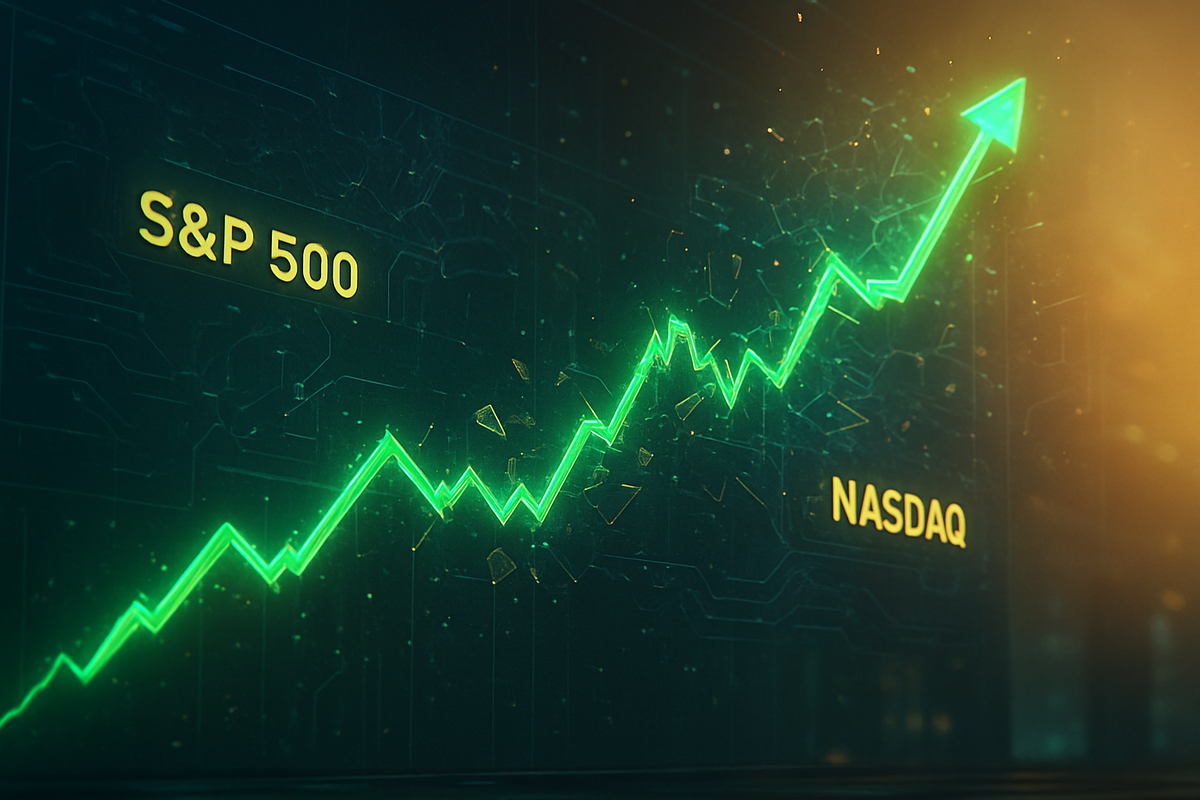
As the final trading days of 2025 wind down, the U.S. equity markets are delivering a historic performance that has caught many analysts by surprise. Following a year defined by the maturation of artificial intelligence and a shifting interest rate environment, the S&P 500 and Nasdaq Composite have surged to fresh all-time highs in a broad-based technical breakout. This "Santa Claus rally," which began in earnest on December 24, has pushed the S&P 500 toward the 6,940 level, marking a year-to-date gain of nearly 18% and signaling a robust appetite for risk as investors look toward 2026.
The implications of this year-end surge are profound, suggesting that the market has successfully transitioned from a valuation-driven rally—fueled by hype—to a sustainable earnings-led cycle. With corporate balance sheets showing the first tangible fruits of "Agentic AI" productivity gains and the financial sector reclaiming its role as a market leader, the technical landscape has shifted. The breakout is not merely a product of a few mega-cap tech names; instead, it represents a widening of market participation that many believe will provide the necessary foundation for continued growth in the coming year.
A Quarter of Resilience: From Tariff Panics to Record Highs
The path to these year-end records was far from linear. The fourth quarter of 2025 began under a cloud of volatility in October, as markets grappled with a "tariff panic" and heightened uncertainty surrounding the U.S. elections. During this period, major indices saw a brief but sharp pullback as investors de-risked in anticipation of potential trade disruptions. However, the narrative shifted dramatically in November following a swift and decisive election resolution. The removal of political uncertainty acted as a catalyst, sparking a powerful relief rally that reclaimed lost ground and set the stage for the December breakout.
Key players in this year-end drama included institutional heavyweights who moved back into the market as technical levels were breached. By mid-December, the S&P 500 broke through key resistance levels, supported by a "Golden Cross" on several sectoral charts—a technical signal where a short-term moving average crosses above a long-term one. This momentum was further bolstered by the Federal Reserve’s signaling of a "Goldilocks" environment, where growth remains stable enough to support earnings while inflation cools sufficiently to allow for a projected terminal rate of 3.4%.
The technical milestone of the month occurred on December 19, when the market saw a coordinated breakout across multiple sectors. While the Nasdaq Composite led the charge with a 22.3% year-to-date gain, reaching near 23,645, the Dow Jones Industrial Average (NYSE: DIA) also found its footing, closing late December near 48,731. This synchronized movement across indices suggests a high degree of conviction among market participants, as heavy institutional volume accompanied the breach of psychological price barriers.
Winners of the Breakout: AI Titans and Financial Stealth Leaders
The primary beneficiaries of this technical surge have been companies at the intersection of high-growth technology and revitalized financials. Palantir Technologies Inc. (NYSE: PLTR) emerged as a standout performer, completing a classic "cup-with-handle" formation—a bullish continuation pattern—breaking out above $190.39 on December 19. The stock has since climbed to $195, fueled by its leadership in the "Agentic AI" space, where AI agents are now performing complex corporate tasks autonomously. Similarly, NVIDIA Corp. (NASDAQ: NVDA) maintained its dominance, ending the year up 40% as it continues to supply the essential hardware for the world’s AI infrastructure.
The financial sector, however, has been the "stealth leader" of the quarter. The Charles Schwab Corporation (NYSE: SCHW) provided a watershed moment for the sector when it broke out above the psychological $100 level in mid-December, following a multi-month consolidation pattern. This move was echoed by giants like JPMorgan Chase & Co. (NYSE: JPM) and The Goldman Sachs Group, Inc. (NYSE: GS), which are being increasingly viewed by investors as "tech-adjacent" due to their deep integration of blockchain and AI into core banking operations. A re-steepening yield curve has further boosted the profitability outlook for these institutions, drawing capital away from defensive sectors.
On the other hand, the year-end rally has left some laggards in its wake. Companies slow to adapt to the AI-driven productivity shift or those heavily exposed to legacy manufacturing have struggled to keep pace with the broader indices. While Tesla, Inc. (NASDAQ: TSLA) is currently testing the critical $500 resistance level, its journey has been more volatile compared to the steady ascent of its tech peers. Meanwhile, small-cap stocks, though beginning to participate in the Santa Claus rally, have largely underperformed their large-cap counterparts for the majority of 2025, creating a "top-heavy" market structure that remains a point of concern for some analysts.
Macro Significance and the Historical Context of the 2025 Rally
The current market environment fits into a broader industry trend of "AI Maturation." Unlike the speculative fervor of late 2023 and 2024, the 2025 breakout is underpinned by actual capital expenditure and productivity data. Microsoft Corp. (NASDAQ: MSFT), Alphabet Inc. (NASDAQ: GOOGL), Amazon.com, Inc. (NASDAQ: AMZN), and Meta Platforms, Inc. (NASDAQ: META) are collectively spending between $300 billion and $400 billion annually on AI capex. This level of investment has created a ripple effect across the semiconductor and software industries, reinforcing the "moats" of these mega-cap companies while forcing competitors to either innovate or face obsolescence.
Historically, this period draws comparisons to the late 1990s tech boom, though with a critical difference: today’s leaders are highly profitable with massive cash reserves. The current breakout also mirrors the post-pandemic rally of 2021, but with a more disciplined Federal Reserve. The regulatory landscape has also played a role, as a pro-business environment following the November election has reduced fears of aggressive antitrust actions, particularly in the tech and financial sectors. This has allowed for a "merger and acquisition" (M&A) tailwind to emerge, further supporting stock valuations.
However, the technical indicators also flash a warning. The S&P 500’s Relative Strength Index (RSI) currently sits near 72.9, a level that traditionally signals the market is "overbought." While an overbought RSI can persist in a strong bull market, it suggests that a period of consolidation or a minor pullback may be necessary in early 2026 to "reset" the indicators. Market breadth—the number of stocks participating in the rally—has been "subtly weak" for much of the year, though it began to improve in late December as more mid-cap names reclaimed their 50-day moving averages.
Looking Ahead: The 2026 Outlook and Strategic Pivots
As we move into 2026, the short-term outlook remains cautiously optimistic. Most Wall Street firms, including Morgan Stanley and J.P. Morgan, have set year-end 2026 targets for the S&P 500 between 7,100 and 7,800, representing a potential gain of 11% to 14%. The primary driver for the first half of the year is expected to be a "rotation into cyclicals." As the Fed continues its gradual rate-cutting cycle, sectors like industrials and materials—which have lagged behind tech—may see their own technical breakouts as borrowing costs decline and global growth stabilizes.
Strategic pivots will be required for investors who have been heavily concentrated in "Magnificent Seven" stocks. The emergence of the financial sector as a growth engine suggests that a more balanced portfolio may be necessary to capture the next leg of the bull market. Furthermore, the shift from AI infrastructure to AI application (Agentic AI) means that software companies and service providers may begin to outpace hardware manufacturers like NVIDIA in terms of percentage gains. Investors should also keep a close eye on the energy-tech subsector, where companies like FuelCell Energy, Inc. (NASDAQ: FCEL) are starting to reclaim long-term moving averages, signaling a potential trend reversal in clean energy.
Potential challenges include a "hard landing" for the economy if the Fed’s cooling measures prove too effective, or a resurgence of inflation that could halt the rate-cut cycle. Additionally, any geopolitical friction that disrupts the global semiconductor supply chain remains a significant tail-risk. However, the current momentum suggests that the "path of least resistance" for the market remains upward, provided that corporate earnings continue to meet the high bar set by current valuations.
Summary and Investor Takeaways
The 2025 year-end breakout has solidified the current bull market's status as one of the most resilient in recent history. By overcoming election-year volatility and transitioning into an earnings-led growth phase, the major indices have set a high watermark for the start of 2026. The key takeaways from this period are the broadening of market leadership into financials and the technical validation of the AI revolution through patterns like the cup-with-handle breakouts in Palantir and Charles Schwab.
Moving forward, the market appears to be in a "Goldilocks" phase—not too hot to trigger inflation, but not too cold to threaten a recession. While the overbought RSI levels suggest that the pace of gains may slow in January, the underlying technical health of the market remains strong. Investors should watch for continued improvement in market breadth and the ability of the S&P 500 to hold the 6,900 level as support during any early-year pullbacks.
Ultimately, the significance of the 12/26/2025 market status lies in its message of stability. The "Santa Claus rally" has provided more than just a seasonal boost; it has offered a roadmap for 2026, where productivity gains and a favorable interest rate environment are expected to be the primary engines of wealth creation. As we enter the new year, the focus will remain squarely on whether the "Agentic AI" promise can continue to translate into the robust earnings growth that the market has now priced in.
This content is intended for informational purposes only and is not financial advice.