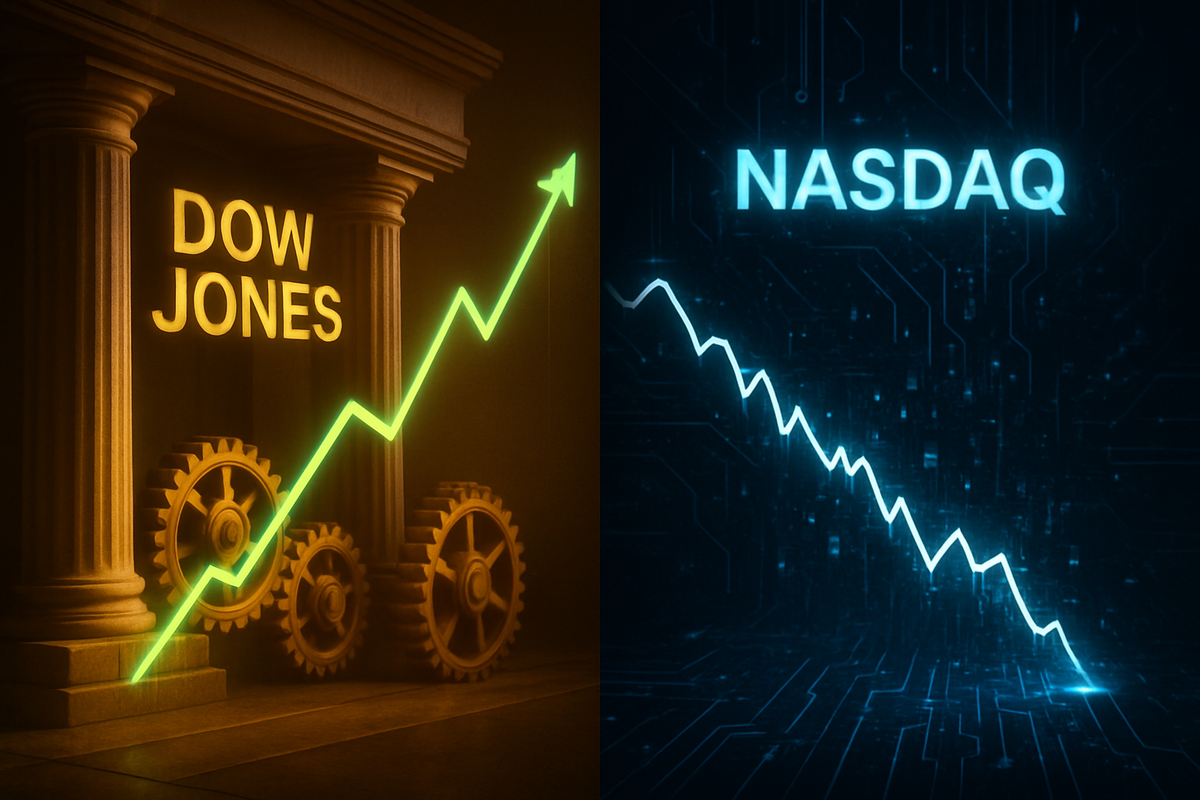
As the final trading week of 2025 begins, a striking "Great Divergence" has emerged on Wall Street, defining the closing chapters of the year’s market narrative. On this Monday, December 29, 2025, the Dow Jones Industrial Average (DJIA) continues to hover near its recent all-time highs, showcasing the resilience of the "real economy" and traditional value stocks. In contrast, the tech-heavy Nasdaq Composite is grappling with a deeper slide, as the high-octane artificial intelligence trade that dominated the first three quarters of the year faces a reality check of slowing growth and valuation skepticism.
The divergence is a sharp departure from the trend seen earlier in the decade. While the Nasdaq remains up approximately 22% for the year, its momentum has stalled significantly in the fourth quarter, gaining a mere 1.5% since October. Meanwhile, the Dow has surged to record levels, breaching the 48,500 mark earlier this month and maintaining a robust 14.5% gain for the year. This shift signals a massive rotation as investors pull capital out of expensive growth names and into the stable, dividend-paying blue chips that anchor the industrial and financial sectors.
The Shift to the "Real Economy"
The current market environment is the culmination of several months of economic recalibration. Throughout 2025, the Federal Reserve executed a series of three interest rate cuts, bringing the benchmark rate down to a range of 3.50% to 3.75%. While lower rates typically benefit growth stocks, the primary beneficiaries this year have been the interest-rate-sensitive "old guard" companies. This "broadening out" of the market rally was accelerated by a robust Q3 GDP growth rate of 4.3%, which reinforced investor confidence in domestic manufacturing, infrastructure, and financial services.
The timeline leading to today’s divergence was punctuated by a mid-december shock from Oracle (NYSE: ORCL), whose disappointing cloud revenue targets triggered a broader retreat in the enterprise software and AI sectors. This served as a catalyst for "AI fatigue," as market participants began to question the immediate return on the massive capital expenditures funnelled into data centers over the past three years. While the Dow remained insulated by its lack of heavy tech concentration, the Nasdaq was hit by a "sell the news" dynamic that has persisted into the year-end.
Key stakeholders, including institutional fund managers, have spent the last two weeks "window dressing" their portfolios, selling off high-flying tech winners to lock in gains and rotating into undervalued cyclicals. The atmosphere on the trading floor today is one of cautious rebalancing, with the Dow trading nearly flat at 48,710.97, while the Nasdaq has slipped 0.1% as investors brace for the final sessions of the year.
Winners and Losers of the Great Rotation
The primary winners of this late-2025 rotation are found in the industrial and financial heart of the Dow. Goldman Sachs (NYSE: GS) has emerged as a titan of the quarter, with its stock price reaching a 52-week high of $919.10 in mid-December. The firm has benefited from a resurgence in deal-making and a favorable yield curve, posting a staggering 56% year-to-date return. Similarly, Caterpillar (NYSE: CAT) has capitalized on the infrastructure boom required to power the very AI data centers that are causing tech investors so much anxiety. Trading near $583.15, Caterpillar’s 12% surge in Q4 underscores the market's preference for companies with tangible assets and clear earnings visibility.
On the losing side of today’s divergence are the former darlings of the AI era. Nvidia (NASDAQ: NVDA), which replaced Intel in the Dow late last year, has seen its meteoric rise moderate. While the stock remains one of the world's most valuable, its momentum has cooled as investors weigh its $190.53 share price against the cooling demand for high-end GPUs. Broadcom (NASDAQ: AVGO) has also faced pressure, as the market shifts its focus from hardware expansion to software profitability.
Even within the Dow, the divergence is visible. UnitedHealth Group (NYSE: UNH) has struggled throughout 2025, down nearly 36% for the year due to rising medical care ratios and regulatory hurdles. However, even UNH showed signs of a "bottoming out" today, rising slightly as value seekers look for laggards that might rebound in 2026. Meanwhile, Nike (NYSE: NKE) has provided a surprise boost to the blue-chip index, with its "WinNow" turnaround strategy finally gaining traction, lifting the stock to $60.93 in late-December trading.
AI Fatigue and the Return of Value
The divergence between the Dow and the Nasdaq fits into a broader historical pattern often seen after periods of intense speculative growth. Much like the post-dot-com era or the post-2021 tech correction, the market is currently undergoing a "valuation reset." Investors are no longer willing to pay extreme multiples for "potential" AI earnings; they are demanding "proven" AI earnings. This skepticism has created a ceiling for the Nasdaq, while the Dow, which trades at a more modest price-to-earnings ratio, has become a safe haven for capital.
The wider significance of this shift extends to the regulatory and policy landscape. The Federal Reserve’s pivot toward a more neutral stance suggests that the era of "easy money" that fueled the tech boom is truly over, replaced by a "higher-for-longer" reality where 3.5% is the new floor. This environment favors companies with strong cash flows and manageable debt—the very definition of a Dow blue-chip. Furthermore, the official retirement of Warren Buffett as CEO of Berkshire Hathaway (NYSE: BRK.B) on December 31 marks the symbolic end of an era, yet his philosophy of value investing appears to be more relevant than ever as the market rotates back to his favored sectors.
Looking Ahead: The 2026 Outlook
As we look toward the first quarter of 2026, the short-term focus will remain on the FOMC minutes scheduled for release tomorrow, December 30. These minutes will provide critical clues as to whether the Fed will continue its cutting cycle or pause to assess the impact of 2025's robust GDP growth. If the Fed signals a more hawkish tone, the pressure on the Nasdaq could intensify, while the Dow may continue to benefit from the "higher-for-longer" yield environment that supports bank earnings.
Market participants should also watch for strategic pivots within the tech sector. Companies that have spent 2025 building AI infrastructure will likely face immense pressure in 2026 to show how that infrastructure translates into bottom-line profit. This "Year of Efficiency 2.0" could lead to a new wave of consolidation or cost-cutting measures. Conversely, the "Santa Claus Rally" could still provide a short-term lift to both indices in the coming days, though the Dow appears better positioned to hold those gains into the new year.
The Final Verdict on 2025’s Market Close
The performance divergence witnessed today is more than just a year-end anomaly; it is a reflection of a maturing bull market. The Dow’s stability in the face of the Nasdaq’s slide suggests that the "Great Rotation" is not a sign of a market crash, but rather a healthy rebalancing. Investors have moved from a state of "FOMO" (Fear of Missing Out) regarding AI to a state of "FORO" (Fear of Overpaying), leading them back to the reliable earnings of the industrial and financial giants.
Moving forward, the key takeaway for investors is the importance of market breadth. The concentrated rally of 2024 and early 2025 has given way to a more balanced environment where diverse sectors can lead. While the Nasdaq retains its secular bull trend due to the long-term potential of technology, the Dow's dominance at the end of 2025 serves as a reminder that in an uncertain economic climate, "boring" blue chips often provide the most exciting returns. Investors should keep a close eye on interest rate trajectories and corporate guidance in January to see if this value-led momentum has the legs to carry through 2026.
This content is intended for informational purposes only and is not financial advice.