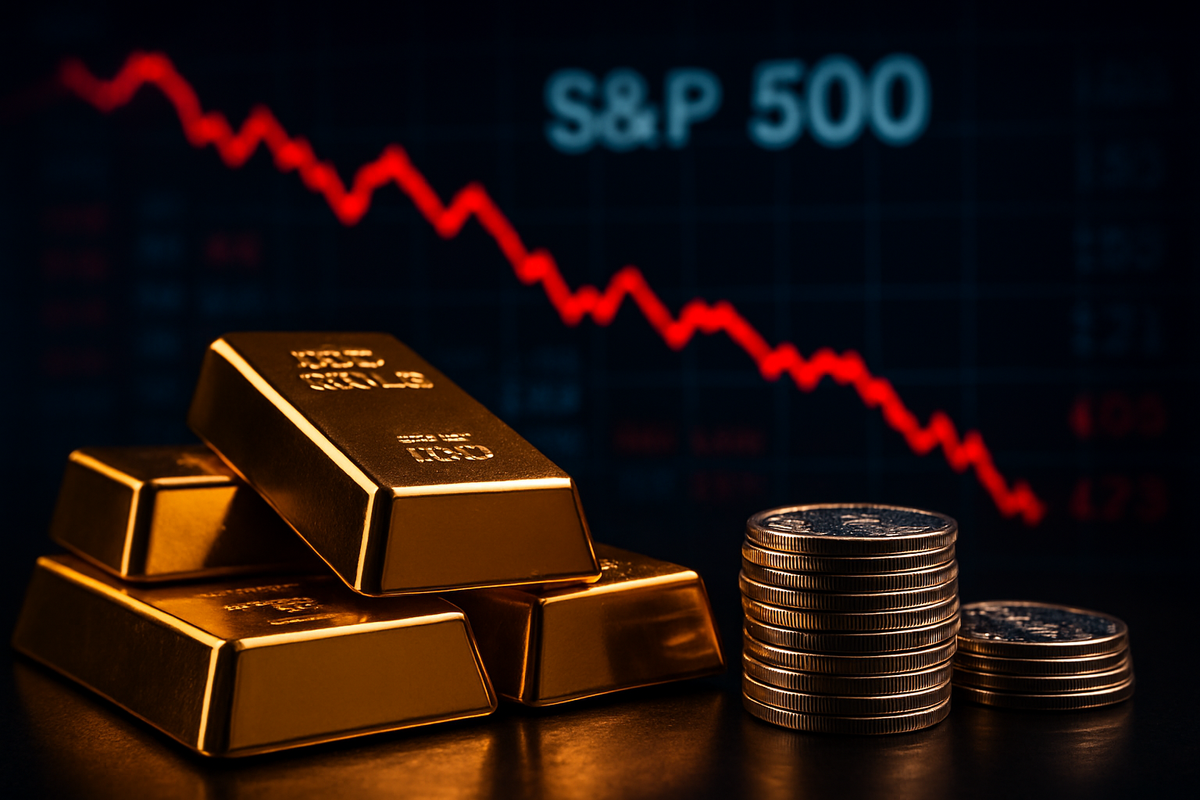
As the final trading days of 2025 unfold, a stark divergence has emerged in global financial markets. While the broader equity market, represented by the Vanguard S&P 500 ETF (NYSE: VOO), continues to lose momentum amid year-end profit-taking and valuation concerns, precious metals have staged a resilient "V-shaped" recovery. This shift underscores a growing investor preference for tangible assets as the "AI euphoria" that dominated much of the year begins to face rigorous scrutiny.
The rebound on Tuesday, December 30, 2025, follows a turbulent start to the week where both gold and silver suffered sharp, technical-driven sell-offs. However, the swift return of buyers suggests that the fundamental bull case for precious metals—rooted in geopolitical instability and fiscal uncertainty—remains firmly intact. As equities slide, the role of gold and silver as a "safe haven" has once again moved to the forefront of the market narrative.
The Great Divergence: A Tale of Two Trading Days
The market volatility began in earnest on Monday, December 29, 2025, with what many traders described as a "flash crash" in the metals complex. Gold, represented by the SPDR Gold Shares (NYSE: GLD), plummeted nearly 5%, dropping from its all-time high of $4,550 toward the $4,300 level. Silver, tracked by the iShares Silver Trust (NYSE: SLV), experienced an even more violent correction, tumbling between 9% and 14% to reach the low $70s. The primary catalyst for this sudden liquidation was a surprise decision by the CME Group to hike margin requirements for gold and silver futures, which forced over-leveraged participants to exit positions in a thin, holiday-thinned market.
However, the panic was short-lived. By Tuesday morning, December 30, the narrative shifted from liquidation to accumulation. Gold reclaimed the $4,400–$4,500 range, while silver surged by as much as 7%, reclaiming critical technical support levels. In contrast, the S&P 500 remained under pressure, sliding approximately 0.5% on Monday and struggling to find its footing on Tuesday. The "Santa Claus Rally" that many expected for equities appears to have stalled, as investors rotate capital out of high-flying tech stocks and into the perceived safety of hard money.
The initial market reaction to this divergence has been one of cautious repositioning. Institutional desks are noting that the "buy the dip" mentality, which previously fueled the tech sector, is now being applied to commodities. The speed of the rebound in GLD and SLV has caught many short-sellers off guard, leading to a "short squeeze" that has further accelerated the upward price action in the final hours of the 2025 trading year.
Mining Giants and Tech Titans: The Shifting Balance of Power
The volatility in the underlying metals has been amplified in the share prices of major mining corporations. Newmont Corporation (NYSE: NEM), the world’s largest gold miner, saw its shares drop more than 5% during Monday’s rout, losing nearly $6 in value. However, by Tuesday morning, the stock had already begun to claw back those losses, rising approximately 2% to trade around the $102.49 mark. Analysts at major firms like Raymond James have maintained "Buy" ratings on NEM, pointing to the company's strong margins and Tier-1 asset base as a cushion against short-term price swings.
Similarly, Barrick Gold (NYSE: GOLD) has mirrored this "V-shaped" recovery. After plunging nearly 4.8% on Monday, the stock mounted a 2% recovery in early Tuesday trading. Despite the start-of-week volatility, Barrick has emerged as one of the top performers of 2025, boasting a staggering 184% year-to-date surge. The company’s success has been driven by expanded exploration efforts and significantly higher average realized gold prices, which have bolstered its balance sheet and allowed for increased dividend payouts to shareholders.
On the losing side of this rotation are the megacap technology firms that have led the S&P 500 higher for most of the decade. Companies like Nvidia (NASDAQ: NVDA) and Tesla (NASDAQ: TSLA) have faced selling pressure as investors lock in gains following a year of 18–19% returns for the VOO. The transition of capital from "growth" at any price to "value" and "safety" is a trend that appears to be accelerating as the year closes, leaving tech-heavy portfolios vulnerable to further corrections if the rotation persists into January.
Geopolitical Friction and Fiscal Fragility: The Engines of the Metal Rally
The fundamental drivers behind the gold and silver rebound are deeply rooted in a "perfect storm" of geopolitical and macroeconomic factors. A primary catalyst on December 30 was the intensification of a U.S. naval blockade on Venezuelan oil tankers. This maritime "quarantine" has sparked immediate fears of a broader conflict in Latin America and a potential global energy supply shock. As Brent crude prices pushed toward $62 per barrel, the uncertainty drove a flight to gold as a hedge against regional escalation.
Furthermore, the backdrop of stalled peace negotiations between Russia and Ukraine has dampened hopes for a geopolitical de-escalation in early 2026. This persistent tension, combined with a U.S. national debt that has ballooned to $38 trillion, has significantly weakened confidence in the U.S. dollar. The U.S. Dollar Index (DXY) fell approximately 10% over the course of 2025, creating a favorable tailwind for dollar-denominated assets like gold and silver.
Silver’s performance has been further bolstered by its industrial utility. In 2025, silver was officially added to the U.S. Critical Minerals list, recognizing its essential role in AI data centers, solar energy infrastructure, and the global electric vehicle (EV) fleet. This structural supply deficit has acted as "rocket fuel" for the metal, allowing it to outperform gold on a percentage basis throughout the year. The rebound on Tuesday confirms that industrial demand remains a powerful floor for silver prices, even in the face of technical selling.
The 2026 Horizon: Will the Bull Run in Hard Assets Persist?
Looking ahead to the first quarter of 2026, the primary question for investors is whether this rotation into precious metals is a temporary hedge or a long-term strategic shift. The Federal Open Market Committee (FOMC) minutes from the December meeting suggested a growing divide among officials. While some favor continued rate cuts to support growth, a dissenting group is prioritizing stability as inflation shows signs of re-accelerating. This policy uncertainty typically favors gold, which thrives in environments where real interest rates are volatile or falling.
Strategic pivots may be required for traditional 60/40 portfolios that have historically relied on bonds for protection. With the $38 trillion debt overhang, the traditional inverse correlation between stocks and bonds has weakened, leading many wealth managers to increase their allocations to "alternative" assets like GLD and SLV. If the S&P 500 continues to struggle with high valuations and slowing earnings growth in the tech sector, the "commodity supercycle" could become the dominant theme of 2026.
Market opportunities are likely to emerge in the mid-tier mining sector as larger players like Newmont and Barrick look to replenish their reserves through acquisitions. Investors should also watch for potential regulatory shifts, as the inclusion of silver on critical mineral lists may lead to government incentives for domestic mining and recycling, further impacting the supply-demand balance.
Investor Outlook: Navigating the New Commodity Supercycle
The events of late December 2025 serve as a potent reminder of the cyclical nature of financial markets. The sharp recovery in gold and silver following a technical "flush" suggests that the market is currently more concerned with preservation of capital and geopolitical hedging than with chasing the next leg of the AI rally. The key takeaway for the final days of the year is that "hard assets" have regained their status as essential components of a diversified portfolio.
Moving forward, the market will likely remain sensitive to any headlines regarding the Venezuelan blockade or shifts in Fed rhetoric. Investors should keep a close eye on the $4,500 level for gold and the $75 level for silver; a sustained break above these points could signal the next leg of the bull market. Conversely, if the S&P 500 can find support and the VOO manages to reclaim its 50-day moving average, the urgency for safe-haven assets may temporarily diminish.
In the coming months, the focus will shift to corporate earnings and how mining companies manage their increased cash flows. For the broader market, the transition from a tech-led growth environment to a more balanced, commodity-aware landscape represents a significant structural change. Watching the interplay between the DXY, Treasury yields, and metal prices will be critical for anyone looking to navigate the complexities of the 2026 financial landscape.
This content is intended for informational purposes only and is not financial advice.