
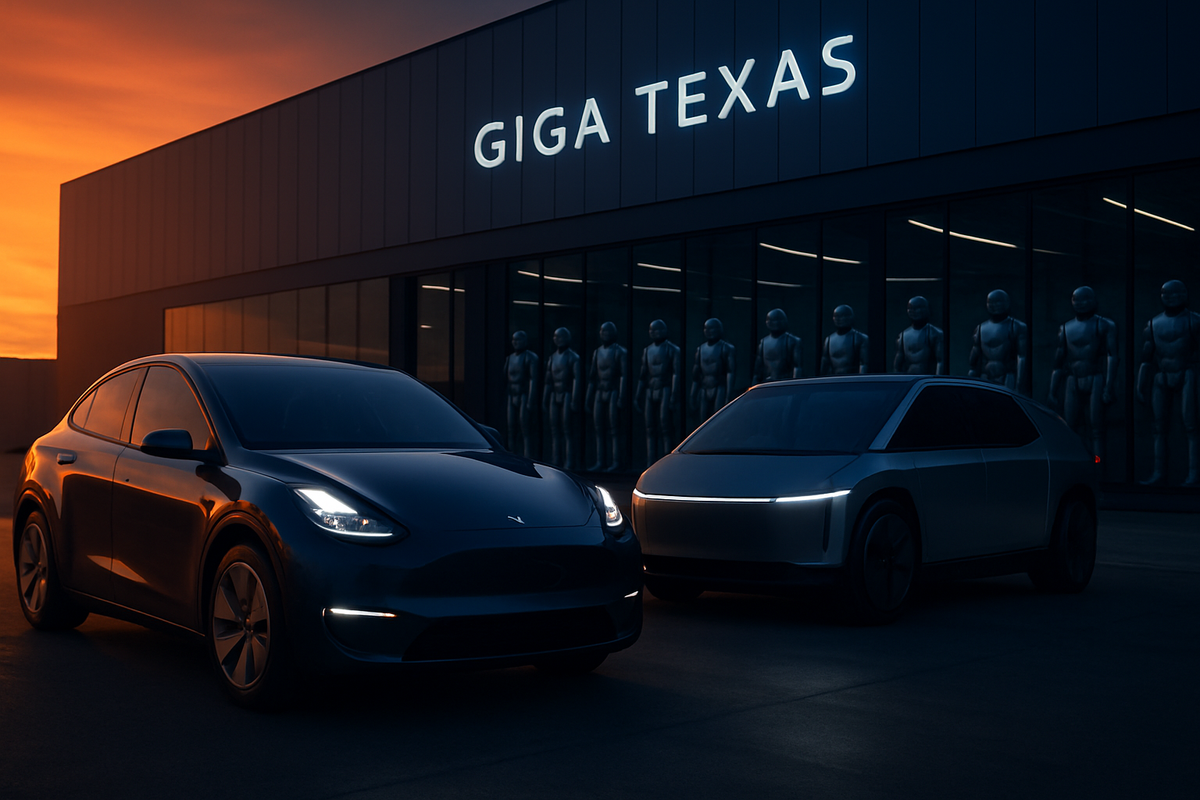
As the final trading days of 2025 approach, Tesla (NASDAQ: TSLA) remains the most polarizing and volatile fixture on Wall Street. The electric vehicle pioneer is ending the year caught between two conflicting identities: a legacy automaker struggling with a historic sales contraction and a burgeoning AI powerhouse achieving significant milestones in robotics and autonomous transit. While the stock touched a record intra-day high of $498.46 in mid-December, it enters the final week of the year under heavy pressure, trading near $470 as investors grapple with a "demand cliff" that has sent shockwaves through the automotive sector.
The immediate implications of this volatility are profound for the broader market. Tesla’s ability to maintain its premium valuation—increasingly decoupled from traditional vehicle delivery metrics—is being tested by a combination of high interest rates and the expiration of critical consumer incentives. As the company pivots its primary focus from mass-market car production to the "Cybercab" and the Optimus humanoid robot, the market is witnessing a high-stakes transition that could either cement Tesla’s status as the world’s most valuable company or lead to a significant correction if its AI promises fail to materialize in the 2026 fiscal year.
A Year of Strategic Pivots and Macroeconomic Headwinds
The closing months of 2025 have been defined by a dramatic shift in Tesla’s product roadmap. For years, investors anticipated the "Model 2," a $25,000 compact car designed to bring electric mobility to the masses. However, in a move that stunned analysts, the company largely deprioritized the project in favor of a "stripped-down" version of its existing platform. The resulting Model Y Standard, launched in October 2025 with a starting price of $39,990, removed premium features like the panoramic glass roof and rear-row infotainment to hit a lower price point. While intended to broaden the brand's appeal, early data suggests the model is primarily cannibalizing sales of the more profitable Model 3 and higher-trim Model Y variants.
This product shift coincided with a brutal macroeconomic environment. On September 30, 2025, the federal $7,500 EV tax credit officially expired, creating a massive pull-forward in demand during the third quarter followed by a "gloomy" Q4 outlook. This "demand cliff" was further exacerbated by a 43-day government shutdown in late 2025, which dampened consumer confidence and delayed regulatory filings. Despite the Federal Reserve issuing a 25-basis-point interest rate cut in December—bringing the federal funds rate down to a range of 3.5%–3.75%—the relief came too late to save Tesla’s annual delivery numbers. For the first time in the company's modern history, annual deliveries are projected to decline by approximately 8% year-over-year, totaling roughly 1.65 million units.
Amidst these operational struggles, the "Tesla AI" narrative reached a fever pitch. In December 2025, Tesla reached a critical milestone in its Austin, Texas, Robotaxi pilot, conducting the first successful driverless tests without human safety monitors in the front seat. This technical achievement, alongside the groundbreaking for a dedicated Optimus factory at Giga Texas in November, provided the fuel for the stock's mid-month rally. However, the contrast between the small-scale Robotaxi fleet (currently fewer than 50 vehicles) and the shrinking core automotive business has left Wall Street deeply divided, with price targets ranging from a bullish $1,000 to a bearish $158.
Winners and Losers in the Global EV Shakeout
The shifting landscape of 2025 has created clear winners and losers. The most prominent victor is BYD (OTC: BYDDF), which officially surpassed Tesla this year as the world’s largest manufacturer of battery-electric vehicles (BEVs) by annual sales. BYD’s projected 15.7% global market share has been bolstered by its diverse lineup of affordable hybrids and BEVs, allowing it to thrive in markets where Tesla has faltered. In Europe, where Tesla’s sales contracted by nearly 12% in late 2025, BYD saw its volume surge by over 200%, highlighting the competitive pressure from vertically integrated Chinese manufacturers.
In the autonomous driving space, Alphabet Inc. (NASDAQ: GOOGL) through its Waymo subsidiary continues to hold the safety high ground. While Tesla’s "Cybercab" pilot is making headlines, Waymo’s established fleet has maintained a significantly lower crash rate per mile, according to late-2025 NHTSA data. Tesla’s crash rate of one per 40,000–62,500 miles remains a point of regulatory scrutiny compared to Waymo’s vastly superior safety record. Meanwhile, in the industrial robotics sector, Figure AI—backed by Microsoft (NASDAQ: MSFT)—has emerged as a formidable rival to Tesla’s Optimus. Figure AI’s successful integration of its "Figure 03" robots into BMW (ETR: BMW) factories has given it a lead in the commercial deployment of embodied AI, even as Tesla ramps up its internal pilot lines in Fremont.
Legacy automakers like Ford (NYSE: F) and General Motors (NYSE: GM) find themselves in a precarious middle ground. Both companies have pulled back on aggressive EV targets in 2025, opting instead to lean into high-margin internal combustion and hybrid trucks to weather the high-interest-rate environment. This conservative approach has protected their balance sheets but has left them further behind in the race for software-defined vehicles and autonomy, where Tesla and Rivian (NASDAQ: RIVN) continue to iterate at a much faster pace.
The Significance of the "Embodied AI" Era
The events of late 2025 signal a broader industry trend: the transition from the "Early Adopter" phase of electric vehicles to a "Mass Market" era defined by extreme price competition and the rise of AI. Tesla’s struggle to grow deliveries suggests that the initial wave of EV enthusiasm has plateaued, and the next leg of growth will require either unprecedented price parity with gasoline vehicles or a complete reimagining of the car as a service rather than a product.
This shift is also reflected in the regulatory landscape. The end of the federal tax credit marks a transition toward a post-subsidy market where manufacturers must survive on efficiency and innovation alone. Furthermore, the 2025 "World Humanoid Robot Games" held in Beijing served as a historical precedent, proving that humanoid robotics is no longer a futuristic concept but a rapidly maturing industrial sector. Tesla’s pivot toward Optimus and the Cybercab represents a bet that the future of transportation and labor is inherently linked to "Embodied AI"—intelligence that can interact with the physical world. If Tesla can successfully scale its Optimus Gen 3 for commercial sale in 2026, it may redefine the industrial economy in the same way it redefined the automotive industry a decade ago.
Looking Ahead: The 2026 Roadmap
The short-term outlook for Tesla will be dominated by its ability to execute on the "Cybercab" mass production, currently slated for the second quarter of 2026. This purpose-built vehicle, which lacks traditional controls like pedals or a steering wheel, is the lynchpin of Elon Musk’s vision for a high-margin autonomous transport network. If Tesla can secure the necessary regulatory permits in states like Nevada and Arizona—which have seen delays in late 2025—it could begin to offset its automotive margin compression with high-margin software and service revenue.
In the long term, the Giga Texas Optimus factory remains the company's most ambitious project. With a target capacity of 10 million units per year by 2027, Tesla is positioning itself to be the primary supplier of the world’s robotic workforce. However, the strategic pivot requires an immense amount of capital at a time when vehicle sales are cooling. The primary challenge for 2026 will be managing this "valley of death"—balancing the declining profits of a maturing car business with the massive R&D requirements of a nascent AI and robotics empire.
Final Assessment and Investor Takeaways
As 2025 draws to a close, the key takeaway for investors is that Tesla is no longer just a car company, and its stock can no longer be valued using traditional automotive multiples. The current volatility reflects the market's attempt to price in a future that is still years away, even as the present-day business faces its toughest headwinds since the Model 3 ramp-up in 2018.
Moving forward, the market will be hyper-focused on three critical metrics in early 2026: the Q1 delivery numbers to see if the "demand cliff" persists, the progress of FSD (Full Self-Driving) version 13 and 14 updates, and any further commercial deployments of the Optimus robot. While the risks of competition from BYD and the safety leads of Waymo are real, Tesla’s vertical integration and massive data advantages in AI remain its greatest strengths. For those watching the markets, the "Tesla Paradox" of 2025 is a reminder that in the world of high-tech disruption, the path to the future is rarely a straight line.
This content is intended for informational purposes only and is not financial advice