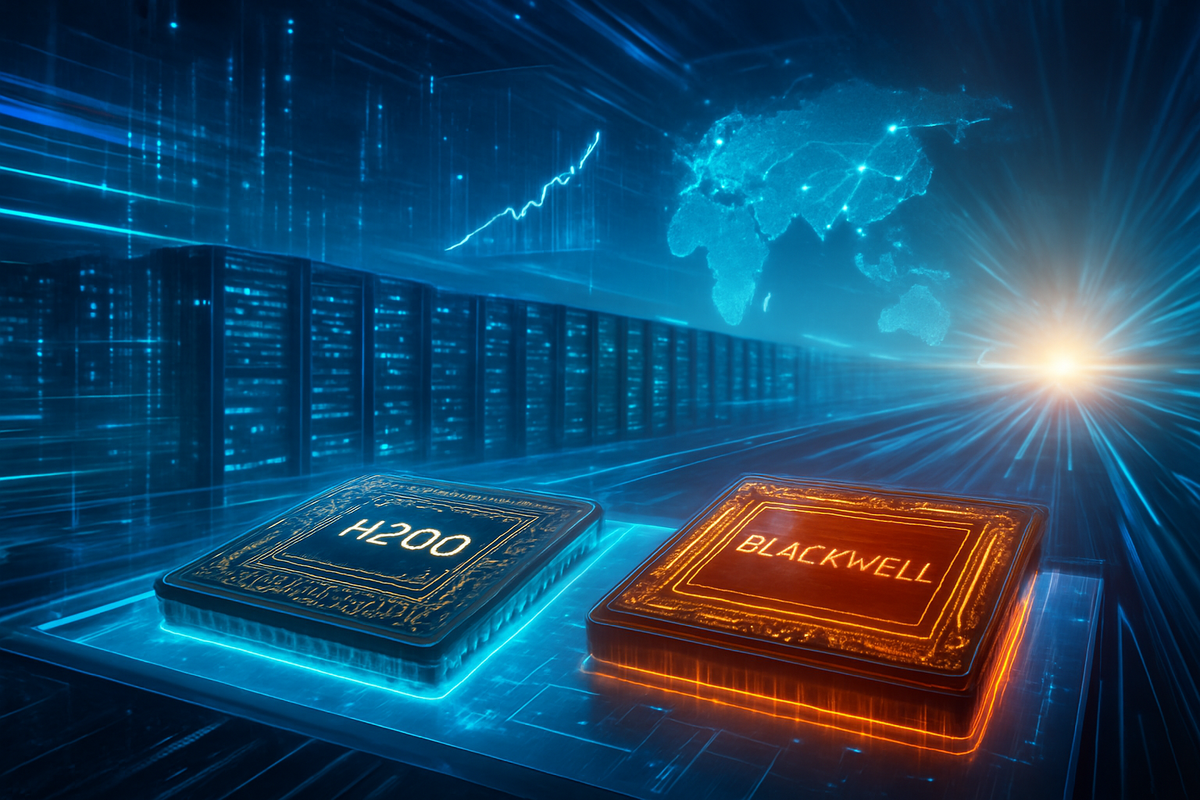
As 2025 draws to a close, NVIDIA (NASDAQ: NVDA) is defying the traditional product lifecycle by securing a massive second wave of demand for its "legacy" Hopper architecture. While the market’s attention has been fixed on the high-performance Blackwell B200 series, reports of renewed supply chain talks for the H200 chip have sent a clear signal to Wall Street: the AI infrastructure boom is not just accelerating—it is diversifying. NVIDIA’s stock, which recently eclipsed the $5 trillion market capitalization milestone, continues to find support from a "dual-track" strategy that balances the cutting-edge Blackwell rollout with a strategic resurgence of H200 production.
The immediate implication of this supply chain pivot is a significant de-risking of NVIDIA’s 2026 revenue outlook. By extending the life of the H200 through 2026, NVIDIA is effectively bridging the "scarcity gap" created by Blackwell’s massive 3.6-million-unit backlog. This move ensures that the company captures every possible dollar of global compute demand, even as its most advanced silicon remains sold out for the next four to six quarters.
The H200 Pivot: China, Constraints, and the $4 Billion Opportunity
The resurgence of the H200 is rooted in a surprising geopolitical shift and a persistent supply bottleneck. In December 2025, the U.S. government approved a new "transactional diffusion" trade model, allowing NVIDIA to export H200 chips to approved customers in China, provided a 25% revenue-sharing fee is paid to the U.S. Treasury. This policy change triggered an immediate "pre-tariff pull-forward" from Chinese tech giants like Alibaba (NYSE: BABA) and ByteDance (Private), who have reportedly placed orders for more than 2 million H200 units for delivery throughout 2026.
To meet this sudden spike in demand, NVIDIA has reportedly re-entered negotiations with TSMC (NYSE: TSM) to ramp up additional 4nm production capacity specifically for the H200, with work scheduled to begin in Q2 2026. This is a significant departure from earlier expectations that NVIDIA would fully transition its 4nm allocations to the Blackwell 4NP node. The timeline of events suggests that NVIDIA is leveraging its existing H200 inventory—estimated at roughly 700,000 units—as a stop-gap while the new production lines are spinning up.
Key stakeholders, including NVIDIA CEO Jensen Huang and U.S. trade officials, have characterized this as a "Goldilocks" solution. The H200 is powerful enough to handle the current wave of large language model (LLM) inference and mid-tier training, yet it fits within the regulatory guardrails that the more powerful Blackwell chips currently exceed. The market reaction has been overwhelmingly positive, with analysts viewing the China deal as an "unlocked" revenue stream that could contribute between $4 billion and $17 billion per quarter in 2026.
Supply Chain Beneficiaries: The Winners of the Dual-Track Era
The extension of the H200 lifecycle creates a unique set of winners across the global semiconductor ecosystem. TSMC stands as the primary beneficiary, as it now maintains high utilization rates for its 4nm nodes while simultaneously scaling the more complex packaging required for Blackwell. By keeping the H200 in production, TSMC avoids the "lumpy" revenue transitions often seen between major architecture shifts.
In the memory sector, the sustained demand for H200 and Blackwell has led to a historic supply crunch for High Bandwidth Memory (HBM). SK Hynix (KRX:000660) and Micron Technology (NASDAQ: MU) have already signaled that their 2025 HBM3e capacity is fully committed. Reports indicate that SK Hynix and Samsung Electronics (KRX:005930) are planning a 20% price hike for HBM3e in early 2026, capitalizing on NVIDIA's need to equip both H200 and Blackwell systems with massive amounts of memory.
Server manufacturers are also reaping the rewards of this diversified demand. Dell Technologies (NYSE: DELL) recently raised its fiscal 2026 AI server revenue forecast to $20 billion, citing a massive $14.4 billion backlog that includes both H200 and Blackwell configurations. Similarly, Supermicro (NASDAQ: SMCI) has pivoted to promoting liquid-cooled H200 racks as a high-availability alternative for customers who cannot wait for Blackwell slots. These companies are finding that the H200’s lower power requirements (700W compared to Blackwell’s 1,000W+) make it an easier sell for data centers with existing power constraints.
A New Cycle: From Training Factories to Inference Deployment
The significance of the H200 supply talks extends beyond mere quarterly earnings; it marks a transition in the broader AI industry. We are moving from the "AI Factory" era—focused on massive, trillion-parameter model training—to the "Deployment" era, where inference and local model optimization take center stage. The H200, optimized for memory-bound inference tasks, is perfectly positioned to be the workhorse of this second phase.
This trend has significant ripple effects for competitors like AMD (NASDAQ: AMD) and Intel (NASDAQ: INTC). By flooding the mid-to-high-end market with H200 supply, NVIDIA is making it increasingly difficult for rivals to gain a foothold in the "inference-first" data center. The H200’s established software ecosystem (CUDA) and proven reliability give it a massive advantage over newer, unproven alternatives. Furthermore, the 25% fee-sharing model with the U.S. government sets a new regulatory precedent, potentially turning chip exports into a significant source of federal revenue, which could influence future trade policy.
Historically, semiconductor cycles were characterized by a "out with the old, in with the new" mentality. However, NVIDIA is rewriting this playbook. By maintaining two high-performance architectures simultaneously, the company is effectively competing against itself, ensuring that even if a customer cannot afford or access the flagship Blackwell chip, they remain within the NVIDIA ecosystem via the H200.
Looking Ahead to 2026: The Road to Rubin
As we look toward 2026, the primary challenge for NVIDIA will be managing its gross margins. While the H200 sales in China provide a massive revenue floor, the 25% government fee and rising HBM costs could put pressure on NVIDIA’s mid-70s margin targets. Investors will be watching closely to see if NVIDIA can pass these costs onto customers or if it will choose to absorb them to maintain market share.
Strategically, the H200 extension serves as a bridge to the late-2026 launch of the Rubin (R100) architecture. Rubin is expected to move to a 3nm process and introduce HBM4 memory, representing another generational leap in performance. By keeping the H200 and Blackwell lines running at full tilt through 2026, NVIDIA is building a financial fortress that will fund the massive R&D required for the Rubin transition.
The most likely scenario for 2026 is one of "infrastructure maturity." We expect to see a shift toward more specialized AI hardware, with H200s handling the bulk of global AI inference while Blackwell clusters tackle the world’s most complex scientific and generative AI challenges. The potential for a "Rubin-led" super-cycle in late 2026 remains the primary catalyst for long-term bulls.
Final Thoughts: A Market in Constant Acceleration
As 2025 concludes, the key takeaway is that NVIDIA has successfully decoupled its growth from the limitations of a single product line. The H200 is no longer a "legacy" chip; it is a strategic asset that allows NVIDIA to dominate the Chinese market, alleviate Blackwell supply constraints, and maintain a vice-grip on the global AI server market.
Moving forward, the market will transition from questioning "how much demand is there?" to "how much supply can be delivered?" NVIDIA’s ability to orchestrate a complex, multi-architecture supply chain across TSMC, SK Hynix, and global server makers is perhaps its greatest competitive advantage. For investors, the focus in the coming months should remain on HBM pricing, the pace of the Blackwell ramp, and any further shifts in U.S.-China trade policy. With a $5 trillion valuation and a clear path to 2026 growth, NVIDIA enters the new year not just as a chipmaker, but as the indispensable architect of the global AI economy.
This content is intended for informational purposes only and is not financial advice