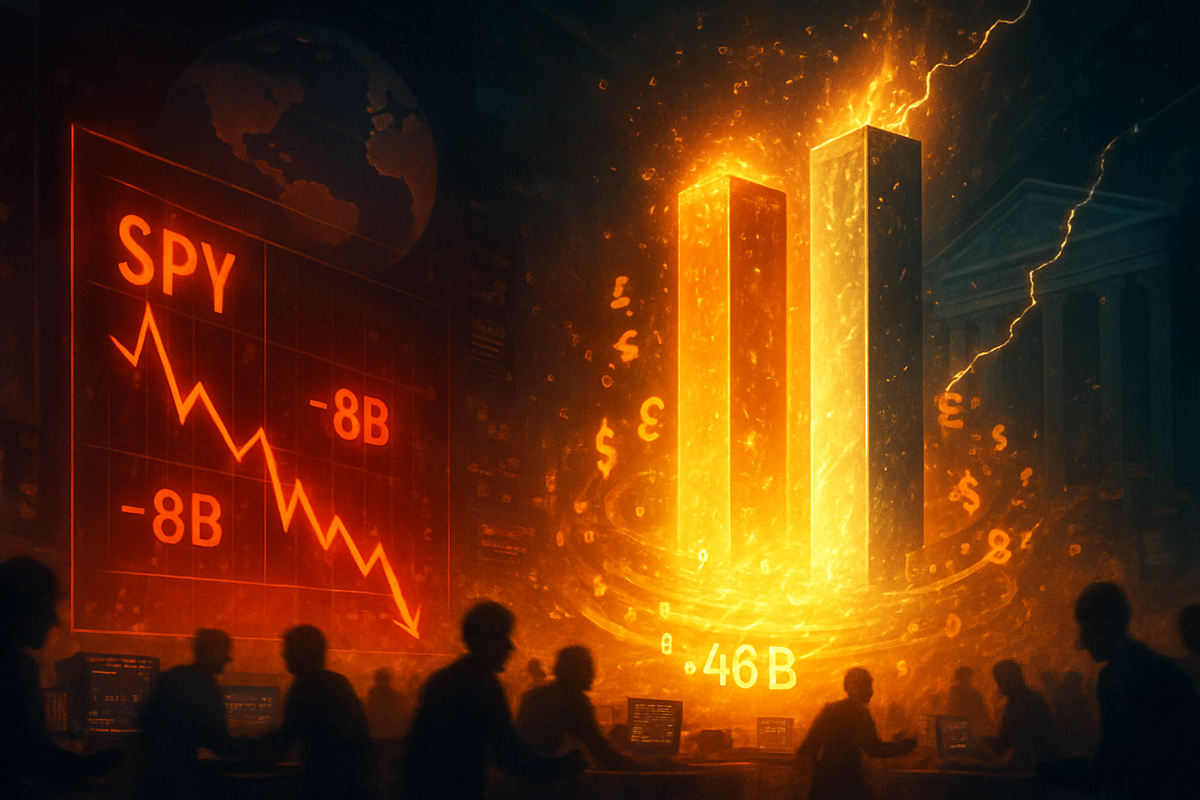
NEW YORK — The opening weeks of 2026 have ushered in a period of unprecedented market turbulence, as a "perfect storm" of geopolitical shocks and a direct assault on the independence of the Federal Reserve has sparked what analysts are calling a "violent recalibration of risk." In the first ten trading days of the year, investors have staged a massive exodus from traditional U.S. equities, pulling a staggering $8 billion from the SPDR S&P 500 ETF Trust (NYSE Arca: SPY). This capital has not left the market entirely but has instead rotated into "hard assets" at a record-breaking pace, with $46 billion flowing into specialized ETFs, spearheaded by a historic surge into the SPDR Gold Shares (NYSE Arca: GLD) and the iShares Silver Trust (NYSE Arca: SLV).
As of mid-January 2026, the financial landscape is being redrawn by a "Sell-America" trade that reflects a profound erosion of institutional trust. With gold prices shattering records to trade above $4,600 per ounce and silver spiking to a multi-decade high of $84 per ounce, the rotation signifies more than just a seasonal shift; it is a structural hedge against a world where the traditional "safe haven" of the U.S. dollar and its central bank are increasingly viewed as being under siege.
A Perfect Storm: Subpoenas and Global Upheaval
The catalyst for this market fracture was a series of high-intensity events that converged during the first week of January. The most jarring for domestic markets occurred on Sunday, January 11, 2026, when the U.S. Department of Justice served grand jury subpoenas to Federal Reserve Chair Jerome Powell and the central bank’s board of governors. While the investigation officially concerns the $2.5 billion renovation costs of the Fed’s headquarters, the timing and nature of the probe have been widely interpreted as political intimidation. In an extraordinary video statement released shortly after, Chair Powell denounced the move as a "pretext" to compromise the Fed’s autonomy, fueling fears that the administration is attempting to force aggressive rate cuts ahead of the expiration of Powell’s term in May 2026.
Simultaneously, the global geopolitical map has been thrown into chaos. In South America, a U.S.-backed operation recently led to the unseating and capture of Venezuelan President Nicolás Maduro. While the transition of power to Delcy Rodríguez has sparked hope for long-term stability, the immediate vacuum has created extreme volatility in energy markets. Furthermore, the U.S. administration’s public flirtation with the annexation of Greenland has soured relations with European allies, while intense civil unrest in Iran—triggered by a 40% depreciation of the rial—has brought the Middle East to a breaking point.
Perhaps the most significant blow to the commodity markets came from Beijing. On January 1, 2026, China reclassified silver as a "strategic dual-use material," imposing strict state controls on exports. This move created an immediate physical supply squeeze in Western markets, sending the iShares Silver Trust (NYSE Arca: SLV) into a vertical ascent as industrial and speculative demand collided with a lack of available bullion.
Winners and Losers in the Age of Volatility
The primary beneficiaries of this "violent recalibration" are the providers of hard-asset vehicles. State Street Global Advisors, the manager of SPDR Gold Shares (NYSE Arca: GLD), has seen its assets under management (AUM) swell as institutional investors abandon the "paper" security of the S&P 500. Similarly, BlackRock (NYSE: BLK), the parent company of the iShares Silver Trust (NYSE Arca: SLV), has benefited from the massive rotation into silver as a hedge against both inflation and geopolitical supply chain weaponization.
Conversely, the broad-market indices are bearing the brunt of the capital flight. The $8 billion outflow from the SPDR S&P 500 ETF Trust (NYSE Arca: SPY) represents a significant loss of confidence in the "Goldilocks" scenario that dominated 2025. Large-cap technology companies, often seen as a proxy for the U.S. economy, are facing headwinds as the "Sell-America" sentiment takes hold. However, some energy giants are navigating the chaos effectively. Exxon Mobil (NYSE: XOM) and Chevron (NYSE: CVX) have reportedly entered high-level talks with the administration regarding the rehabilitation of Venezuelan oil infrastructure, potentially positioning themselves as winners if the post-Maduro transition stabilizes.
Traditional banking institutions are also finding themselves in a precarious position. As the independence of the Federal Reserve is questioned, the reliability of the U.S. Treasury market—the bedrock of the global financial system—is being re-evaluated. If the Fed is perceived as a political tool rather than an independent arbiter of monetary policy, the risk premium on all U.S. assets is likely to remain elevated, pressuring the valuations of major financial players like JPMorgan Chase & Co. (NYSE: JPM).
The Erosion of Institutional Independence
The wider significance of this capital rotation cannot be overstated. It marks a departure from the historical precedent where investors would "flee to quality" by purchasing U.S. Treasuries and domestic stocks during global crises. Instead, the current "Sell-America" trade suggests that the U.S. itself is now perceived as a source of systemic risk. The conflict between the White House and the Federal Reserve is particularly damaging; markets rely on the predictability of the Fed to manage inflation and employment. When that predictability is replaced by DOJ subpoenas and public broadsides, the result is the current "violent recalibration."
Furthermore, China's weaponization of silver exports mirrors previous restrictions on rare earth elements, signaling a new era of "resource nationalism" that could keep commodity prices volatile for years to come. This fits into a broader trend where global powers are using control over physical materials to counter financial dominance. The fact that $46 billion moved into ETFs in just six trading days suggests that institutional investors are no longer content with "diversification" in the traditional sense; they are seeking absolute protection in assets that cannot be devalued by policy shifts or subpoena-driven volatility.
What Lies Ahead: The May 2026 Deadline
The short-term outlook remains tethered to the escalating standoff at the Federal Reserve. Investors are closely watching the FOMC meetings leading up to May 2026, when Jerome Powell’s term expires. If the administration succeeds in installing a loyalist successor—such as current board member Stephen Miran, who has consistently advocated for aggressive rate cuts—the flight from the dollar and into gold and silver may only accelerate.
In the long term, the market's survival will depend on whether the "violent recalibration" leads to a new equilibrium or a full-scale abandonment of the dollar-based order. Strategic pivots are already occurring; hedge funds and family offices are increasing their allocations to "un-correlated" assets, including physical bullion and decentralized digital assets. The potential for a "commodity super-cycle" driven by geopolitical instability is high, and market participants must adapt to a landscape where political risk is no longer an "outlier" but a core component of every valuation model.
A Summary of the Market's New Reality
The events of January 2026 have fundamentally altered the investor playbook. The record-shattering $46 billion inflow into ETFs—and the corresponding $8 billion exit from the SPY—serves as a clear signal: the market is pricing in a future defined by institutional fragility and geopolitical confrontation. The "Sell-America" trade is a symptom of a deeper crisis of confidence that began with DOJ subpoenas and was exacerbated by a global scramble for resources.
Moving forward, the primary metric for investors will not be corporate earnings or traditional economic data, but the integrity of the institutions that govern the markets. The survival of the Fed’s independence and the stabilization of the "resource wars" with China will be the key themes of the coming months. For now, gold at $4,600 and silver at $84 are not just price points; they are the benchmarks of a world in the midst of a violent, and perhaps permanent, recalibration of risk.
This content is intended for informational purposes only and is not financial advice.