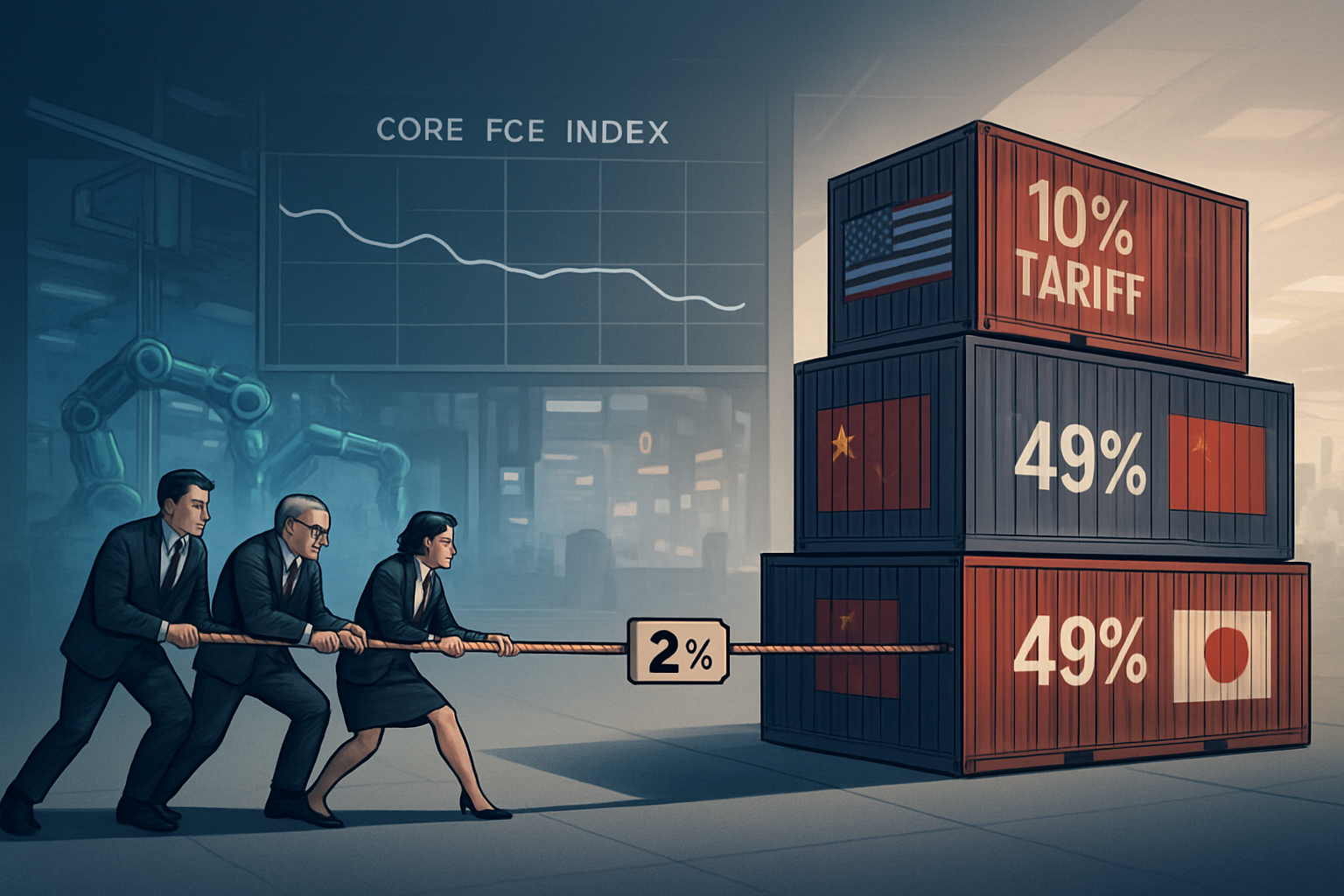
As the United States enters the first quarter of 2026, the global economy is grappling with a radical shift in trade dynamics that has upended decades of globalization. The aggressive "protectionist-plus" policies enacted throughout 2025—headlined by a 10% universal baseline tariff and even steeper duties on key trade partners—have created a unique macroeconomic environment: growth remains surprisingly resilient due to massive fiscal stimulus, but inflation has become "sticky," hovering stubbornly above the Federal Reserve’s long-held 2% goal.
This intersection of trade policy and monetary stability has placed Federal Reserve Chair Jerome Powell in a precarious position. While the economy continues to benefit from the "One Big Beautiful Bill" (OBBB) stimulus package, the passthrough costs of higher import duties are now hitting the consumer directly. With core Personal Consumption Expenditures (PCE) projected to average between 2.4% and 2.7% for the 2026 fiscal year, the era of ultra-low inflation appears to have been replaced by a new, more expensive normal that threatens to delay interest rate cuts indefinitely.
The Tariff Rollout: A New Baseline for 2026
The current economic landscape is the direct result of a rapid-fire series of trade actions that began in early 2025. Following the implementation of a 10% universal baseline tariff in April 2025, the administration tightened the screws on major competitors and neighbors alike. By January 2026, the effective tariff rate on Chinese imports has reached an unprecedented 49%, while goods from Mexico and Canada that fail to meet strict "substantial transformation" rules under the revised USMCA face 25% "National Emergency" levies. This aggressive stance was designed to force a resurgence in domestic manufacturing, but the immediate side effect has been a sustained pressure on supply chain costs.
A critical flashpoint in this timeline occurred in late 2025 with the introduction of the "TrumpRx" marketplace. Facing the threat of 100% tariffs on branded medicines, several major pharmaceutical companies were forced to choose between massive duties or entering a direct-to-consumer platform that benchmarks drug prices against the lowest rates in other developed nations. Simultaneously, the newly established Strategic Active Pharmaceutical Ingredients Reserve (SAPIR) has mandated that companies donate a portion of their domestic production to a national stockpile, further complicating the cost structures of the healthcare sector as 2026 begins.
Market reactions have been intensely volatile. While the initial announcement of the OBBB Act in mid-2025 sent equities to record highs on the back of promised tax credits and overtime deductions, the "Second Wave" of tariff impacts in early 2026 has sobered investors. The Federal Reserve has responded by maintaining a neutral stance, keeping the federal funds rate between 3.0% and 3.25%, effectively signaling that the "last mile" of the inflation fight will be the hardest.
Winners and Losers: Scale and Domestic Footprints Define Success
In this high-tariff environment, the divide between corporate winners and losers is largely determined by their ability to absorb costs or bypass them through domestic production. Walmart (NYSE: WMT) has emerged as a clear leader, hitting all-time highs as it leverages its massive scale to force suppliers to eat tariff costs. Walmart’s aggressive 2025 investment in automation—now covering 60% of its distribution centers—has allowed it to maintain margins even as it warns that price hikes for apparel and electronics are inevitable this spring.
Conversely, Target (NYSE: TGT) has struggled, with its stock price remaining nearly 40% below its 2024 highs. Target’s higher exposure to discretionary goods, such as home decor and fashion (which comprise roughly 75% of its sales), makes it particularly vulnerable to the 25% duties on imported finished goods. Unlike its larger rival, Target lacks the logistical infrastructure to fully mitigate the "National Emergency" tariffs, forcing it to choose between losing customers or sacrificing its bottom line.
In the pharmaceutical space, the strategy has shifted from global sourcing to localized security. Eli Lilly (NYSE: LLY) has insulated itself from the worst of the trade war by pledging over $32 billion in new domestic manufacturing facilities across North Carolina and Virginia. By participating in the TrumpRx platform, Lilly has secured tariff exemptions for its high-demand GLP-1 medications, such as Mounjaro and Zepbound. Similarly, Pfizer (NYSE: PFE) avoided 2026 tariff penalties by committing to $70 billion in U.S. investment through 2028, securing a three-year exemption that has stabilized its 2026 earnings projections despite the broader industry turmoil.
Wider Significance: The End of the Globalization Era
The shift witnessed in 2026 represents more than just a temporary trade dispute; it is the formal end of the "Great Moderation" that characterized the early 21st century. The historical precedent for such a shift—the protectionist eras of the late 19th and early 20th centuries—suggests that while domestic industry may grow, it comes at the cost of higher consumer prices and reduced capital efficiency. The U.S. economy is currently a laboratory for this experiment, testing whether a $150 billion annual fiscal stimulus can outpace the inflationary drag of a 10% universal tariff.
The ripple effects are being felt most acutely in the supply chain. With 70% of Active Pharmaceutical Ingredients (APIs) still sourced from China and India, the mandate to build the SAPIR reserve is forcing a radical, and expensive, "near-shoring" of the chemical industry. This move toward regionalization is being echoed by trade partners; Mexico’s decision on January 1, 2026, to hike its own tariffs on Chinese raw materials to 50% demonstrates that the U.S. trade policy is now being exported to its neighbors, creating a North American trade bloc that is increasingly decoupled from the rest of the world.
The Road Ahead: Scenarios for the Rest of 2026
The short-term outlook for 2026 depends heavily on a pending U.S. Supreme Court ruling regarding the legality of tariffs imposed under the International Emergency Economic Powers Act (IEEPA). If the court rules against the administration, billions of dollars in collected duties would need to be refunded, potentially flooding the economy with liquidity and sparking a fresh round of inflation that would force the Federal Reserve to resume interest rate hikes. If the tariffs are upheld, the current "sticky" inflation of 2.7% is likely to persist through the end of the year.
Looking further out, the strategic pivot for corporations will be "automation or relocation." Companies that cannot bring manufacturing back to the U.S. will be forced to follow Walmart’s lead in substituting high-cost labor and logistics with high-tech distribution. We may also see the emergence of "Tariff-Free Zones" or further sector-specific deals similar to the Pfizer agreement, where public companies trade domestic investment for trade leniency.
Conclusion: What to Watch in the Coming Months
The macroeconomic story of 2026 is one of a resilient consumer balanced against a more expensive world. The primary takeaway for investors is that the Federal Reserve's 2% inflation target is no longer a short-term reality but a long-term aspirational goal, likely not reachable until 2027 or 2028. The convergence of fiscal stimulus and trade protectionism has created a floor for inflation that the Fed's traditional tools are struggling to lower.
In the coming months, market participants should keep a close eye on monthly CPI prints and the "TrumpRx" enrollment numbers, as these will be the first indicators of how much tariff cost is being passed to the public. Additionally, any signs of cooling in the labor market could be the catalyst that finally forces a change in trade or monetary policy. For now, the "high-tariff, high-stimulus" regime remains the dominant force in the 2026 market, rewarding those with domestic assets and punishing those still reliant on the old global order.
This content is intended for informational purposes only and is not financial advice