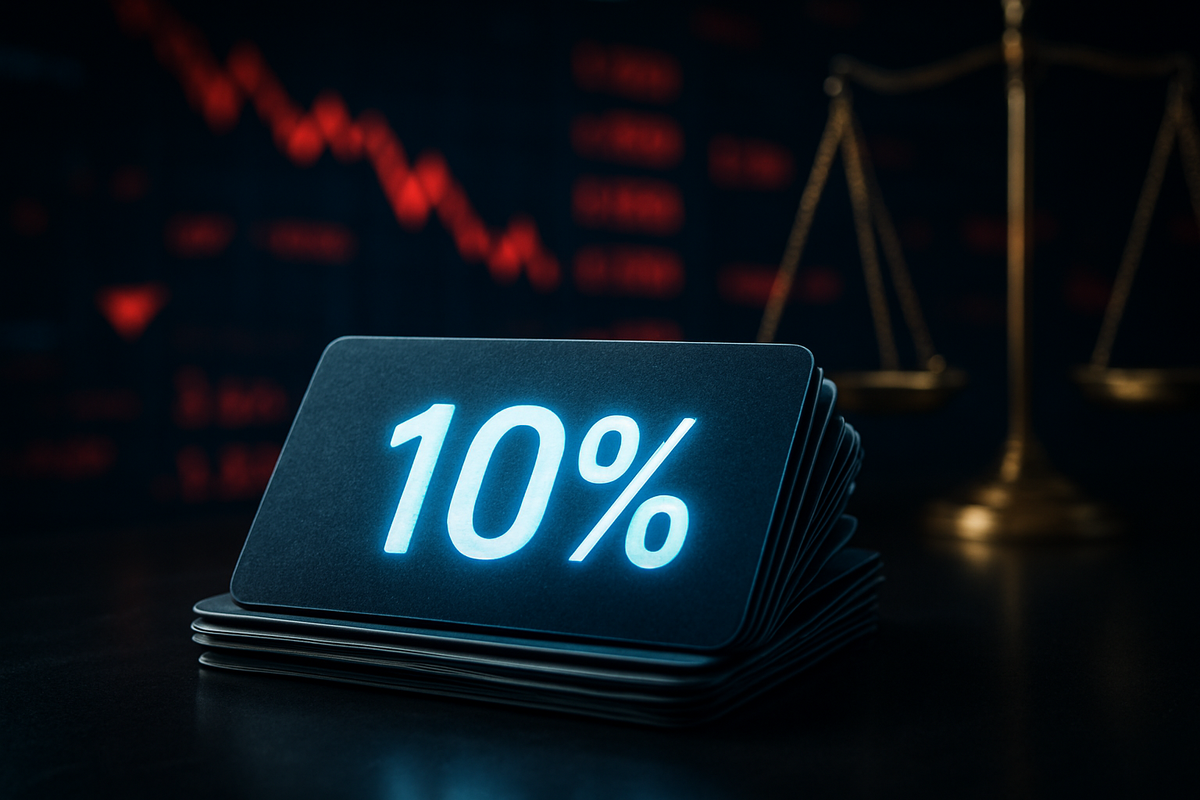
In a move that has sent shockwaves through the financial sector, President Donald Trump has reignited a contentious battle with the nation’s largest lenders by reaffirming his pledge to cap credit card interest rates at 10%. Following a series of social media declarations in early January 2026, the proposal has rapidly transitioned from a campaign talking point into a looming legislative reality. The immediate fallout was visible across trading floors, as bank stocks experienced a sharp sell-off amid fears that such a cap would dismantle the high-margin consumer credit business model and lead to a significant contraction in the availability of credit for millions of Americans.
The implications of this proposal are profound, threatening to erase billions in interest income for major financial institutions while theoretically providing a $100 billion annual windfall for debt-burdened consumers. However, the proposal has drawn a fierce backlash from both Wall Street and economic analysts, who warn of a "credit desert" where subprime borrowers are effectively locked out of the financial system. As the administration moves to codify this cap into law, the debate has evolved into a high-stakes standoff between populist economic policy and the structural realities of modern fractional-reserve banking.
The Return of the 10% Pledge
The current tension trace back to President Trump’s 2024 campaign, where he first floated the 10% interest rate cap during rallies in Georgia and New York, characterizing modern APRs—often exceeding 25%—as "extortion." While many analysts initially dismissed the rhetoric as campaign posturing, the narrative changed on January 9, 2026, when the President issued a directive via Truth Social calling for a one-year temporary cap of 10% to take effect by the first anniversary of his second inauguration. He argued that the American consumer had been "suffocated" by high rates while banks posted record profits.
The timeline accelerated rapidly last week. On January 13, the President publicly endorsed the Credit Card Competition Act, which targets "swipe fees" collected by networks like Visa (NYSE: V) and Mastercard (NYSE: MA). This was followed on January 15, 2026, by Senator Roger Marshall (R-Kan) announcing the "Consumer Affordability Protection Act." This bill aims to codify the 10% cap for institutions with over $100 billion in assets, exempting smaller community banks and credit unions to blunt rural political opposition.
The banking industry's reaction was swift and unified. Trade groups, including the American Bankers Association and the Bank Policy Institute, released joint statements arguing that the proposal would "destroy the credit safety net." Industry titans also used their Q4 earnings calls this week to voice dissent. Jamie Dimon, CEO of JPMorgan Chase (NYSE: JPM), warned that "price controls" would fundamentally alter how services are provided, potentially forcing banks to stop offering credit cards to higher-risk segments of the population altogether.
Winners and Losers: The Stock Market Verdict
The market's reaction to the proposal has been decisively negative for the financial sector, with lenders specializing in consumer credit bearing the brunt of the volatility. Capital One (NYSE: COF) has emerged as one of the most vulnerable players, with its stock sliding nearly 11% since the January 9th announcement. Analysts point to Capital One’s high concentration of subprime and near-prime borrowers; at a 10% interest cap, the risk of default in these segments would likely outweigh the potential returns, forcing a massive restructuring of their loan book.
Similarly, Discover Financial Services (NYSE: DFS)—which is currently in the middle of a high-profile merger with Capital One—saw its shares drop 8% as investors questioned the long-term viability of the combined entity's business model under such strict interest limits. Synchrony Financial (NYSE: SYF), which specializes in retail-branded cards for stores like Amazon and Lowe's, also fell 8.4%. Because Synchrony relies heavily on high-interest margins to offset the risks of its niche lending, a 10% cap is viewed as an existential threat to its current operations.
The "Big Three" consumer banks have not been spared, though their diversified revenue streams offered some insulation. Citigroup (NYSE: C) saw its shares decline by 7.1%, given its extensive domestic card presence. Bank of America (NYSE: BAC) and JPMorgan Chase (NYSE: JPM) experienced more moderate but still significant dips of 6.8% and 3.2%, respectively. For these giants, the concern is twofold: the direct loss of interest income and the potential for a secondary hit as they are forced to scale back credit lines, potentially cooling the broader consumer spending that drives their other business units.
Broader Significance and the "Horseshoe" Coalition
This event represents a significant shift in the political landscape of financial regulation. The 10% cap has created an unusual "horseshoe" alliance, where populist Republicans like Josh Hawley and President Trump find themselves in alignment with progressive stalwarts like Bernie Sanders, who has long advocated for national usury laws. This bipartisan pressure suggests that even if the current bill faces resistance from traditional fiscal conservatives in the GOP, the populist momentum behind it is stronger than at any point in the last four decades.
Historically, this proposal echoes the usury laws of the mid-20th century, before the 1978 Supreme Court ruling in Marquette National Bank of Minneapolis v. First of Omaha Service Corp effectively allowed banks to export the interest rates of their home states across the country. By seeking to re-impose a federal ceiling, the Trump administration is attempting to reverse 50 years of financial deregulation. The move also signals a broader trend toward "price transparency" and "affordability" mandates that could eventually extend to other sectors like insurance or healthcare.
The ripple effects on competitors and partners are already being calculated. If interest income is slashed, banks will almost certainly look to recoup losses through other means. This could lead to the elimination of popular cash-back and travel rewards programs, which are currently funded by the high margins on interest and swipe fees. Furthermore, fintech disruptors that rely on "buy now, pay later" (BNPL) models might see an influx of users as traditional credit cards become harder to obtain, potentially triggering a new wave of regulation in the shadow banking sector.
The Road Ahead: Strategic Pivots and Risks
In the short term, the battle will move to the Senate floor. While Senator Marshall’s bill has the President’s backing, it faces a steep climb against a lobbying blitz from the financial services industry. Investors should expect heightened volatility as legislative markups occur throughout February. If the bill appears likely to pass, banks will likely begin "pre-emptive tightening," reducing credit limits and increasing minimum credit score requirements for new applicants well before the law takes effect.
Longer-term, the industry may undergo a structural pivot. If the 10% cap becomes law, the era of "free" credit cards—those with no annual fees and generous rewards—may come to an end. Banks might transition toward a "subscription model" for credit, where users pay higher monthly or annual fees to access a card, regardless of whether they carry a balance. This shift would fundamentally change the relationship between banks and consumers, moving away from interest-based revenue toward fee-based stability.
The most significant risk remains the potential for a credit crunch. If banks stop lending to the roughly 47 million Americans with subprime credit scores, these individuals may be forced to turn to even less regulated and more predatory alternatives, such as payday lenders or unregulated online credit platforms. The administration will have to balance the political win of "lowering rates" against the economic reality of millions losing their primary tool for liquidity.
Summary and Investor Outlook
President Trump’s 10% credit card interest rate cap has moved from the campaign trail to the center of the 2026 legislative agenda, creating a high-stakes environment for the banking sector. While the proposal is designed to provide relief to debt-laden consumers, the market’s reaction underscores the fear of systemic credit contraction. The sharp declines in stocks like Capital One (NYSE: COF) and Synchrony Financial (NYSE: SYF) highlight where the industry feels most vulnerable.
Moving forward, the market will be hyper-sensitive to any signs of GOP leadership in the House or Senate softening their resistance to the bill. Investors should watch for the Q1 2026 earnings reports in April, which will likely contain the first concrete data on how banks are adjusting their lending standards in anticipation of the cap. Furthermore, any news regarding the Capital One and Discover merger will be a key indicator; if the deal is scuttled or significantly altered due to these new regulatory threats, it would signal a "new normal" for financial M&A.
Ultimately, the 10% cap proposal is a litmus test for the new era of economic populism. Whether it results in a more affordable financial landscape or a restricted "credit desert" will depend on the final language of Senator Marshall’s bill and the banking industry’s ability to adapt its centuries-old business model to a 10% ceiling.
This content is intended for informational purposes only and is not financial advice.