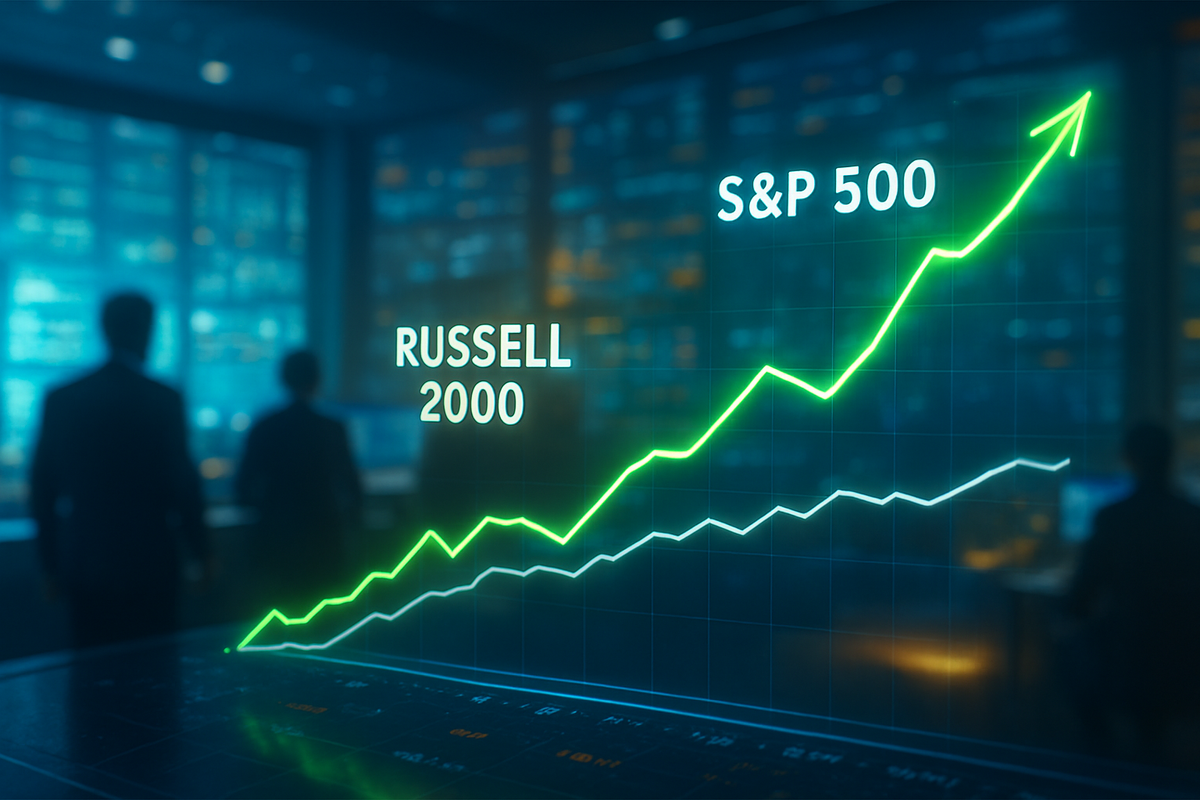
As the opening bells of 2026 ring across Wall Street, a definitive shift in market leadership is unfolding. In the first trading sessions of the new year, the Russell 2000 index, a benchmark for small-cap stocks, has notably outperformed the tech-heavy S&P 500 and the Nasdaq Composite. This early-January momentum follows a blistering finish to 2025, signaling what many analysts are calling "The Great Rotation"—a long-awaited migration of capital from overextended mega-cap technology giants into the broader, more domestically focused small-cap sector.
The immediate implications are profound for both institutional and retail investors. After years of "Magnificent 7" dominance, the market's breadth is finally expanding. This rotation is being fueled by a "Goldilocks" economic environment: a steady cycle of Federal Reserve interest rate cuts, cooling inflation that has stabilized near 2.7%, and a historic valuation gap that has left small-cap stocks trading at a significant discount compared to their large-cap counterparts. As 2026 begins, the narrative is shifting from "AI at any price" to a search for tangible earnings growth and value in the neglected corners of the market.
A New Leadership Emerges
The surge in small-cap performance did not happen in a vacuum. The timeline leading to this moment began in earnest during the final quarter of 2025. Following the Federal Reserve's decision to continue its easing cycle, bringing the federal funds rate down to a range of 3.50%–3.75% by December 2025, the Russell 2000 (IWM) staged a massive "catch-up" rally. In the last three weeks of December alone, the index jumped 12%, hitting a new all-time high of 2,590. This momentum has carried directly into the first sessions of 2026, with small caps extending their lead as investors rebalance portfolios for the new fiscal year.
Key stakeholders, including Federal Reserve Chair Jerome Powell and Treasury officials, have navigated a complex landscape marked by a brief but disruptive 43-day government shutdown in October 2025. Despite the resulting data gaps, the underlying trend of "disinflation" remained intact, providing the Fed with the cover needed to pivot toward a neutral rate policy. This policy shift has been a massive boon for small-cap companies, which typically carry higher levels of variable-rate debt compared to cash-rich mega-caps. The reduction in interest expenses is now flowing directly to the bottom line, sparking a fundamental rerating of the sector.
Market reactions have been swift. Trading desks reported record inflows into small-cap ETFs during the final days of 2025, a trend that has accelerated in the opening hours of 2026. While the S&P 500 (SPY) remains near record highs, its gains have been muted as investors take profits from the high-flying tech sector to fund their new positions in regional banks, biotech, and domestic manufacturers.
Winners and Losers of the Shift
The primary beneficiaries of this rotation are "high-quality" small-caps with strong balance sheets and domestic exposure. In the financial sector, regional banks like Huntington Bancshares (NASDAQ: HBAN) and Truist Financial (NYSE: TFC) have seen a resurgence. HBAN, in particular, entered 2026 with strong momentum following its strategic merger with Cadence Bank, positioning it to capture higher net interest income as the yield curve steepens. Similarly, smaller players like Community Trust Bancorp (NASDAQ: CTBI) and Plumas Bancorp (NASDAQ: PLBC) are being hailed as "Dividogs" for their healthy margins and consistent payouts in a lower-rate environment.
The biotechnology sector has also emerged as a clear winner. Lower capital costs have breathed new life into R&D-heavy firms like Revolution Medicines (NASDAQ: RVMD) and EyePoint Pharmaceuticals (NASDAQ: EYPT). These companies, alongside precision oncology standout Celcuity (NASDAQ: CELC), are increasingly seen as prime acquisition targets for "Big Pharma" companies looking to replenish their pipelines ahead of a major patent cliff later this year. Furthermore, the domestic manufacturing boom has benefited "picks and shovels" providers like Select Water Solutions (NYSE: WTTR) and Sterling Infrastructure (NASDAQ: STRL), which are essential to the ongoing reshoring of American industry.
Conversely, the "Magnificent 7" are facing a "Validation Phase" that has tempered their growth. Nvidia (NASDAQ: NVDA), the poster child of the 2023-2024 AI bull run, saw its share price stabilize in late 2025 as concerns over "infrastructure saturation" and thermal management issues with its Blackwell chips emerged. Microsoft (NASDAQ: MSFT) has also felt the pinch of "CapEx fatigue," with investors questioning the immediate return on its $35 billion quarterly AI investments. Apple (NASDAQ: AAPL) continues to struggle with hardware stagnation, as its new "Apple Intelligence Pro" subscription service has yet to spark the massive iPhone refresh cycle many had hoped for.
Analyzing the Wider Significance
This rotation represents a fundamental shift in the market's internal mechanics. For much of the past two years, the "AI trade" was the only game in town, leading to a historic concentration of wealth in just a handful of stocks. By early 2026, the S&P 500 was trading at a forward P/E of 22x, while the S&P SmallCap 600 sat at a much more attractive 15x. This 30% discount created a "mean reversion" pressure that finally boiled over as the Fed's easing cycle became a reality.
The trend also reflects a broader shift in industrial policy. The "all-in" U.S. approach to domestic manufacturing and reshoring is favoring companies that operate primarily within American borders. Unlike global mega-caps, which must navigate complex geopolitical tensions and currency fluctuations, small-cap firms like Gorman-Rupp (NYSE: GRC) are more direct beneficiaries of local infrastructure spending and corporate tax supports. This "America-first" investment theme is likely to be a defining characteristic of the 2026 market.
Historically, periods of extreme market concentration—such as the Nifty Fifty era of the 1970s or the Dot-com bubble of the late 1990s—have been followed by multi-year periods of small-cap outperformance. If the current trend holds, 2026 could mark the beginning of a secular bull market for the Russell 2000, driven by an "earnings inflection point" where small-cap growth finally outpaces the moderating gains of the tech giants.
The Road Ahead: 2026 and Beyond
Looking ahead, the short-term outlook remains bullish for small caps, but challenges persist. The "refinancing wall" is a critical hurdle; approximately 40% of the Russell 2000 remains unprofitable, and many of these "zombie companies" must refinance debt issued during the pandemic era at current rates, which, while falling, are still higher than 2021 levels. Investors will need to be discerning, favoring "quality" small caps over those burdened by excessive leverage, such as Spectrum Brands (NYSE: SPB), which faces additional margin pressure from potential tariff-induced cost hikes.
A significant strategic pivot may be required for institutional managers who have been "overweight" tech for years. As the "ROI Gap" in AI continues to be a topic of debate, we may see a shift toward "AI adopters"—smaller companies that are using AI to streamline operations—rather than the "AI providers" who build the infrastructure. This transition will require a more granular approach to stock picking than the broad-based index buying that dominated the early 2020s.
Furthermore, the leadership of the Federal Reserve will be a major focal point. Jerome Powell’s term is set to expire in May 2026. The transition to a successor could introduce a bout of mid-year volatility, especially if the new Chair's stance on the "neutral rate" differs from the current trajectory. Markets are currently pricing in a target of 3.00%–3.25%, and any deviation from this path could temporarily derail the small-cap rally.
Summary and Investor Outlook
The early days of 2026 have confirmed that the market's "Great Rotation" is no longer a theoretical exercise but a tangible reality. The Russell 2000's outperformance marks a healthy broadening of the market, reducing the systemic risk posed by extreme concentration in mega-cap tech. For investors, the key takeaways are clear: valuation matters, interest rate sensitivity is a primary driver of returns, and the "earnings inflection" has shifted in favor of the smaller, domestic players.
Moving forward, the market appears to be in a transition from a momentum-driven environment to one based on fundamental value and cyclical recovery. While the "Magnificent 7" will remain essential components of any diversified portfolio, they are no longer the sole engines of growth. The "catch-up trade" in small caps has significant room to run, provided the Fed stays the course on its easing cycle and the domestic economy avoids a hard landing.
In the coming months, investors should keep a close watch on the "quality" metrics of small-cap indices, the progress of M&A activity in the biotech and banking sectors, and the quarterly earnings reports of the tech giants for signs of AI monetization. The 2026 market is proving to be a year of diversification, and those who have positioned themselves for this rotation are already seeing the rewards.
This content is intended for informational purposes only and is not financial advice.