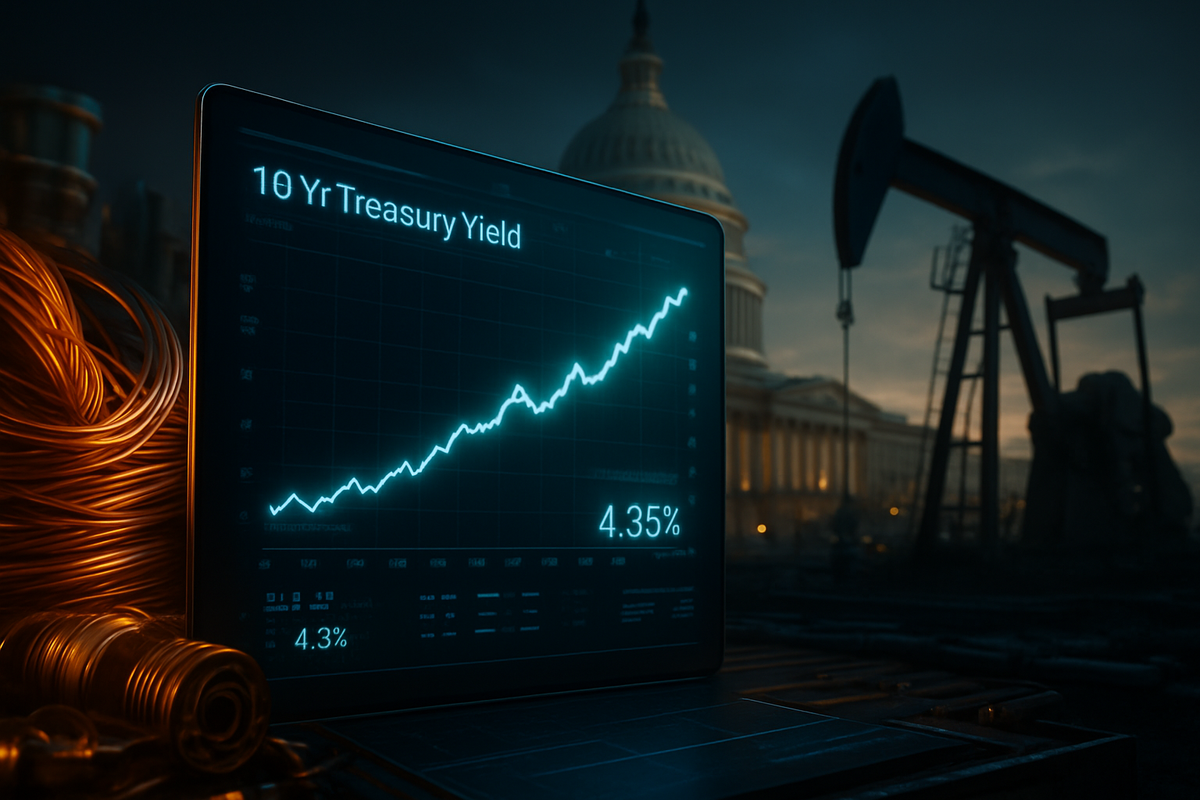
As the first trading week of 2026 unfolds, the U.S. financial landscape is being reshaped by a significant retreat in Treasury bond prices. This downward pressure on bonds, which has pushed the benchmark 10-year Treasury yield toward a multi-month high of 4.35%, signals a profound shift in investor sentiment regarding the nation’s fiscal health and economic resilience. Market participants are increasingly looking past the volatility of the previous year, focusing instead on a labor market that appears to be entering a "low-hire, low-fire" equilibrium, forcing a wholesale reassessment of how long interest rates must remain elevated to combat persistent, "sticky" inflation.
The immediate implications of this bond market rout are being felt across the globe. As yields rise, the cost of capital for corporate America is climbing, particularly for the technology giants currently in the midst of a historic capital expenditure cycle. Simultaneously, the divergence in the commodity markets—where oil prices are languishing under a supply glut while industrial metals like copper soar—is painting a complex picture of an economy that is transitioning from traditional energy consumption toward an AI-driven, electrified future.
The Yield Spike and the Powell Succession
The current turbulence in the bond market is the culmination of several converging factors that took root in late 2025. The primary catalyst was the passage of the "One Big Beautiful Bill Act" (OBBBA) in July 2025, which averted the expiration of the 2017 tax cuts but significantly expanded the long-term federal deficit. As the calendar turned to January 2, 2026, the reality of this fiscal path became unavoidable for bond vigilantes. Investors are demanding higher premiums to hold U.S. debt, fearing that the permanent extension of lower tax rates, combined with new provisions like the "No Tax on Tips" policy, will keep consumer demand—and thus inflation—higher for longer.
Compounding this fiscal anxiety is the looming leadership transition at the Federal Reserve. With Chair Jerome Powell’s term set to expire in May 2026, the White House is expected to announce a nominee later this month. The uncertainty surrounding the next Chair’s ideological leanings has introduced a "succession premium" into the yield curve. Traders are hedging against the possibility of a more dovish successor who might tolerate inflation above the 2% target, a sentiment that has kept the 10-year Treasury yield from dipping back toward the 3.5% levels seen in early 2025.
Initial market reactions have been swift. The S&P 500 saw a volatile opening to the year as growth-sensitive sectors grappled with higher discount rates. However, the labor market remains the ultimate arbiter of the Fed's next move. With the unemployment rate hovering between 4.4% and 4.6%, the "sturdy but slowing" narrative remains intact. Investors are hyper-focused on upcoming Non-Farm Payroll data, seeking clues on whether the cooling labor market will finally give the Fed enough cover to continue its gradual easing cycle or if the "sticky" 2.8% core PCE inflation will force a pause.
Winners and Losers in a High-Yield Environment
In this environment of slipping bond prices, the banking sector has emerged as a primary beneficiary. Institutional giants like JPMorgan Chase & Co. (NYSE: JPM) and Bank of America Corp. (NYSE: BAC) are seeing their net interest margins (NIM) stabilize as the yield curve steepens. Furthermore, the massive wave of corporate bond issuance—led by technology firms seeking to fund AI infrastructure—is providing a lucrative windfall for investment banks like Goldman Sachs Group Inc. (NYSE: GS), which are managing the underwriting for what is expected to be a record $900 billion in tech-sector debt in 2026.
Conversely, the "Hyperscalers" of the tech world are facing a double-edged sword. While companies like Microsoft Corp. (NASDAQ: MSFT), Amazon.com Inc. (NASDAQ: AMZN), and Meta Platforms Inc. (NASDAQ: META) continue to report robust earnings driven by AI integration, their massive capital expenditure plans—projected to exceed $600 billion collectively this year—are becoming more expensive to finance. Oracle Corp. (NASDAQ: ORCL), in particular, has become one of the largest non-financial debt issuers as it builds out regional data centers, making its stock price increasingly sensitive to fluctuations in the 10-year Treasury.
The commodity sector is witnessing a stark divergence that is creating distinct winners and losers. Oil majors like Exxon Mobil Corp. (NYSE: XOM) and Chevron Corp. (NYSE: CVX) are struggling with a "supply wave" from non-OPEC producers that has kept Brent crude prices in the $50-$60 range. However, the "electrification trade" is in full swing. Freeport-McMoRan Inc. (NYSE: FCX) and Southern Copper Corp. (NYSE: SCCO) are reaping the rewards of a copper "supercycle." Driven by the energy transition and the immense power requirements of new data centers, copper prices are trending toward $13,000 per tonne, shielding these miners from the broader malaise affecting the energy sector.
The Macro Significance and the AI Infrastructure Shift
The current bond market volatility is more than just a reaction to interest rates; it is a reflection of a fundamental shift in the American industrial base. We are seeing the "peak year" of the Infrastructure Investment and Jobs Act (IIJA) spending, with over $56 billion allocated for highway and grid modernization in 2026 alone. This federal tailwind is supporting industrial demand even as high rates cool the housing market. The ripple effect is being felt in the automotive sector, where California’s mandate requiring 35% of new 2026 model year cars to be zero-emission is forcing a massive pivot. Tesla Inc. (NASDAQ: TSLA) remains the frontrunner, but legacy automakers like General Motors Co. (NYSE: GM) and Ford Motor Co. (NYSE: F) are now facing the reality of a bifurcated market where regulatory compliance costs are rising just as financing becomes more expensive.
Historically, a rise in yields of this magnitude often preceded a recession, but the 2026 landscape is unique. The "AI-driven productivity" narrative is providing a floor for the economy that didn't exist in previous cycles. Unlike the dot-com bubble, the current tech spending is backed by significant cash flows and a tangible build-out of physical assets—data centers, power plants, and semiconductor fabs. This "tangible ROI" phase is what investors are currently trying to price, and the bond market is the primary venue for this valuation exercise.
Furthermore, the geopolitical backdrop of 2026 adds a layer of complexity. As the U.S. holds the G20 Presidency, the Miami summit later this year is expected to focus on global debt stability. Any coordination on international tax standards or AI regulation could have immediate impacts on the multi-national corporations that dominate the U.S. indices. The bond market is currently acting as a "canary in the coal mine" for these upcoming policy shifts, pricing in the risk of a more fragmented global trade environment following the 2025 tariff implementations.
What Comes Next: The Path to the Midterms
In the short term, the market will be dominated by "Fed-watching" as the nomination for Powell's successor takes center stage. A "hawkish" nominee could send yields toward 4.5%, potentially triggering a deeper correction in growth stocks. Conversely, a "dovish" pick might soothe the bond market but raise fears of a late-2026 inflation spike. Strategically, companies are already pivoting; many are moving away from "just-in-time" inventory toward "just-in-case" to mitigate the impact of lingering trade tensions and the scheduled phase-out of 100% bonus depreciation, which drops to 20% this year.
Looking toward the latter half of 2026, the U.S. midterm elections will likely introduce a period of legislative gridlock. Historically, markets perform well under a divided government, but the fiscal cliff resolved in 2025 has left the Treasury with a massive interest-expense burden. The "market opportunity" in 2026 may lie in the "Old Economy" sectors that have successfully integrated AI—industrials and utilities that can manage the increased power demand of the new data centers.
Summary and Investor Outlook
The start of 2026 marks a turning point where the "higher for longer" interest rate environment is no longer a temporary hurdle but a permanent feature of the fiscal landscape. The bond market's reassessment of U.S. economic strength reflects a nation that is growing at a moderate 2% pace but carrying a significantly higher debt load. The key takeaway for investors is the transition from speculative growth to "infrastructure-backed" growth.
Moving forward, the market will be defined by the divergence between sectors: the resilience of copper and AI-linked tech versus the headwinds facing traditional energy and rate-sensitive consumers. Investors should keep a close eye on the 10-year Treasury yield's interaction with the 4.35% level and the upcoming January jobs report. These will be the primary indicators of whether the U.S. economy can sustain its "sturdy" momentum or if the weight of rising yields will finally force a more significant slowdown.
This content is intended for informational purposes only and is not financial advice.