As the global semiconductor industry enters a critical expansionary phase, all eyes are turning toward Veldhoven. On January 28, 2026, ASML Holding N.V. (NASDAQ: ASML) is set to release its fourth-quarter 2025 earnings and, more importantly, its official guidance for 2026 and 2027. This upcoming report is being hailed as the ultimate bellwether for the "AI 2.0" era, providing the definitive hardware roadmap for a market that is rapidly approaching a $1 trillion total valuation.
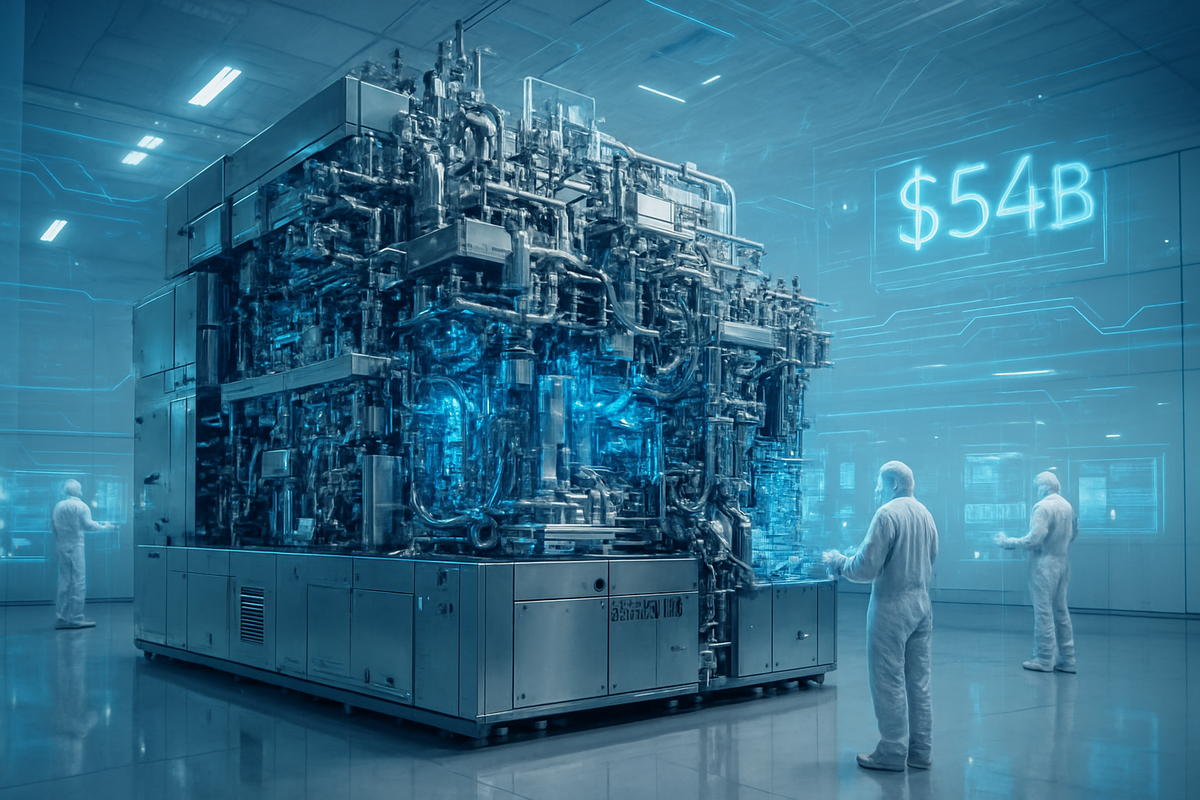
The anticipation has reached a fever pitch following the blockbuster announcement from Taiwan Semiconductor Manufacturing Company (NYSE: TSM), which recently unveiled a staggering $54 billion capital expenditure (capex) plan for 2026. This 32% year-over-year increase from the world’s largest foundry serves as a massive vote of confidence in ASML’s lithography technology. For investors, the question is no longer whether the semiconductor recovery is happening, but how high the ceiling goes as ASML transitions from its 2025 "transition year" into what analysts predict will be a record-breaking 2027.
A High-Stakes Earnings Call: Numbers and Narratives
The January 28 report is expected to show a robust finish to 2025, with consensus revenue estimates hovering around $11.1 billion. However, the backward-looking figures are secondary to the forward-looking order book. Following the recent capex surges from the foundry and memory sectors, analysts at major firms like Morgan Stanley and Bernstein are anticipating Q4 2025 order intakes to reach historical peaks of €8 billion to €9 billion. This influx is driven by the urgent need for Extreme Ultraviolet (EUV) lithography machines required to manufacture the next generation of 2nm and 1.4nm chips.
The timeline leading to this moment has been defined by a pivot from general-purpose computing to specialized AI infrastructure. Throughout 2025, ASML successfully navigated a "bridge year," clearing older inventory and readying its supply chain for the commercialization of High-Numerical Aperture (High-NA) EUV tools. The market reaction in the weeks leading up to this earnings call has been overwhelmingly bullish, with ASML’s stock price trending toward the €1,500 mark as institutional investors price in a "super-cycle" fueled by the convergence of AI, 5G-Advanced, and high-performance computing.
The stakes are particularly high for ASML's management, who must now provide clarity on the ramp-up of the TWINSCAN EXE:5200B—their flagship High-NA machine. While Intel Corporation (NASDAQ: INTC) has been the first to adopt this technology, the broader industry is watching to see when Samsung Electronics (KRX: 005930) and TSMC will integrate these €350 million units into their high-volume manufacturing lines. ASML’s ability to hit its 2026 revenue target of €36.5 billion to €38 billion will depend largely on the yield and delivery schedule of these sophisticated systems.
The Winners and Losers of the 2nm Arms Race
The primary winner in the current landscape is undoubtedly ASML, which maintains a monopoly on the EUV technology required for sub-7nm chips. However, the ripple effects of TSMC's $54 billion spending spree create a complex web of beneficiaries. Taiwan Semiconductor Manufacturing Company (NYSE: TSM) itself is positioning for dominance, with its 2nm (N2) capacity for 2026 reportedly already fully booked by titans like NVIDIA Corporation (NASDAQ: NVDA) and Apple Inc. (NASDAQ: AAPL). TSMC’s massive investment is a defensive moat, ensuring that any rival—be it Intel or Samsung—will have to spend significantly more to catch up in terms of both volume and yield.
On the other side of the ledger, Intel Corporation (NASDAQ: INTC) faces a "make-or-break" period. Having been the first to receive and install High-NA EUV tools, Intel is betting its entire "IDM 2.0" strategy on leapfrogging TSMC at the 14A node. While Intel is a "winner" in terms of technological early adoption, the financial strain of these investments remains a concern for shareholders. Conversely, Samsung Electronics (KRX: 005930) is emerging as an aggressive challenger, taking delivery of High-NA tools in early 2026 to bolster its 2nm Exynos and AI chip production, hoping to regain the market share it lost during the 3nm era.
In the chip design space, NVIDIA Corporation (NASDAQ: NVDA) and Advanced Micro Devices (NASDAQ: AMD) remain the ultimate beneficiaries of ASML’s innovation. As ASML enables denser transistor counts, these designers can push the boundaries of Large Language Models (LLMs) and Edge AI. However, companies specializing in "legacy nodes" or older automotive chips may find themselves sidelined as the industry's capital and attention are sucked into the high-end AI vacuum, potentially leading to a bifurcated market where only the most advanced players thrive.
The Broader Significance: Beyond the Silicon
The anticipation for ASML’s guidance reflects a structural transformation in the global economy. We are moving past the traditional "boom and bust" cycles of the semiconductor industry into a period of "structural demand." The $54 billion TSMC capex is not just a number; it is a signal that AI server spending, projected to hit $312 billion in 2026, is becoming a foundational utility. This shift is also driving a hardware replacement cycle in consumer electronics, as "Edge AI"—AI-capable PCs and smartphones—requires more advanced logic and High-Bandwidth Memory (HBM) that only ASML's latest machines can help produce.
Furthermore, the geopolitical implications of ASML’s 2026 roadmap cannot be overstated. With TSMC earmarking a significant portion of its budget for its Arizona facilities and Intel building out its "Silicon Heartland" in Ohio, the lithography tools shipped by ASML are the physical manifestation of "reshoring" efforts. This event fits into a broader trend of sovereign AI, where nations are treating semiconductor capacity as a matter of national security. ASML, as the sole provider of the necessary equipment, finds itself at the center of a delicate regulatory dance between the U.S., Europe, and Asia.
Historically, ASML’s earnings have served as a "canary in the coal mine." In 2024, their cautious outlook signaled a period of inventory digestion. Now, in January 2026, a bullish guidance would confirm that the industry has not only digested that inventory but is starving for more capacity. The shift from "printing transistors" to "packaging systems"—evidenced by TSMC’s $10 billion investment in CoWoS and advanced packaging—shows that ASML is now part of a larger, integrated ecosystem where the bottleneck is no longer just the chip itself, but how many chips can be stacked and cooled together.
What Comes Next: The Road to 2027
Looking ahead, the short-term focus will be on the execution of the 2026 ramp-up. If ASML can successfully deliver its backlog of EUV systems without supply chain hiccups, the company is on track for what Morgan Stanley calls a "peak profit year" in 2027. Investors should watch for any strategic pivots regarding the adoption of High-NA. While Intel is all-in, TSMC has hinted at extending Low-NA EUV through multi-patterning for its 1.4nm (A14) node. If TSMC eventually commits to a massive High-NA order in 2026, it would trigger another massive re-rating of ASML’s stock.
The long-term challenge for ASML and its partners will be managing the sheer cost of innovation. With machines costing over $350 million, the pool of companies capable of buying them is shrinking. This could lead to a future where the industry is dominated by an even smaller "Big Three" (TSMC, Intel, Samsung), supported by a handful of "Hyper-scalers" like Microsoft and Amazon who design their own silicon. ASML will likely need to adapt its business model to provide more software-driven lithography optimizations and service-based revenue to help these few customers maximize their massive capital investments.
Final Assessment: A Defining Moment for Markets
As we approach the January 28 earnings call, the narrative is clear: ASML is the linchpin of the digital future. The company's guidance will either validate the massive $54 billion capex plans of its customers or suggest that the industry is getting ahead of itself. However, given the "insatiable" demand for AI accelerators and the sold-out status of 2026 HBM capacity, the odds favor a highly optimistic outlook. The semiconductor industry is no longer just a sector of the stock market; it is the engine of global economic growth.
For investors, the key takeaways are to watch the order intake and the gross margin projections for late 2026. A gross margin target approaching 56% would indicate that ASML has successfully navigated the high costs of High-NA R&D and is beginning to reap the rewards of its monopoly. As the calendar flips toward February, the results from Veldhoven will likely set the tone for the entire tech sector for the remainder of the year. The "Trillion Dollar Era" of semiconductors is no longer a distant dream—it is being printed, one layer at a time, by ASML’s machines.
This content is intended for informational purposes only and is not financial advice.