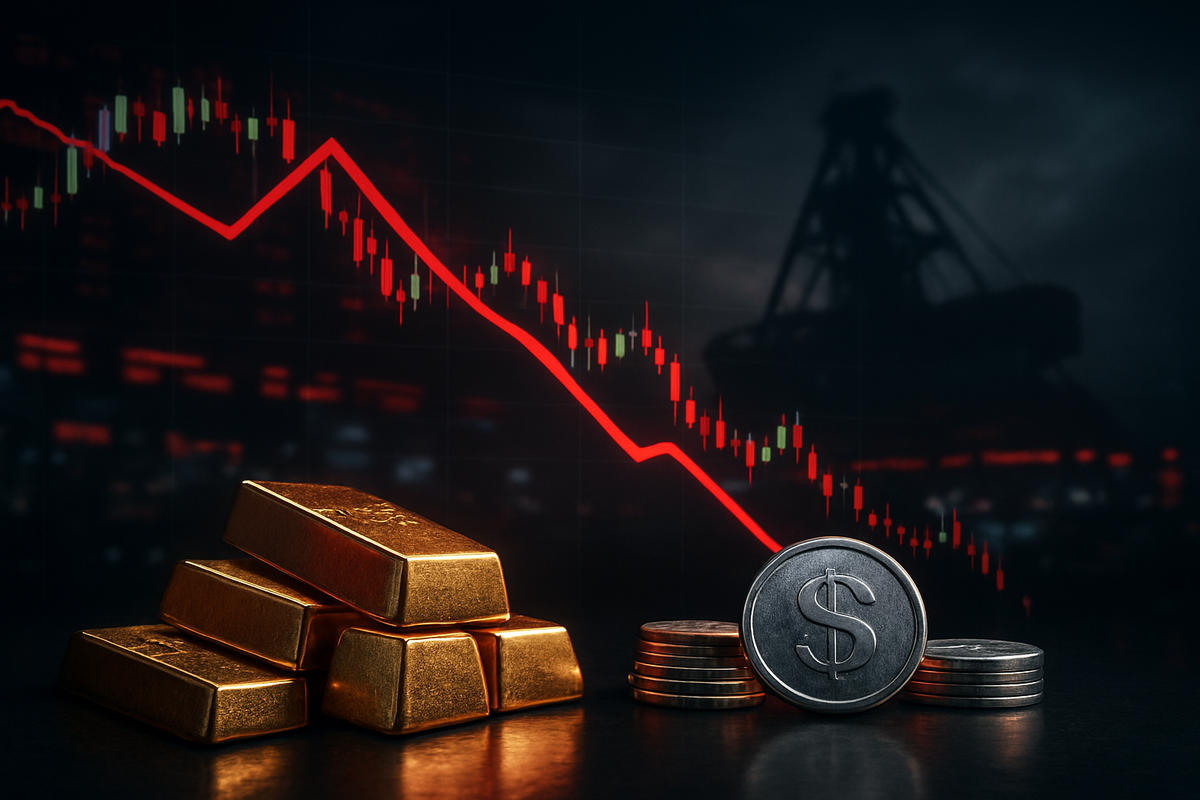
The global precious metals market suffered its most violent "flash crash" in recent history today, January 30, 2026, as a "perfect storm" of hawkish U.S. monetary policy signals and massive technical liquidations erased months of gains in a matter of hours. Gold prices, which had reached a staggering peak of nearly $5,600 per ounce earlier this month, plummeted more than 8% to settle near $5,114, while silver—the recent darling of retail "meme" traders—crashed over 16% to the $100 psychological threshold.
This dramatic reversal has sent shockwaves through the mining sector, with industry titans like Newmont Corporation (NYSE: NEM) and Freeport-McMoRan Inc. (NYSE: FCX) seeing billions in market capitalization vanish in a single trading session. For an industry that spent 2025 riding a wave of record-breaking prices and rampant inflation fears, today’s volatility marks a sobering reality check and a potential shift in the global macroeconomic narrative.
The End of the Parabolic Run: A Timeline of the Collapse
The sell-off did not occur in a vacuum; it followed a historic, nearly vertical rally that characterized late 2025. Driven by a combination of a weakening U.S. Dollar and aggressive buying from central banks in China, India, and Turkey, gold and silver had entered 2026 in "overbought" territory. However, the definitive catalyst for today's crash arrived with the morning's news from Washington: the official nomination of Kevin Warsh to succeed Jerome Powell as Chair of the Federal Reserve.
Warsh, a well-known hawk with a history of skepticism regarding quantitative easing, immediately signaled that his tenure would prioritize inflation containment and potentially "higher-for-longer" interest rates. The market reaction was instantaneous. The U.S. Dollar Index (DXY) roared back from a four-year low, and Treasury yields spiked. Because gold and silver are non-yielding assets, the sudden rise in the opportunity cost of holding bullion triggered a massive exit by institutional funds. By mid-morning, a wave of automated stop-loss orders was triggered as gold fell through its $5,400 support level, turning a standard correction into a full-scale rout.
Key stakeholders, including institutional hedge funds that had been leveraged long on the "debasement trade," found themselves caught in a liquidity trap. Retail investors, who had driven silver to a peak of $120/oz just days ago, were particularly hard hit as silver dipped below $100 in a move that analysts described as "violent and indiscriminate."
Mining Giants Reeling: Impact on Newmont and Freeport-McMoRan
The equity markets were not spared, as mining stocks—often treated as leveraged plays on the underlying metal prices—bore the brunt of the volatility. Newmont Corporation (NYSE: NEM), the world’s largest gold miner, saw its shares tumble approximately 7.6% today. The stock had hit a record high of $134 just 48 hours ago, buoyed by the successful Q4 2025 launch of commercial production at its Ahafo North mine in Ghana. Despite Newmont’s exceptionally strong balance sheet and record free cash flow, the sheer velocity of the gold price drop forced a massive de-risking among shareholders.
Freeport-McMoRan Inc. (NYSE: FCX) faced a similarly challenging day, with its shares retreating roughly 6.2% to close near $61. Freeport’s journey to this point has been a rollercoaster; the company spent much of late 2025 recovering from a devastating September 2025 mudslide at its flagship Grasberg mine in Indonesia, which had temporarily crippled production. While the stock had gained over 70% since that incident due to soaring copper and gold demand, today’s crash was exacerbated by management’s recently issued 2026 guidance. The company had already warned of a "phased recovery" at Grasberg, and with gold prices now in retreat, investors are questioning whether the company can maintain its aggressive dividend payout schedule.
While these major producers are better capitalized than they were in previous cycles, the "losers" today include junior miners and exploration companies that lack the cash reserves to weather a prolonged period of lower prices. Conversely, the "winners" may ironically be the large-scale industrial consumers of silver and copper, who may now see a reprieve from the skyrocketing input costs that plagued their margins throughout 2025.
A Shift in the Macroeconomic Tide
Today’s event is more than just a price correction; it signifies a potential end to the "safe-haven mania" that dominated the industry for the past 18 months. Throughout late 2024 and 2025, gold and silver were viewed as the only credible hedges against a perceived collapse of the dollar and geopolitical instability. However, the "Warsh Pivot" suggests that the U.S. may be entering a new era of dollar-strength and monetary discipline, a trend that historically acts as a significant headwind for precious metals.
This event mirrors the historical "Taper Tantrum" of 2013, where a sudden shift in Fed policy expectations led to a multi-year bear market in commodities. However, unlike 2013, the current market is characterized by significant retail participation and "meme-stock" style volatility in silver. The ripple effects are likely to be felt across the globe, particularly in emerging markets that have been stocking up on gold reserves to diversify away from the dollar. If the dollar’s rebound sustains, these central banks may be forced to pause their buying programs, removing the "floor" that has kept prices elevated.
Looking Ahead: Tactical Retreat or Long-Term Bear Market?
In the short term, analysts expect a period of "base-building" and extreme volatility. The technical damage done today is significant, and gold will likely need to consolidate above the $5,000 mark to convince investors that the bull market is not over. For mining companies like Newmont (NYSE: NEM) and Freeport-McMoRan (NYSE: FCX), the focus will now shift to operational efficiency. With the easy gains from rising spot prices now behind them, these companies must prove they can remain profitable if gold stabilizes in the $4,800–$5,000 range.
The long-term outlook remains tied to the Federal Reserve’s actual actions once Warsh takes the helm. If the promised "hawkishness" fails to materialize or if geopolitical tensions flare up again, gold could quickly reclaim its lost ground. However, the most likely scenario for the remainder of 2026 is a "strategic pivot" by investors toward value and yield, favoring companies with low debt and high dividend yields over speculative exploration plays.
Summary and Investor Outlook
The January 30 "flash crash" serves as a stark reminder that even the most powerful rallies can be undone by a shift in policy and sentiment. The key takeaways from today's market carnage are:
- Fed Leadership Matters: The nomination of Kevin Warsh has fundamentally altered the "dollar debasement" narrative.
- Silver Volatility: The 16% drop in silver highlights the dangers of retail-driven parabolic moves.
- Mining Resilience: While NEM and FCX fell sharply, their strong 2025 earnings provide a buffer that was absent in previous decades.
Moving forward, investors should watch the U.S. Dollar Index and upcoming Fed minutes for confirmation of this hawkish trend. While the long-term story of resource scarcity remains intact, the era of "easy money" in the metals market has, at least for now, come to an abrupt and painful end.
This content is intended for informational purposes only and is not financial advice.