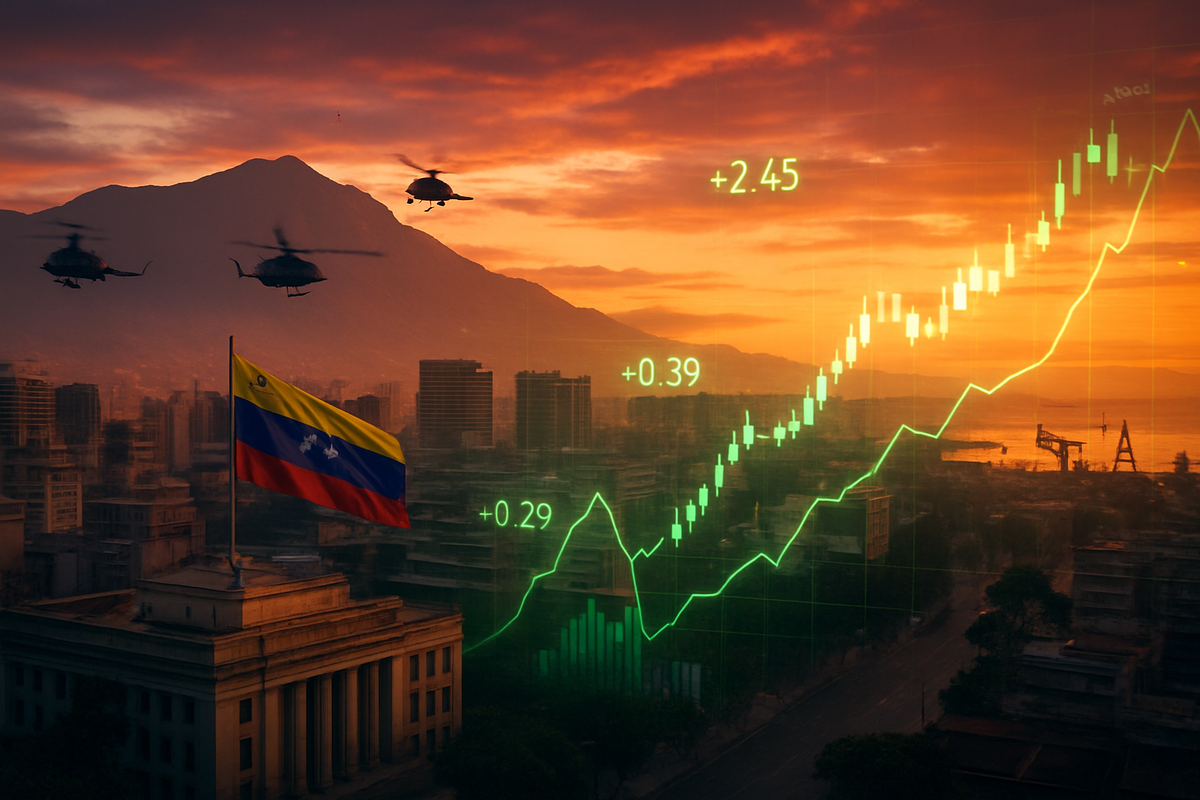
The geopolitical landscape of the Western Hemisphere shifted overnight as United States special operations forces successfully captured Venezuelan President Nicolás Maduro in a daring raid on his residence in Caracas. Code-named "Operation Absolute Resolve," the mission culminated in the early hours of January 3, 2026, marking the end of Maduro’s decade-long grip on power and his subsequent arraignment in a Manhattan federal court on narco-terrorism charges. The event has sent shockwaves through global financial markets, triggering an immediate "risk-on" rally that saw the Dow Jones Industrial Average surge past the 49,000 mark for the first time in history.
The immediate implications of the capture are profound, as investors bet on a swift end to years of crushing sanctions and the potential for a massive reconstruction effort in Venezuela’s decaying oil sector. While Brent Crude and West Texas Intermediate (WTI) saw initial psychological spikes of roughly 1.5%, the real story lies in the equity markets, where U.S. energy majors and oilfield service providers are bracing for what analysts are calling the "Orinoco Gold Rush." The sudden removal of the Maduro regime has essentially vaporized a decade of geopolitical risk premium, replacing it with a speculative fervor for South American resource revitalization.
The Fall of the Miraflores Strongman
The capture of Nicolás Maduro was the climax of a meticulously planned military and diplomatic offensive that accelerated throughout 2025. Following the return of the Trump administration to the White House in January 2025, the U.S. adopted a "maximum pressure 2.0" strategy, which included designating the Maduro-linked Cartel de los Soles as a foreign terrorist organization and doubling the bounty on Maduro’s head to $50 million. By late 2025, the U.S. had established a naval blockade in the Caribbean, effectively choking off the regime’s remaining illicit oil revenues and setting the stage for the January 3rd intervention.
At approximately 2:00 AM local time on January 3, U.S. Army Delta Force operators, supported by the 160th Special Operations Aviation Regiment, executed a precision strike on the Fort Tiuna military complex. After neutralizing air defenses, ground teams secured Maduro and his wife, Cilia Flores, within thirty minutes. The pair was swiftly extracted to the USS Iwo Jima before being transported to New York. By January 5, 2026, Maduro was appearing before a federal judge, pleading not guilty to charges of narco-terrorism and cocaine importation, while maintaining his status as a "political prisoner."
The market reaction was instantaneous. On Monday, January 5, the first full trading day following the capture, Brent Crude rose to $61.76 per barrel as traders weighed the potential for short-term supply disruptions against the long-term prospect of a massive Venezuelan production surge. Despite the initial price jump, the broader market remains in a state of oversupply, which has kept the oil price spike relatively contained compared to previous Middle Eastern conflicts. However, the volatility in the energy sector has reached levels not seen since the early days of the Ukraine-Russia conflict, as the world awaits the formation of a transitional government in Caracas.
Energy Giants and Service Providers Poised for a Windfall
The primary beneficiary of the regime change is undoubtedly Chevron (NYSE: CVX). As the only U.S. oil major that maintained a continuous, albeit restricted, presence in Venezuela through special licenses, Chevron is uniquely positioned to ramp up production. Shares of CVX surged 5.1% to $163.85 following the news, as the company is expected to be the "lead architect" of the country’s immediate production recovery. Analysts believe Chevron could double its current Venezuelan output of 220,000 barrels per day (bpd) within eighteen months if sanctions are fully lifted and infrastructure is secured.
ExxonMobil (NYSE: XOM) and ConocoPhillips (NYSE: COP) also saw significant gains, rising 2.2% and 2.6% respectively. For these companies, the fall of Maduro represents more than just a new drilling opportunity; it is a chance to settle long-standing grievances. ExxonMobil is reportedly in high-level discussions with U.S. officials to return to the country as a condition for recovering $1.6 billion in compensation for assets nationalized in 2007. Similarly, ConocoPhillips is looking to finally collect on arbitration awards exceeding $12 billion related to the expropriation of its Hamaca and Petrozuata projects.
The real "winners" in the short term, however, may be the oilfield service companies. Halliburton (NYSE: HAL) and SLB (NYSE: SLB) saw their stock prices jump 7.8% and 10% respectively on Monday. Venezuela’s oil infrastructure is currently in a state of extreme disrepair, with many wells "shut-in" or damaged by years of neglect. The anticipated "Orinoco Reconstruction" contracts—required to fix pipelines, refineries, and pumping stations—are expected to be worth tens of billions of dollars over the next decade. These service providers are viewed as the essential "picks and shovels" for any successful revitalization of the Venezuelan energy sector.
A New Chapter in Global Geopolitics and Energy Policy
The removal of Maduro fits into a broader global trend of "near-shoring" energy security and reducing Western dependence on adversarial regimes. For years, Venezuela’s absence from the mainstream global market forced the U.S. and Europe to rely more heavily on OPEC+ and Russian supplies. A stabilized, pro-Western Venezuela could eventually return to its 1990s peak of 3 million bpd, potentially acting as a massive counterbalance to OPEC's pricing power. This event signals a major victory for the U.S. "energy dominance" doctrine, shifting the center of gravity in the global oil market back toward the Western Hemisphere.
Historically, this event draws comparisons to the 1989 capture of Manuel Noriega in Panama or the fall of Saddam Hussein in 2003. However, the economic stakes in Venezuela are significantly higher due to its status as the holder of the world’s largest proven oil reserves—estimated at over 300 billion barrels. The "geopolitical risk premium," which typically adds $5 to $10 to the price of a barrel of oil during times of instability, is currently being recalibrated. While the capture initially caused a price spike, the long-term expectation of a "wall of Venezuelan crude" hitting the market is actually exerting downward pressure on long-dated oil futures.
The policy implications are equally vast. The U.S. Treasury Department is expected to issue a series of general licenses in the coming weeks, effectively dismantling the sanctions regime that has defined U.S.-Venezuela relations for years. This will likely be accompanied by a massive humanitarian and economic aid package, potentially involving the IMF and World Bank. The goal will be to create a stable environment for foreign direct investment, though the legal complexities of resolving decades of expropriation claims and defaulted sovereign debt will remain a significant hurdle for years to come.
The Road to Reconstruction: Scenarios and Challenges
In the short term, the primary challenge for the market and the transitional government will be security. While Maduro is in custody, remnants of the "Colectivos" (pro-regime militias) and the Tren de Aragua gang could pose a threat to oil infrastructure and foreign personnel. Investors should watch for the deployment of private security firms and potentially a continued U.S. military presence to safeguard key assets like the Jose Crude Terminal. A "successful" transition hinges on the ability of the new administration to provide a transparent legal framework for new contracts, which will be the litmus test for long-term capital commitment from the likes of Exxon and ConocoPhillips.
Over the long term, the market will focus on the speed of production recovery. While the potential is massive, the cost is equally daunting. Experts at JPMorgan estimate that restoring Venezuela to its former glory will require upwards of $100 billion in investment over the next ten years. This creates a massive opportunity for the global banking sector and infrastructure firms, but it also carries the risk of a "stranded asset" scenario if the global transition to renewable energy accelerates faster than Venezuela can pump its oil. The strategic pivot for companies like Chevron will be balancing this massive capital expenditure against their long-term carbon reduction goals.
Market Outlook and Final Thoughts
The capture of Nicolás Maduro is a watershed moment for the 21st-century energy market. It represents the potential re-integration of a "lost giant" into the global economy and a significant shift in the geopolitical balance of power. For investors, the takeaway is clear: the energy sector is entering a period of high-reward volatility. The immediate surge in the Dow and the specific gains in CVX, HAL, and SLB reflect a market that is hungry for the "unlocking" of Venezuelan resources, even as it remains cautious about the logistical and security hurdles ahead.
Moving forward, the market will be hyper-sensitive to any signs of civil unrest in Caracas or delays in the formation of a transitional council. Investors should closely monitor the "Orinoco Reconstruction" progress and the legal proceedings in New York, as any setbacks could quickly re-introduce the geopolitical risk premium that the market has so recently shed. The next six months will be critical in determining whether Venezuela becomes the next great emerging market success story or remains a cautionary tale of resource wealth and political instability.
This content is intended for informational purposes only and is not financial advice.