LAS VEGAS — January 7, 2026 — Advanced Micro Devices (NASDAQ: AMD) kicked off the 2026 Consumer Electronics Show (CES) with a relentless offensive in the artificial intelligence hardware war, unveiling a suite of "yotta-scale" data center GPUs and next-generation AI PC processors. Despite a keynote that promised a 1,000x performance leap by 2027 and a surprise endorsement from OpenAI, the market responded with a cautious "sell-the-news" posture. AMD shares experienced a 2% slip in after-hours trading on Tuesday, as investors weighed the company’s ambitious roadmap against the looming shadow of its February 3rd earnings report.
The dip highlights a growing tension on Wall Street: while AMD’s technological execution has reached a fever pitch, the valuation now demands flawless financial delivery. As the company transitions to an annual AI release cycle to match its rivals, the upcoming February earnings call has been transformed from a routine update into a high-stakes referendum on AMD's ability to turn silicon promises into sustainable market share gains.
The "AI Everywhere" Keynote: From Data Centers to Desktops
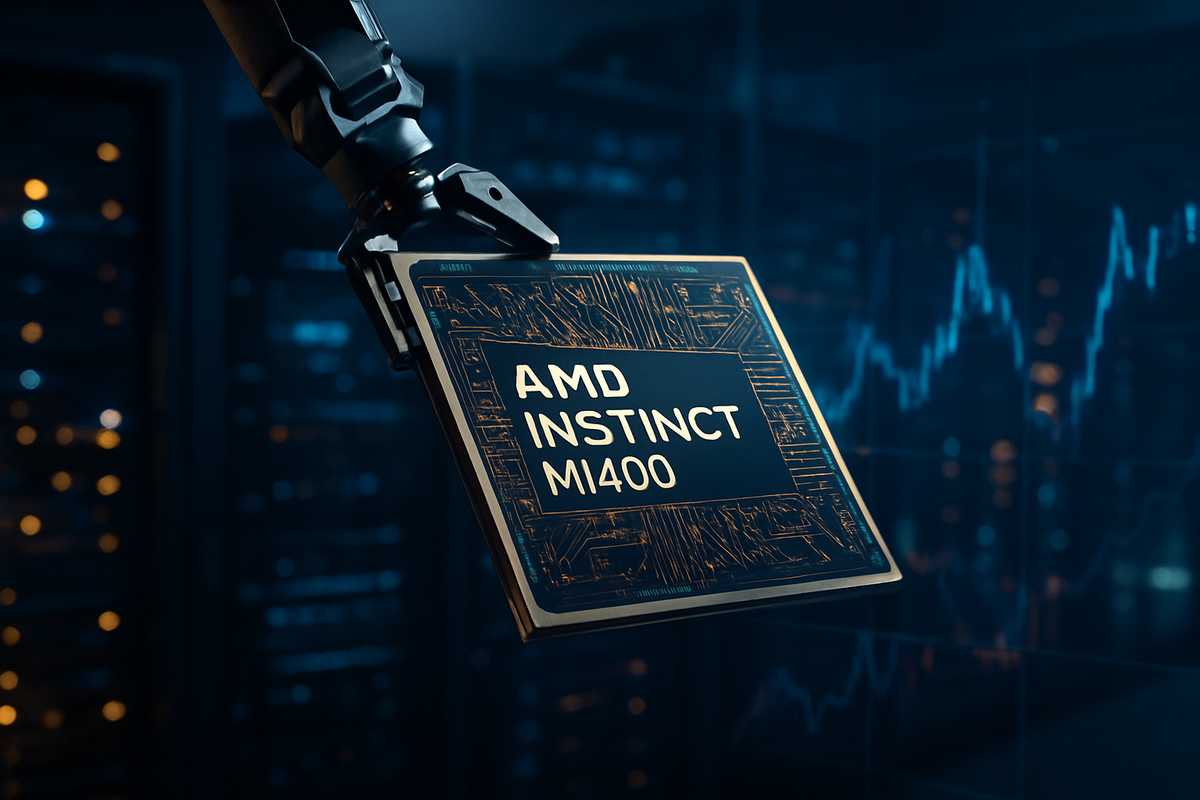
The centerpiece of AMD’s CES presentation was the official unveiling of the Instinct MI400 series, built on the cutting-edge CDNA 5 architecture and manufactured using TSMC’s (NYSE: TSM) 2nm process. CEO Lisa Su introduced the MI455X, a flagship GPU designed for the world’s most demanding large language models. In a strategic move to capture the enterprise market, Su also revealed the MI440X, a chip optimized for on-premises AI training, signaling that AMD is no longer content with just chasing hyperscale cloud providers.
The timeline leading to this moment has been one of rapid acceleration. Throughout 2025, AMD successfully ramped its MI300 and MI325X series, but the CES 2026 announcements mark a pivot toward "rack-scale" systems. The new Helios platform, a massive infrastructure blueprint integrating 72 MI455X GPUs and the upcoming EPYC "Venice" CPUs, is AMD’s direct answer to the integrated systems that have kept competitors in the lead. The highlight of the event came when OpenAI President Greg Brockman joined Su on stage, confirming that OpenAI would be among the first to deploy MI400-based clusters in 2026—a massive validation for AMD’s software ecosystem, ROCm.
Market reaction was swift but complicated. While tech enthusiasts cheered the raw specs of the Ryzen AI 400 "Gorgon Point" mobile chips, which boast a class-leading 60 TOPS (Trillions of Operations Per Second) for AI PCs, the stock faced immediate pressure. The 2% after-hours slip followed a 3% intraday decline on January 6th, as traders locked in profits from a 2025 rally that saw the stock nearly double. The announcement of the "Vera Rubin" platform by NVIDIA (NASDAQ: NVDA) earlier in the week also reminded investors that the lead in AI remains a moving target.
Winners and Losers in the 2nm Era
AMD (NASDAQ: AMD) stands as the primary protagonist, but the ripples of its CES blitz extend across the semiconductor landscape. The company is successfully positioning itself as the "open" alternative to proprietary ecosystems, a strategy that is winning over heavyweights like Meta Platforms (NASDAQ: META) and Alphabet (NASDAQ: GOOGL), who are desperate to diversify their hardware supply chains. However, the pressure to maintain this annual cadence puts immense strain on AMD’s R&D margins, a factor that will be closely scrutinized on February 3rd.
NVIDIA (NASDAQ: NVDA) remains the incumbent to beat. While AMD’s MI400 series is impressive, NVIDIA’s Vera Rubin architecture, which integrates custom ARM-based CPUs with HBM4 memory, suggests the "green team" is still a step ahead in system-level efficiency. Meanwhile, Intel (NASDAQ: INTC) is attempting a comeback with its "Panther Lake" chips and its 18A manufacturing process. While Intel showed progress at CES, it remains in a defensive crouch in the data center, focusing more on reclaiming the "AI PC" crown for consumer laptops.
On the winning side of this hardware arms race are the hyperscalers and PC manufacturers. Companies like Dell Technologies (NYSE: DELL) and HP Inc. (NYSE: HPQ) are poised to benefit from a super-cycle of AI upgrade driven by AMD’s Ryzen AI 400 series. These manufacturers now have a legitimate multi-vendor environment, allowing them to negotiate better pricing and offer a wider range of AI-capable devices to enterprise and consumer markets.
The Shift to Annual Cycles and System-Level Warfare
The significance of AMD’s CES announcements lies in the fundamental shift of the industry's heartbeat. The semiconductor world has moved from a two-year "tick-tock" cycle to an aggressive annual release schedule. This pace, dictated by the insatiable demand for generative AI, has effectively raised the "table stakes" for entry into the high-end GPU market. AMD’s commitment to releasing a new AI architecture every year mirrors NVIDIA’s strategy, signaling that the era of long-tail hardware cycles is over.
Furthermore, the battle has moved from individual chips to "rack-scale" computing. AMD’s Helios platform and NVIDIA’s NVL72 systems represent a future where the "computer" is no longer a single server, but an entire rack of interconnected GPUs, CPUs, and high-speed networking. This trend favors companies with broad portfolios and deep engineering partnerships, potentially squeezing out smaller AI chip startups that lack the scale to provide full-stack infrastructure.
Historically, this resembles the "megahertz wars" of the late 1990s, but with significantly higher stakes. The regulatory environment also looms large; as AI hardware becomes a matter of national security, AMD’s reliance on TSMC’s advanced nodes in Taiwan remains a point of geopolitical sensitivity that analysts continue to monitor.
The Road to February 3rd: The Earnings Test
The short-term focus now shifts entirely to the February 3rd earnings report. This will be the "moment of truth" where AMD must reconcile its bold CES vision with its Q4 2025 financial performance. Investors are looking for more than just a revenue beat; they are demanding aggressive 2026 guidance. Specifically, the market wants to see how quickly the MI400 series will contribute to the bottom line and whether the OpenAI partnership will translate into immediate multi-billion dollar orders.
If AMD can demonstrate that its AI revenue is growing at a rate that justifies its premium valuation, the current 2% slip will likely be viewed as a minor "buy-the-dip" opportunity. However, if the company shows any signs of supply chain bottlenecks or margin compression due to the high cost of 2nm production, the stock could face a more significant correction. The strategic pivot toward "enterprise AI" with the MI440X will also be a key metric to watch, as it represents a higher-margin opportunity than the volume-heavy hyperscale business.
Final Thoughts: A High-Stakes Balancing Act
AMD’s performance at CES 2026 has solidified its position as the only true challenger to NVIDIA’s AI hegemony. By delivering a roadmap that spans from 60-TOPS laptops to exascale data centers, Lisa Su has proven that AMD can compete on every front of the AI revolution. The endorsement from OpenAI is a watershed moment, suggesting that the software gap—long AMD’s Achilles' heel—is finally closing.
However, the market’s lukewarm reaction serves as a reminder that in the AI era, "good" is no longer enough. Investors are now pricing in perfection. Moving forward, the key for AMD will be execution: meeting the aggressive production timelines for the MI400 and successfully navigating the transition to 2nm manufacturing.
As we look toward the February 3rd earnings report, investors should watch for three things: the specific revenue guidance for the Data Center segment in 2026, any updates on the ramp-up of the Helios rack-scale systems, and the adoption rate of the Ryzen AI 400 series among major laptop OEMs. AMD has set the stage for a historic year; now, it must deliver the numbers to back up the hype.
This content is intended for informational purposes only and is not financial advice.