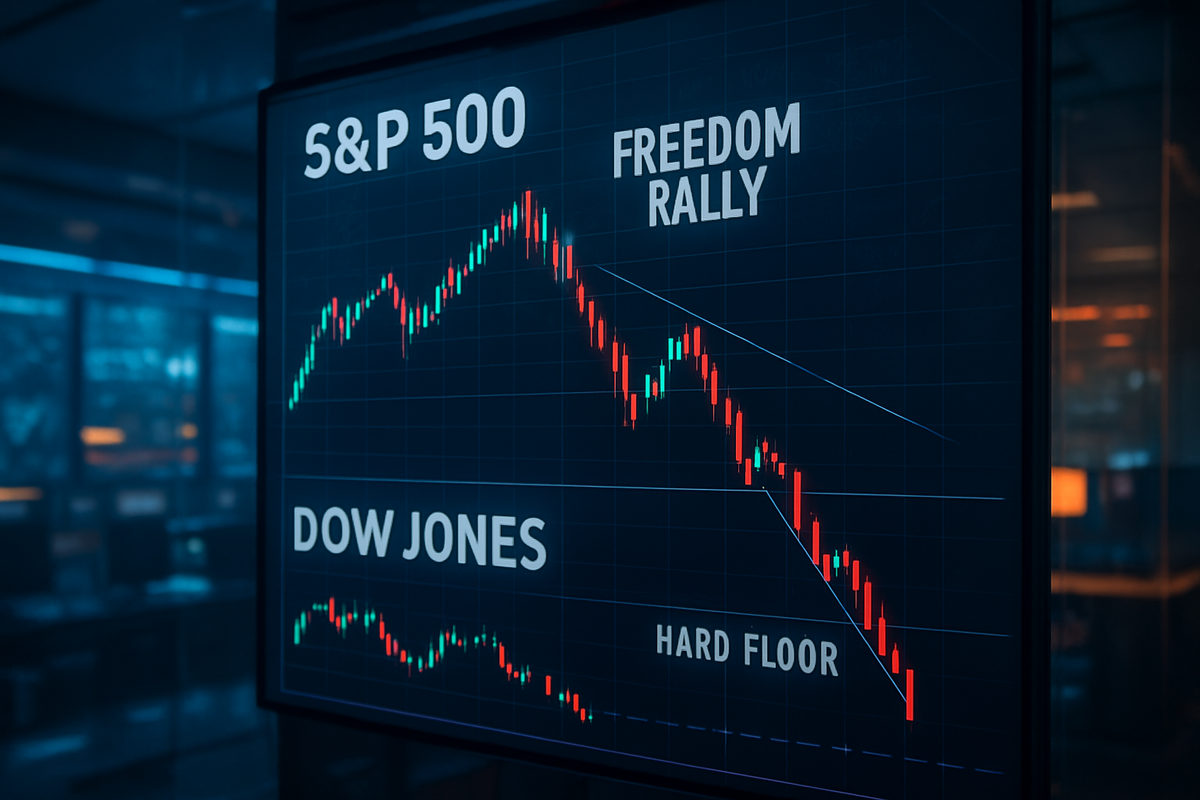
The rapid ascent of the 2026 "Freedom Rally" hit its first significant roadblock on Wednesday, January 7, 2026, as the S&P 500 and Dow Jones Industrial Average retreated from historic milestones. After a week of euphoric buying driven by geopolitical shifts and domestic optimism, the market experienced its first major drop of the year, leaving technical analysts debating whether the decline is a healthy pullback in a new bull market or a failed breakout.
The S&P 500 (INDEXSP:.INX) slipped 0.3%, or approximately 24 points, to close at 6,920.93, ending a three-day streak of record-setting gains. Meanwhile, the Dow Jones Industrial Average (INDEXDJX:.DJI) saw a more pronounced decline, shedding 466 points, or 0.9%, to finish at 48,996.08. The retreat came just 24 hours after the Dow made history by closing above the 49,000 mark for the first time, signaling a momentary pause in the aggressive momentum that has defined the start of 2026.
The Anatomy of the First Major Drop of 2026
The market’s volatility this week can be traced back to a whirlwind of geopolitical and domestic developments. The year began with the "Freedom Rally," sparked by the capture of Venezuelan leader Nicolás Maduro over the weekend. This event led to immediate speculation that a shift in Venezuelan leadership would result in the lifting of sanctions and a surge in global oil supply. Initially, this sent energy and industrial stocks soaring, with the Dow hitting a record high of 49,462.08 on January 6. However, the optimism was tempered on January 7 by a "double whammy" of domestic policy uncertainty and conflicting economic data.
The primary catalyst for Wednesday's sell-off was a series of social media comments from President Trump targeting institutional investors in the residential housing market. The President suggested new policy measures aimed at restricting large-scale corporate ownership of single-family homes to favor individual homebuyers. This sent shockwaves through the real estate and financial sectors. Simultaneously, the Department of Labor’s JOLTS report showed a sharper-than-expected decline in job openings, while the ADP National Employment Report indicated a modest rebound in private hiring. This "mixed bag" of labor data created immediate confusion regarding the Federal Reserve’s interest rate path for the remainder of 2026, prompting many traders to lock in profits from the week's earlier gains.
Winners and Losers: A Tale of Two Tapes
The sector-wide impact of Wednesday's drop revealed a stark divide between defensive resilience and policy-sensitive vulnerability. The homebuilding sector was the hardest hit following the administration's comments. Industry leaders such as D.R. Horton (NYSE: DHI) and PulteGroup (NYSE: PHM) saw their shares tumble by 3.6% and 3.2%, respectively, as investors weighed the potential for increased regulatory oversight on institutional buyers. The financial sector also struggled, with heavyweights like JPMorgan Chase (NYSE: JPM) and Bank of America (NYSE: BAC) both falling more than 2%, acting as the primary anchors dragging down the Dow.
Conversely, the technology sector showed remarkable durability. The Nasdaq Composite (INDEXNASDAQ: .IXIC) managed a slight gain of 0.2%, buoyed by a continued surge in artificial intelligence and semiconductor stocks. NVIDIA (NASDAQ: NVDA) remained a standout performer, extending its 2025 dominance into the new year, while Alphabet (NASDAQ: GOOGL) gained 2.5% despite the broader market's weakness. In the energy space, the outlook was more nuanced; while crude oil price volatility led to a 4% slide in Chevron (NYSE: CVX), Gulf Coast refiners like Valero (NYSE: VLO) and Marathon Petroleum (NYSE: MPC) saw increased interest as they are positioned to benefit from a potential influx of heavy Venezuelan crude.
Technical Significance: Breakout or Fakeout?
From a technical perspective, the current market action is a classic test of "resistance turned support." For the Dow Jones, the 48,870 level—a previous ceiling that was shattered earlier this week—is now being watched as a critical "hard floor." Analysts argue that as long as the Dow remains above this level, the long-term bullish trend remains intact. However, a sustained close below 48,000 would raise concerns of a "bull trap," potentially opening the door for a deeper correction toward the 45,000 range.
The S&P 500 faces a similar litmus test at the 6,910 and 6,800 marks. While the index is currently hovering just above its primary support, a break below 6,800 would signal a transition from a "healthy pullback" to a broader January correction. This volatility mirrors historical precedents where sharp geopolitical-driven rallies are often followed by a period of "mean reversion" as the market digests the actual economic implications of the news. The current environment is being compared by some to the early volatility of 2017 and 2021, where policy-by-social-media often created sharp, short-term dislocations in otherwise trending markets.
What Comes Next: Watching the Floors
In the short term, market participants will be laser-focused on the upcoming Friday jobs report, which will likely serve as the tiebreaker for the conflicting labor data seen earlier this week. If the official employment numbers show resilience, it may provide the necessary fuel for the S&P 500 to make another run at the psychological 7,000 milestone. However, if the data confirms a cooling labor market, the "buy the dip" mentality may be replaced by a more cautious "wait and see" approach.
Strategic pivots are already underway among institutional desks, with a noticeable shift toward "quality" and "cash flow" as the initial euphoria of the 2026 opening bell fades. Investors are increasingly looking at data-storage and infrastructure firms like Western Digital (NASDAQ: WDC) and Seagate (NASDAQ: STX), which have shown strong momentum amid the AI-driven demand for hardware. The ability of these tech-centric names to decouple from the broader Dow-driven weakness will be a key theme to watch in the second half of January.
Market Wrap-Up and Investor Outlook
The first week of 2026 has provided a masterclass in market psychology, transitioning from the "Freedom Rally" highs to a sobering technical test in just a matter of days. The key takeaway for investors is that while the primary trend remains bullish, the "easy money" phase of the January breakout has likely concluded. The market is now entering a phase of price discovery where technical levels like 6,800 on the S&P 500 will determine the narrative for the first quarter.
Moving forward, the primary risk remains policy-driven volatility. As the administration continues to outline its 2026 agenda, sectors ranging from housing to energy will remain sensitive to sudden shifts in sentiment. Investors should keep a close eye on the 200-day moving average for the S&P 500, currently situated near 6,500, as the ultimate "line in the sand" for the year. For now, the market remains in a "pullback" phase, but the coming days will reveal if the bulls have the strength to turn this dip into the next leg of the 2026 breakout.
This content is intended for informational purposes only and is not financial advice.