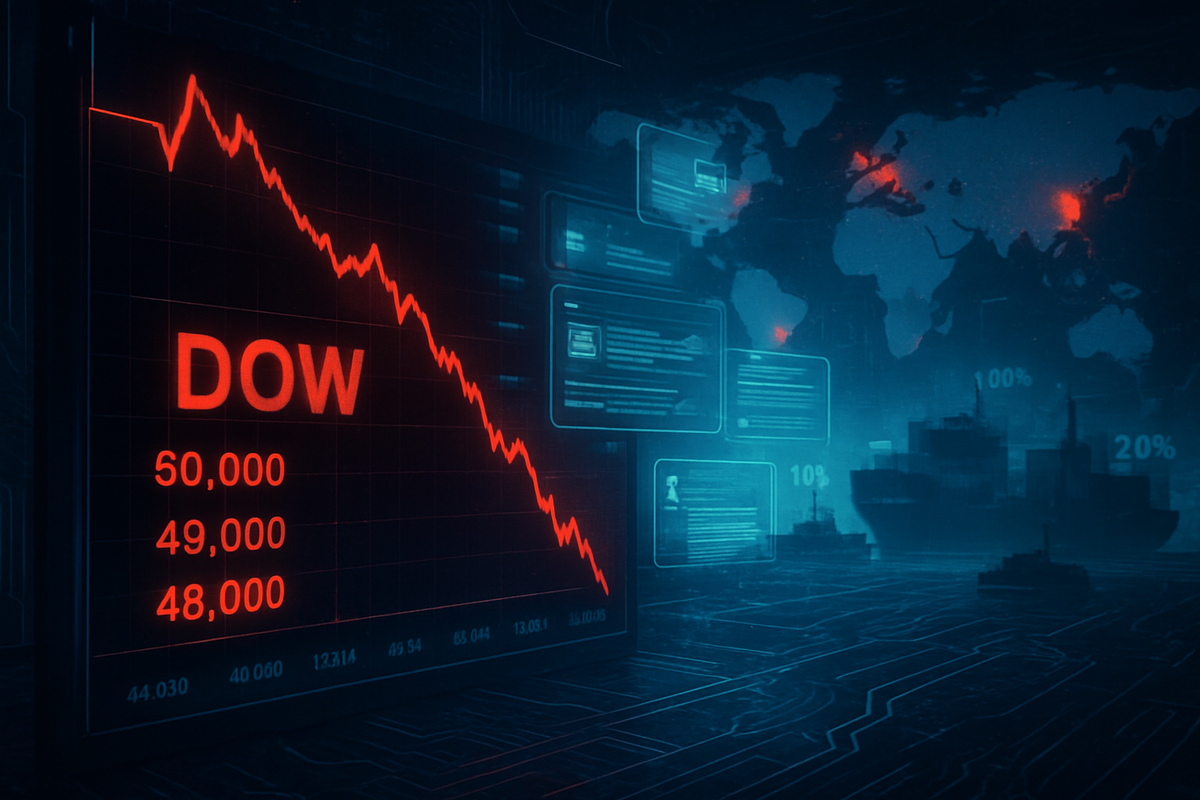
The dawn of 2026 has brought a sobering reality check to global markets as the "New Year Honeymoon" ended abruptly this week. On Wednesday, January 7, 2026, major indices faced a sharp reversal, with the Dow Jones Industrial Average retreating nearly 500 points after flirting with the historic 50,000 milestone just days earlier. This pullback marks a significant shift in investor sentiment, driven by a volatile cocktail of escalating trade protectionism, "sticky" inflation data, and the increasingly influential—and often erratic—discourse found on social media platforms.
The immediate implications are clear: the era of "AI euphoria" is being replaced by a period of "geopolitical pragmatism." As investors digest the impact of aggressive new tariffs and the potential for a leadership vacuum at the Federal Reserve, the market is recalibrating its expectations for the year ahead. The collision of high-stakes global diplomacy and the gamified nature of retail trading on platforms like Reddit and TikTok has created a high-velocity environment where news—and rumors—can wipe out billions in market capitalization in a matter of minutes.
A Perfect Storm of Data and Diplomacy
The market's retreat on January 7 was triggered by a sequence of events that highlighted the fragility of current valuations. The morning began with a stronger-than-expected ADP Private Payrolls report, which immediately cooled hopes for a Federal Reserve rate cut in the first quarter. This "hawkish" data was compounded by a series of earnings previews from banking giants like JPMorgan Chase & Co. (NYSE: JPM) and Blackstone Inc. (NYSE: BX), both of which warned of ballooning operating expenses tied to massive, yet-to-be-monetized investments in artificial intelligence infrastructure.
Simultaneously, the geopolitical landscape reached a boiling point. The "Tariff Shock" of early 2025—a hallmark of the current administration’s trade policy—has finally begun to bite as corporate inventory stockpiles, built up to hedge against 145% duties on Chinese goods, have largely been exhausted. This has forced companies to pass costs directly to consumers, reigniting inflation fears. On the diplomatic front, the "Chip Wars" have entered a new phase of "AI Sovereignty," with the U.S. tightening restrictions on capital flows to Beijing, while China has classified its recommendation algorithms—including those powering TikTok—as strategic national assets to block any potential forced divestiture.
Key stakeholders, including institutional hedge funds and the "finfluencers" of social media, have reacted with uncharacteristic speed. While institutional players moved toward defensive positions in gold and Treasuries, retail sentiment on Reddit, Inc. (NYSE: RDDT) shifted from bullish "dip-buying" to a more defensive posture as users analyzed the potential for a "Fed leadership vacuum." With Jerome Powell’s term set to expire in May 2026, the uncertainty surrounding his successor has introduced a significant risk premium into the bond market, further weighing on equities.
Winners and Losers in a Realigned Economy
In this environment of heightened risk, the defense sector has emerged as a primary beneficiary. Legacy giants like Lockheed Martin (NYSE: LMT) and RTX Corporation (NYSE: RTX) are seeing sustained demand as the conflicts in the Middle East and Eastern Europe transition into long-term, multi-year procurement cycles. Furthermore, specialized players like AeroVironment (NASDAQ: AVAV) have seen their valuations surge due to their dominance in AI-powered drone technology, which has become the new standard in modern attrition warfare. These companies are viewed as "geopolitical hedges," providing stability in an otherwise turbulent market.
Conversely, the "Magnificent Seven" and other tech heavyweights are facing a reckoning. Nvidia (NASDAQ: NVDA), which recently unveiled its "Vera Rubin" architecture at CES 2026, is struggling to maintain its $5 trillion market cap ambitions as investors demand proof of sustained growth amid tightening export controls. Similarly, Microsoft Corporation (NASDAQ: MSFT) is under pressure to demonstrate that its massive 2025 capital expenditures are translating into bottom-line enterprise profits. While Alphabet Inc. (NASDAQ: GOOGL) has found some support through its "Silicon Independence" strategy—using custom AI chips to reduce reliance on third-party foundries—the broader tech sector remains vulnerable to the rising cost of capital.
The social media sector itself is a house divided. Meta Platforms (NASDAQ: META) has successfully transitioned into an "AI Agent" powerhouse, with its open-source Llama models becoming the industry standard. However, platforms like TikTok remain at the center of regulatory volatility, with rumors of a $14 billion sale of its U.S. operations frequently triggering ripples across the retail and tech sectors. Reddit, Inc. (NYSE: RDDT) has carved out a unique niche as an "AI Data Foundry," selling human-generated training data to LLM developers, yet its stock remains a frequent target of the very retail hype it hosts, leading to extreme price swings.
The Viralization of Market Sentiment
The recent pullback highlights a broader trend: the complete integration of social media discourse into the mechanics of Wall Street. No longer just a place for discussion, platforms like Reddit and TikTok now function as primary engines for liquidity and sentiment. The "gamification" of financial content has reached a point where algorithmic sentiment trackers, used by both retail and institutional traders, can trigger massive sell-offs based on viral misinformation or the rapid spread of "macro-anxiety." This has created a "feedback loop" where geopolitical risks are amplified by social media echo chambers, leading to higher intraday volatility.
This event also reflects a historical shift similar to the "Flash Crash" era, but with a social twist. Where previous market shocks were driven by high-frequency trading algorithms, the 2026 pullback is being driven by "social algorithms." Regulatory bodies, including the SEC, are reportedly looking into the role of "sentiment manipulation" and the impact of AI-generated financial advice on retail behavior. The precedent being set here suggests that future market stability may depend as much on moderating social media discourse as it does on traditional monetary policy.
Furthermore, the "AI Sovereignty" movement is creating a fragmented global market. As nations treat data and algorithms as national security assets, the "borderless" nature of the internet—and by extension, global capital—is being challenged. This trend toward "digital nationalism" is likely to lead to more localized market bubbles and crashes, as investors navigate a patchwork of conflicting regulations and trade barriers.
Navigating the Fed Succession and AI Monetization
Looking ahead, the short-term outlook remains clouded by the impending leadership change at the Federal Reserve. The "Powell Transition" will be the dominant story for the first half of 2026. If the administration nominates a candidate perceived as less independent, we could see a more permanent "inflationary premium" baked into the markets. Investors should prepare for a period of "wait-and-see" volatility, where every headline regarding the nomination process triggers a market reaction.
In the long term, the focus will shift from "AI potential" to "AI productivity." The companies that can demonstrate actual cost savings or revenue growth from their AI investments will decouple from the broader tech pack. This "Great Decoupling" will likely create significant opportunities for active managers who can distinguish between hype-driven social media favorites and fundamentally sound technology leaders. Strategic pivots toward "sovereign supply chains" and domestic manufacturing will also be required for companies to survive the ongoing "Tariff Shock."
A New Era of Risk Management
The events of early January 2026 serve as a stark reminder that the "old rules" of market analysis are being rewritten. The market pullback is not just a technical correction; it is a manifestation of a world where geopolitics and social media are inextricably linked. The retreat from the Dow 50,000 level underscores the "valuation wall" that occurs when optimistic projections meet the hard reality of structural economic shifts and global instability.
For investors, the key takeaway is the necessity of a "multi-dimensional" risk strategy. Monitoring traditional economic indicators like payrolls and Fed minutes is no longer enough; one must also account for the "viral velocity" of social media and the "sovereign risks" of a fragmented global trade system. As we move further into 2026, the ability to filter out the noise of the "digital crowd" while navigating the complexities of "New Cold War" economics will be the defining trait of successful market participation.
This content is intended for informational purposes only and is not financial advice.