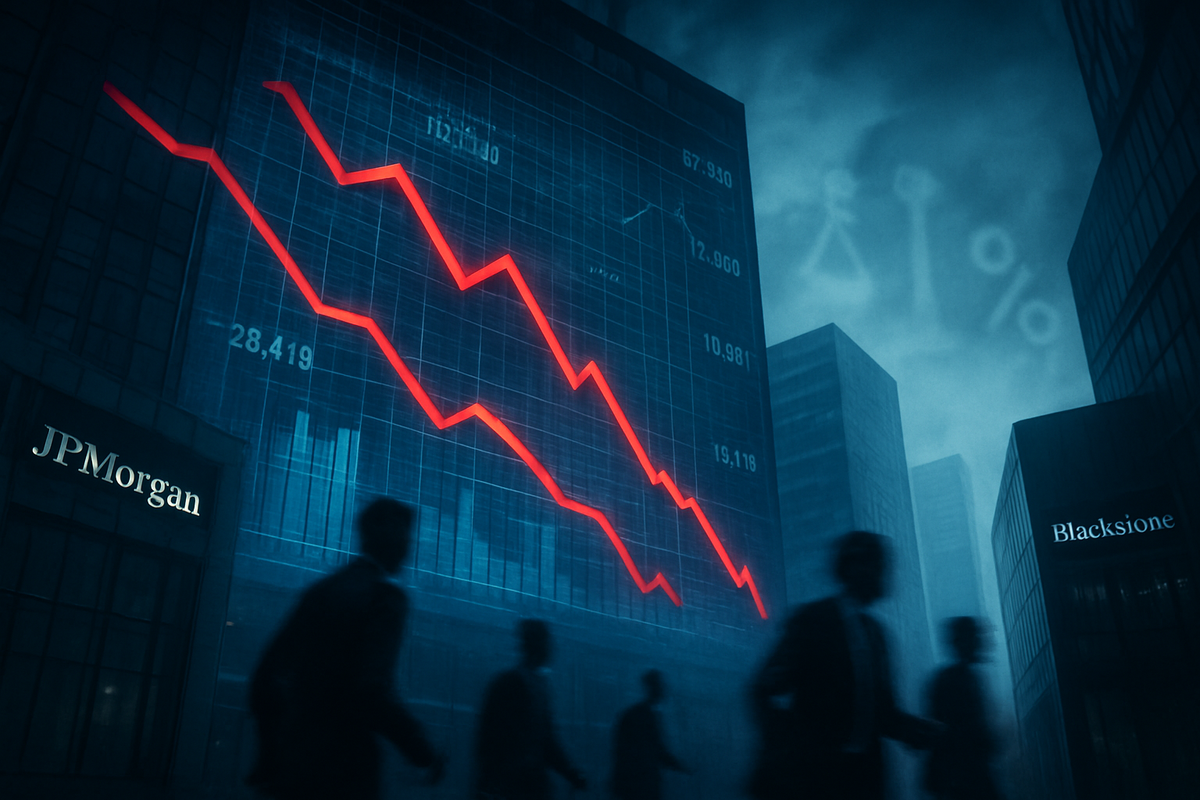
The financial sector, which served as the primary engine for the stock market’s historic climb toward the end of 2025, faced a harsh reality check on Wednesday. After pushing the Dow Jones Industrial Average toward the unprecedented 50,000-point milestone earlier in the week, major financial institutions saw a sharp reversal. The retreat was led by heavyweights JPMorgan Chase & Co. (NYSE: JPM) and Blackstone Inc. (NYSE: BX), as a combination of alarming expense guidance, political headwinds, and shifting interest rate expectations dampened investor enthusiasm.
This sudden downturn marks a significant shift in market sentiment, transitioning from the "Great Rotation" optimism of late 2025 to a cautious "valuation ceiling" in early 2026. As the KBW Banking Index experienced its most substantial single-day pullback in months, analysts are questioning whether the banking sector's rally has finally run out of steam. The immediate implication is a broader market cooling, as investors grapple with the possibility that the Federal Reserve may pause its easing cycle sooner than anticipated, leaving high-flying bank valuations vulnerable to correction.
A "Perfect Storm" Hits the Financial Titans
The slump on January 7, 2026, was not the result of a single factor but rather a "perfect storm" of negative catalysts that converged on the sector. JPMorgan Chase & Co. saw its shares tumble roughly 2.8%, falling to approximately $325.35 after hitting an all-time high just 24 hours prior. The primary driver for the sell-off was a stark warning from management regarding 2026 operating expenses. Estimates for the coming year's costs swelled to $105 billion—nearly $4 billion above consensus—driven by massive investments in artificial intelligence infrastructure and the lingering structural impacts of inflation. This "cost shock" prompted Wolfe Research to issue a dual downgrade for both JPMorgan and Bank of America Corp. (NYSE: BAC), citing a lack of further upside and the need for renewed valuation discipline.
Simultaneously, Blackstone Inc. suffered a more dramatic blow, with its stock plunging 7.3% to $151.00. The catalyst for Blackstone’s decline was political rather than operational. A social media announcement from the White House indicated an intent to ban large institutional investors from purchasing additional single-family homes, a move aimed at addressing housing affordability. As a dominant force in the private equity real estate market, Blackstone was immediately identified as the most vulnerable player to this potential legislation, leading to a wave of institutional capitulation.
The timeline of these events suggests a rapid transition from greed to fear. The first two trading days of 2026 were characterized by record highs and "Goldilocks" economic narratives. However, by mid-week, a cluster of conflicting economic reports—including a sharp decline in JOLTS job openings and an upside surprise in the ISM Services PMI—clouded the "soft landing" outlook. The resulting volatility shattered the complacency that had built up during the year-end rally, forcing a re-evaluation of the entire financial landscape.
Identifying the Winners and Losers in a Shifting Market
The primary losers in this event are the large-cap diversified banks and alternative asset managers. JPMorgan Chase & Co. and Bank of America Corp. are facing a dual threat: rising internal costs and a potential pause in Federal Reserve rate cuts. These institutions benefited immensely from the "un-inversion" of the yield curve in late 2025, but they are now at risk of margin compression if the Fed maintains its current range of 3.50% to 3.75% for an extended period. Blackstone Inc. and other private equity firms with heavy real estate exposure, such as KKR & Co. Inc. (NYSE: KKR), are also on the losing end as they face the prospect of a more restrictive regulatory environment for institutional housing investments.
On the other side of the ledger, defensive sectors may emerge as relative winners as capital rotates out of the cyclically sensitive financials. Insurance companies, such as The Travelers Companies, Inc. (NYSE: TRV), often prove more resilient during periods of interest rate uncertainty due to their fixed-income heavy portfolios. Additionally, some regional banks that are less exposed to the massive AI infrastructure costs plaguing the "Big Four" might find favor if they can maintain disciplined expense ratios.
However, the "winners" in this scenario are few and far between. Even for companies that aren't directly impacted by the housing ban or AI expense surges, the broader market retreat from record highs creates a "rising tide sinks all boats" effect. Investors who were heavily positioned in the financial sector for the 50,000-point Dow chase are now looking for exits, leading to a general contraction in multiples across the sector.
Wider Significance: The End of the Regulatory Honeymoon?
The current slump signifies more than just a bad trading day; it represents a potential shift in the broader industry trend. Throughout 2025, banks enjoyed a "regulatory honeymoon" fueled by the softening of Basel III Endgame requirements. The events of early 2026 suggest that this tailwind has been fully priced in. The market is now shifting its focus back to the fundamentals of the "higher for longer" interest rate environment. If the Federal Reserve pauses its rate-cutting cycle in January, as many now expect, the banking sector will have to rely on organic loan growth—which remains sluggish—rather than expanding net interest margins.
The political pressure on Blackstone also highlights a growing trend of populist-driven housing policy. The proposed "One Big Beautiful Bill Act" and its potential to restrict institutional home buying could have ripple effects across the entire real estate ecosystem, from mortgage lenders to construction firms. This mirrors historical precedents where the government has stepped in to curb institutional influence in essential consumer markets during periods of high inflation or housing shortages.
Furthermore, the uncertainty surrounding the Federal Reserve is compounded by the upcoming expiration of Chair Jerome Powell’s term in May 2026. The market is beginning to price in a "leadership premium," fearing that a more unpredictable successor could disrupt the delicate balance the Fed has maintained. This adds a layer of geopolitical and administrative risk that the banking sector has not had to navigate in several years.
What Comes Next: Strategic Pivots and Market Scenarios
In the short term, the banking sector will be hyper-focused on the upcoming fourth-quarter 2025 earnings season. Investors will be looking for confirmation of the expense guidance provided by JPMorgan and whether other majors like Citigroup Inc. (NYSE: C) will follow suit with similar AI-related cost increases. If the "cost shock" proves to be industry-wide, we could see a prolonged period of underperformance for financial stocks as they digest these investments.
Longer-term, major banks may be forced to pivot their strategies. If the ban on institutional single-family home purchases gains legislative traction, firms like Blackstone will likely need to accelerate their diversification into other alternative assets, such as private credit or infrastructure, to offset the loss of their residential real estate pipeline. For the traditional banks, the challenge will be proving that their massive AI investments can deliver tangible efficiency gains quickly enough to justify the $100 billion-plus expense tabs.
Potential scenarios range from a controlled correction to a more severe downturn. J.P. Morgan’s own research currently estimates a 35% probability of a recession in 2026. If labor market data continues to soften while inflation remains "sticky" near 3%, the Fed will be trapped between cutting rates to save jobs and holding rates to fight prices. This stagflationary environment would be the worst-case scenario for bank valuations, as it would likely lead to both higher credit losses and compressed margins.
Final Thoughts: A New Phase for Financial Investors
The January 7 slump serves as a stark reminder that even the most robust market rallies eventually hit a valuation ceiling. The banking sector, which was the darling of the 2025 market, is now entering a more sober phase where performance will be judged by operational efficiency and regulatory adaptability rather than just macroeconomic tailwinds. The retreat from record highs was perhaps inevitable, but the speed and concentration of the decline in JPMorgan and Blackstone have caught many off guard.
Moving forward, the market will be defined by its ability to navigate interest rate uncertainty and the shifting political landscape. Investors should keep a close eye on the Federal Reserve's January meeting and any further developments regarding housing legislation. The "easy money" era of regulatory relief and yield curve optimism appears to be over, replaced by a period where stock picking and fundamental analysis will once again reign supreme.
The key takeaway for the coming months is one of "hawkish uncertainty." While the financial sector remains a cornerstone of the economy, the path to the next set of record highs will likely be much more volatile. Investors should watch for whether the current slump is a healthy correction or the beginning of a deeper structural shift in how Wall Street values its most powerful institutions.
This content is intended for informational purposes only and is not financial advice.