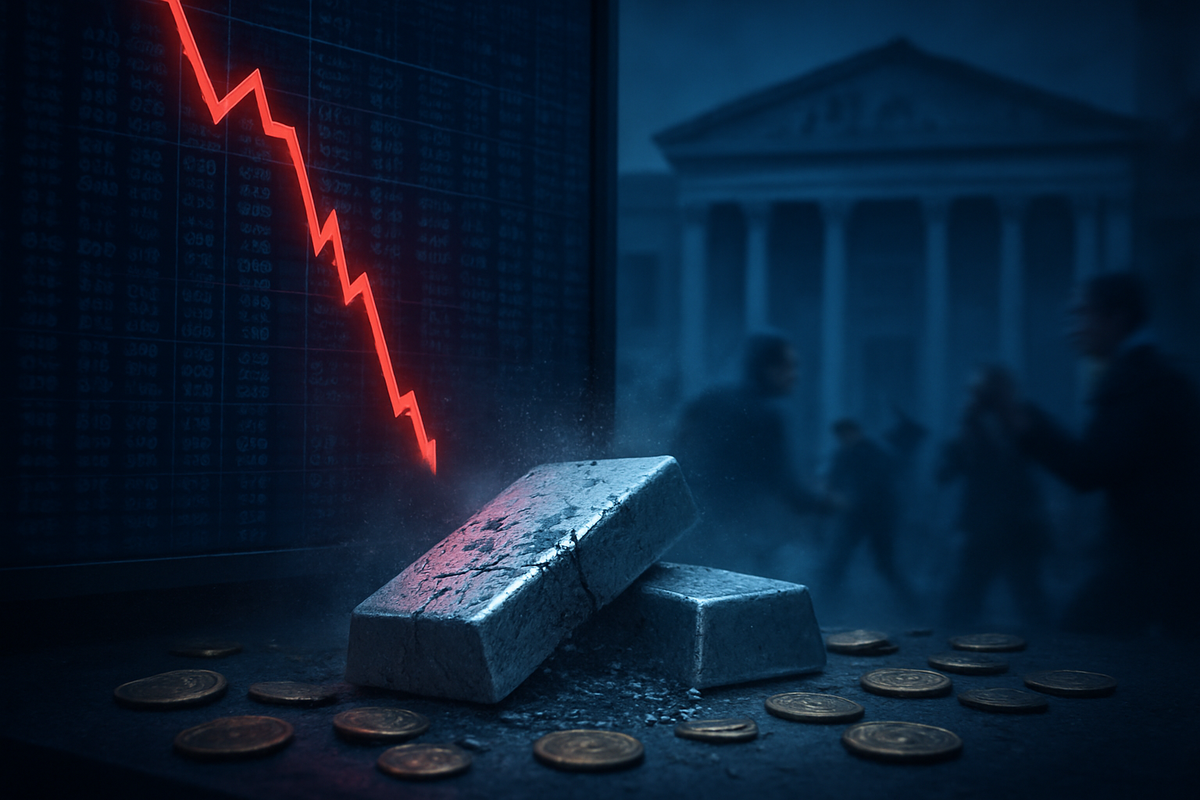
NEW YORK — The global precious metals market is reeling this morning from a "six-sigma" volatility event that has erased trillions in paper wealth over the last 72 hours. Following the formal nomination of Kevin Warsh as the next Chair of the Federal Reserve on Friday, January 30, 2026, silver experienced its most violent single-day collapse since the 1980 "Silver Thursday," plummeting more than 30% and triggering a "liquidity vacuum" that has sent shockwaves through the broader commodities complex.
As of Monday morning, February 2, 2026, gold has followed suit, falling significantly below the psychologically critical $5,000 level. The sudden reversal marks a dramatic end to the "debasement trade" that dominated 2025, as investors pivot from a fear-driven flight to hard assets toward a "relief trade" centered on a resurgent U.S. Dollar and the prospect of a more hawkish, data-dependent Federal Reserve.
The Friday Massacre: A Timeline of the Collapse
The carnage began shortly after the opening bell on Friday, January 30, when the White House officially announced the nomination of Kevin Warsh to succeed Jerome Powell. While Warsh had been on the shortlist for months, markets had largely priced in a more "dovish" candidate expected to accelerate rate cuts. Warsh, a former Fed Governor with deep ties to Wall Street, is widely perceived as a monetary hawk who favors a leaner Fed balance sheet and an aggressive stance against long-term inflation.
By 10:30 AM EST, the "Warsh Effect" took hold as the U.S. Dollar Index (DXY) surged, causing an immediate algorithmic sell-off in precious metals. Silver, which had reached a record high of $121.64 per ounce just twenty-four hours earlier, entered a freefall. The panic intensified when the CME Group raised margin requirements on silver futures by 15%, forcing leveraged hedge funds and retail traders into immediate liquidations. By the end of the session, spot silver had collapsed to roughly $78.53 per ounce—a 31.4% decline that mirrors the 1980 crash caused by the Hunt brothers' failed cornering of the market.
Gold was not spared from the carnage. The yellow metal, which served as the cornerstone of institutional portfolios during the inflationary surge of 2025, shed nearly $900 in value, falling roughly 10% in a single day. Market makers reported a total lack of "bid side" liquidity during the peak of the panic, as the nomination was viewed as a signal that the era of easy money and fiscal-monetary coordination was coming to an abrupt end.
Winners and Losers: Mining Giants and Tech Beneficiaries
The equity markets reflected the carnage in the underlying commodities, particularly among the primary producers. Newmont (NYSE: NEM), the world’s largest gold miner, saw its shares tumble 7.3% as the spot price of gold breached the $5,000 floor. Silver-heavy producers suffered even steeper losses; Pan American Silver (NASDAQ: PAAS) dropped 8.2%, while First Majestic Silver (NYSE: AG) plunged 11% in heavy trading as investors feared that the parabolic margins enjoyed during the 2025 run-up were evaporating in real-time.
Conversely, the collapse in industrial metal prices has provided an unexpected tailwind for the technology and automotive sectors. Companies like Apple (NASDAQ: AAPL) and Tesla (NASDAQ: TSLA), which rely heavily on silver for its high electrical conductivity in components and solar panels, are expected to see significant reductions in raw material costs if the price stays at these lower levels. For these "industrial winners," the precious metals crash acts as a disinflationary subsidy, potentially expanding margins that had been squeezed by the 2025 commodity super-cycle.
Institutional "short-sellers" and macro funds that had rotated into the U.S. Dollar in late January also emerged as significant winners. The trade has quickly shifted from "inflation hedging" to a "flight to quality" within the U.S. financial system, rewarding those who bet against the sustainability of the silver moonshot.
A Paradigm Shift: From Debasement to Discipline
The significance of the Warsh nomination extends far beyond a simple price correction; it represents a fundamental shift in the market's inflation and interest rate expectations. Throughout 2025, precious metals rose on the "debasement trade"—the belief that the Fed would be forced to keep rates low and print money to fund ballooning national deficits. The nomination of Warsh, a known advocate for a smaller Fed footprint and "hard money" principles, has effectively broken that narrative.
This event bears a striking resemblance to the "Volcker Moment" of the early 1980s. By signaling a return to monetary discipline, the administration has sparked a "relief trade" in the dollar and Treasury bonds, at the expense of non-yielding assets. Analysts suggest that the 30% silver drop is a "cleansing" of the excessive leverage that had built up in the system, forcing the market to re-evaluate the true value of hard assets in an environment where real interest rates are expected to remain positive.
The regulatory implications are also mounting. The flash crash has already drawn scrutiny from the Commodity Futures Trading Commission (CFTC), with lawmakers calling for an investigation into the CME's margin hike timing. Critics argue that the sudden increase in capital requirements exacerbated the crash, while the CME maintains that the move was necessary to ensure the integrity of the clearinghouse amid unprecedented volatility.
What Comes Next: Stability or a Deeper Reset?
In the short term, the market is looking for a floor. While silver has attempted to stabilize around the $80 mark on Monday, February 2, the technical damage to the charts is "catastrophic," according to several floor traders. We may see a period of "dead cat bounces" followed by further consolidation as the market waits for Warsh’s confirmation hearings in the Senate. If he doubles down on his hawkish reputation, the "Warsh Shock" could transition into a long-term bear market for precious metals.
For the mining sector, strategic pivots are already underway. Companies like First Majestic Silver may be forced to mothball high-cost projects that were only viable when silver was above $100. Investors should watch for a shift in corporate guidance during the upcoming Q1 earnings season, as miners navigate this new low-price environment. Meanwhile, the broader market will be watching the DXY; if the dollar continues its climb, the pressure on gold and silver is unlikely to abate.
Summary: The End of an Era
The early February 2026 flash crash will likely be remembered as the moment the 2025 precious metals bubble finally burst. The key takeaway for investors is that the "Fed-put" on gold—the idea that the central bank would always bail out the economy with cheaper money—has been called into question by a single personnel change. The nomination of Kevin Warsh has re-introduced the concept of "monetary scarcity" to a market that had forgotten it.
Moving forward, the market is likely to remain highly sensitive to any rhetoric regarding the Fed's balance sheet and "AI-driven productivity" gains, which Warsh often cites as a reason for keeping inflation in check. Investors should watch for the $4,500 level in gold and the $70 level in silver in the coming months. If these supports hold, the market may find a healthy equilibrium; if they fail, the 2026 "Warsh Shock" may only be the beginning of a larger structural reset in global finance.
This content is intended for informational purposes only and is not financial advice.