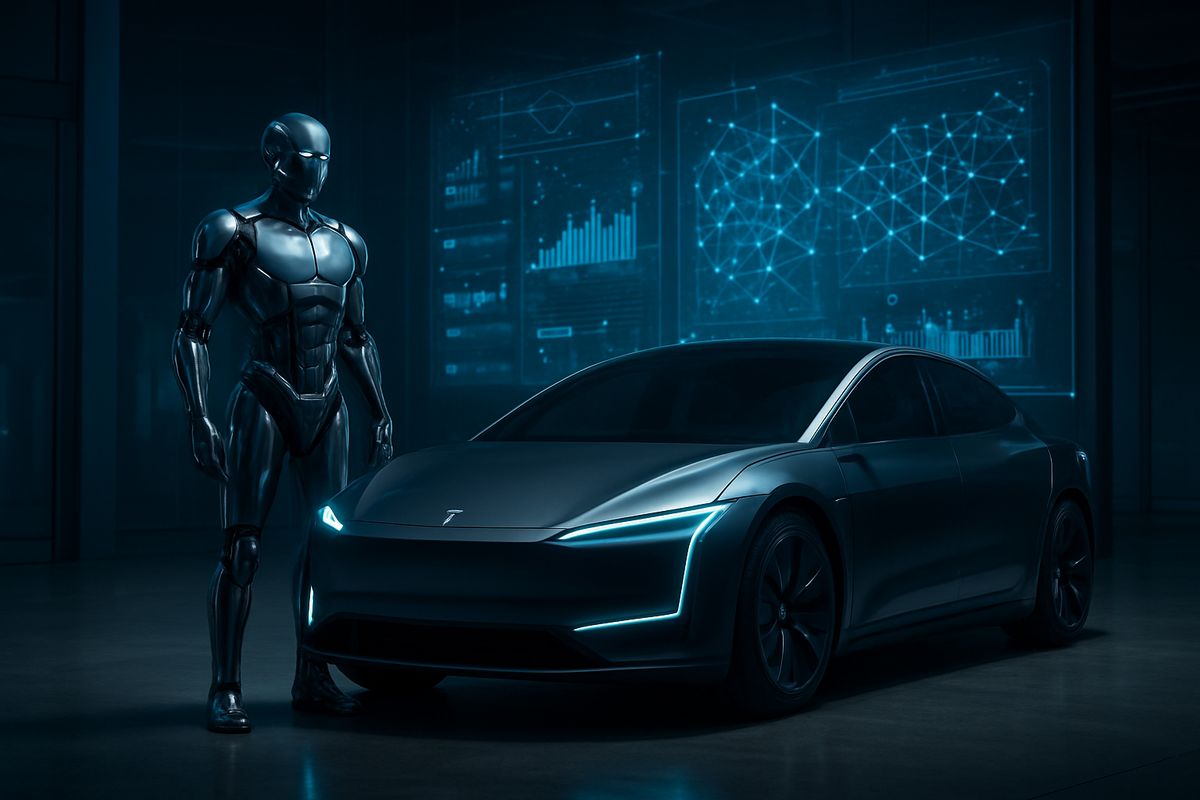
Tesla, Inc. (NASDAQ: TSLA) has officially signaled the end of its era as a mere high-volume electric vehicle manufacturer, reporting Q4 2025 earnings that exceeded analyst expectations while simultaneously doubling down on Elon Musk’s artificial intelligence ambitions. The company confirmed a strategic $2 billion investment into xAI, the artificial intelligence startup founded by Musk, as part of a massive Series E funding round that values the AI entity at a staggering $230 billion. This move, announced alongside a quarterly "beat" on earnings per share, highlights a fundamental shift in Tesla’s corporate identity toward what Musk describes as "Physical AI" and robotics.
The market reaction to the news has been a study in volatility, reflecting a tug-of-war between growth-oriented AI optimists and traditional automotive skeptics. While Tesla’s headline revenue of $24.9 billion surpassed Wall Street estimates, it marked the first annual revenue decline in the company’s history, falling 3% year-over-year. However, investors were buoyed by a significant recovery in gross margins, which climbed to 20.1%, and the aggressive roadmap that integrates xAI’s "Grok" systems directly into Tesla’s next-generation humanoid robots and autonomous vehicle fleet.
Financial Resilience Amidst an Automotive Transition
Tesla’s Q4 2025 earnings report, released in late January 2026, painted a picture of a company in deep transition. Adjusted earnings per share (EPS) came in at $0.50, outperforming the consensus estimate of $0.45, despite a cooling global EV market that saw Tesla’s quarterly deliveries drop 16% to 418,227 units. The financial silver lining was found in the company’s energy storage business, which deployed a record 14.2 GWh in the quarter, and a leaner manufacturing process that bolstered margins even as vehicle sales slowed. The $2 billion investment in xAI was structured through the purchase of Series E Preferred Stock, a move that followed a year of speculation regarding how Musk would reconcile his various tech ventures.
The timing of this investment is particularly notable given the broader "Muskonomy" reshuffle. Just days ago, on February 2, 2026, SpaceX (Private) officially acquired xAI, creating a $1.25 trillion "mothership" entity that now serves as the central hub for Musk’s AI and aerospace efforts. Tesla’s $2 billion stake ensures it remains a primary beneficiary and strategic partner in this ecosystem. Under a new framework agreement, Tesla will not only integrate Grok AI into its vehicle infotainment but also continue its lucrative partnership supplying Megapack batteries to power xAI’s "Colossus" supercomputer clusters.
However, the path to this integration has not been without friction. The $2 billion commitment proceeded despite a contentious shareholder environment in late 2025, where governance experts raised concerns over potential conflicts of interest. Several derivative lawsuits remain active, alleging that the investment unfairly benefits Musk’s private interests at the expense of Tesla’s public shareholders. Despite these legal headwinds, the board moved forward, viewing the access to xAI’s cutting-edge large language models as essential for the development of the "Optimus" humanoid robot and the "Cybercab" autonomous platform.
Ecosystem Winners and Industry Losers
The strategic pivot to AI and robotics creates a new landscape of winners and losers. NVIDIA Corporation (NASDAQ: NVDA) stands as a primary beneficiary, as both Tesla and the newly merged SpaceX/xAI entity remain among the largest consumers of high-end compute hardware. NVIDIA also participated as a strategic investor in the xAI Series E round, further cementing its role as the foundational infrastructure provider for Musk’s ambitions. Similarly, Cisco Systems, Inc. (NASDAQ: CSCO) has seen increased demand for the networking hardware required to link Tesla’s manufacturing hubs with xAI’s massive data centers.
On the losing end of this shift are traditional ride-hailing platforms like Uber Technologies, Inc. (NYSE: UBER) and Lyft, Inc. (NASDAQ: LYFT). Musk’s aggressive push for the "Cybercab"—a purpose-built Robotaxi—aims to disrupt the gig economy model entirely by late 2026. Furthermore, Tesla’s decision to cease production of the flagship Model S and Model X by mid-2026 to repurpose factory space for Optimus production signals a retreat from the luxury sedan market, potentially ceding ground to competitors like Lucid Group, Inc. (NASDAQ: LCID) and BYD Company Limited (OTC: BYDDY), the latter of which solidified its position as the world's top EV seller by volume in 2025.
The Dawn of 'Master Plan Part IV'
The integration of xAI marks the beginning of what Musk calls "Master Plan Part IV," an era defined by autonomous systems rather than personal car ownership. This fits into a broader industry trend where hardware is increasingly commoditized, and value is derived from the software "brain" that controls it. By prioritizing "Physical AI"—AI that can interact with the 3D world—Tesla is attempting to solve the most difficult engineering challenge in history. The company’s planned $20 billion capital expenditure for 2026 is more than double its 2025 budget, a massive bet on a future where the Optimus robot becomes a more significant revenue driver than the Model 3.
This shift mirrors historical precedents, such as Apple Inc.’s (NASDAQ: AAPL) transition from a computer manufacturer to a services and ecosystem company. However, the regulatory environment for "Physical AI" is far more complex than that of digital services. Tesla faces an uphill battle with safety regulators over Full Self-Driving (FSD) and the eventual deployment of humanoid robots in domestic and industrial settings. Comparisons to the early days of autonomous testing suggest that any high-profile failure could lead to stringent policy interventions that might stall Musk's "Von Neumann machine" vision.
Navigating the Path to 2027
In the short term, Tesla must navigate a period of "negative free cash flow" as it ramps up the $20 billion CapEx program. The primary milestone for 2026 will be the April production ramp of the Cybercab. If Tesla can demonstrate a viable, scalable Robotaxi network, the stock's current "AI premium" may be justified. Conversely, any delays in the phase-out of the Model S/X or the repurposing of the Fremont factory could lead to a liquidity crunch, especially if automotive revenue continues its slight downward trajectory.
The long-term success of the xAI investment depends on the synergy between Grok’s cognitive abilities and Tesla’s mechanical hardware. If Optimus can transition from a prototype to a functional industrial tool by 2027, Tesla will have successfully pivoted into a market with virtually unlimited TAM (Total Addressable Market). However, the technical hurdles are immense, and the competition from dedicated robotics firms and other Big Tech AI labs is intensifying.
Closing Thoughts: A High-Stakes Transformation
Tesla’s Q4 2025 results and the xAI deal represent a definitive "burn the boats" moment for the company. By sacrificing its legacy luxury models and shifting billions into AI, Tesla is betting its future on the success of autonomous robotics. For investors, the key takeaways are clear: Tesla is no longer a safe play on EV adoption; it is a high-risk, high-reward bet on the singularity of AI and physical hardware.
Moving forward, the market will be hyper-focused on two metrics: the margin improvement in the energy sector and the milestone achievements of the Optimus program. As the "Muskonomy" becomes more interconnected through the SpaceX-xAI mothership, the lines between Musk’s ventures will continue to blur. Investors should watch closely for the April Cybercab launch and any updates on the Series E valuation of xAI, as these will be the primary catalysts for the stock in the coming months.
This content is intended for informational purposes only and is not financial advice.