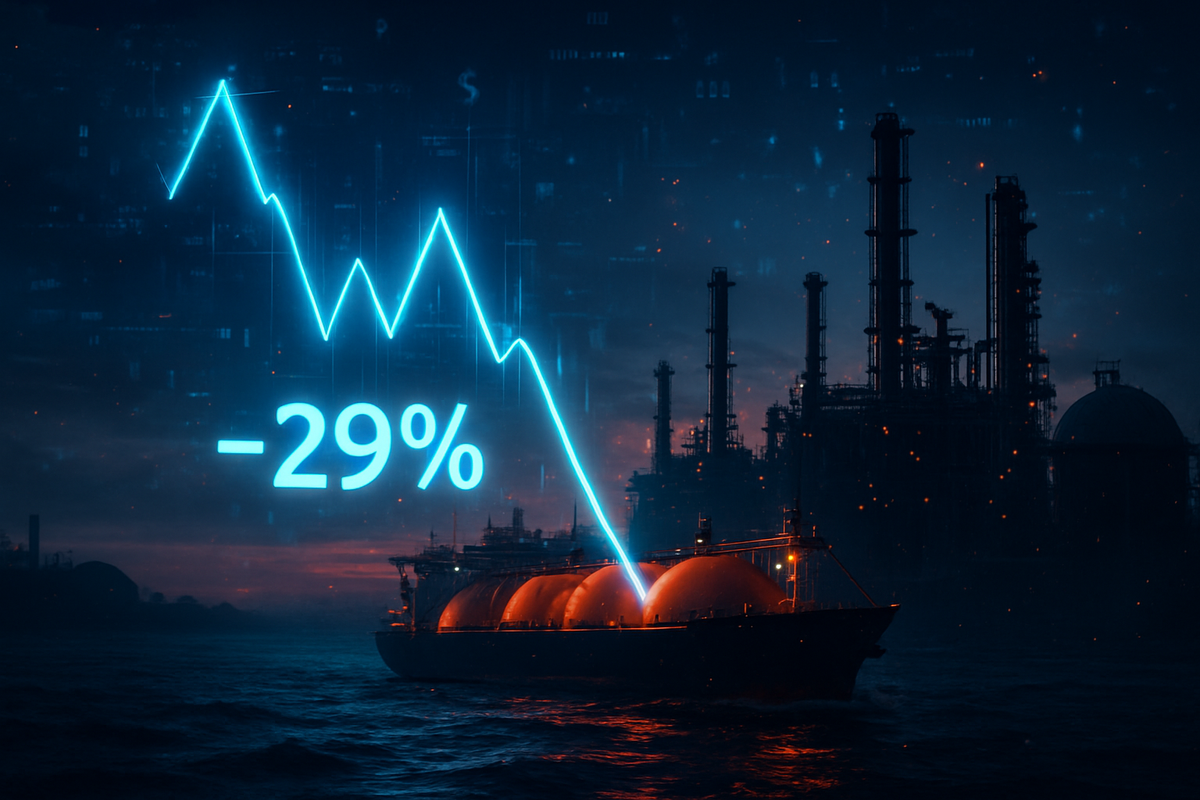
The natural gas market has entered a period of unprecedented turbulence, shifting from a historic price collapse in February to a geopolitical powder keg in March. After natural gas futures plummeted by 29% in February 2026, the market outlook has turned "haywire," as traders pivot from domestic oversupply fears to the very real threat of a global supply chokehold. As of March 12, 2026, the United States Natural Gas Fund (NYSE Arca: UNG) is trading near $12.88, reflecting a cautious but tense equilibrium as the industry braces for further shocks.
This sudden reversal comes as Goldman Sachs (NYSE: GS) sounds the alarm on escalating tensions in the Middle East. While the market spent much of the last month pricing in a mild end to winter and record-breaking domestic production, the narrative has been violently disrupted by military operations near the Strait of Hormuz. What was a domestic story of weather-driven price normalization has rapidly transformed into a high-stakes global energy crisis.
The Great February Collapse and the March Pivot
The road to the current volatility began with a "round-trip" that left even seasoned traders breathless. In late January 2026, Winter Storm Fern gripped the United States, causing massive wellhead freeze-offs and a record-breaking storage withdrawal of 249 Bcf. By January 23, Henry Hub spot prices had skyrocketed to an all-time high of $30.72 per MMBtu. However, as the storm subsided and forecasts turned unseasonably warm, the "weather premium" evaporated with startling speed.
Throughout February 2026, natural gas futures went into a tailspin, declining 29% as the market realized the winter supply crunch was over. On February 2 alone, the March futures contract recorded its largest one-day decline in three decades, falling 26%. By late February, prices had bottomed out near $3.13 per MMBtu, a staggering 90% drop from the January peak. This collapse was driven by a surge in U.S. production, which reached a record 120 Bcf/d, leading many to believe the market was headed for a prolonged period of oversupply.
The calm was short-lived. By the first week of March, geopolitical risks took center stage. Military operations involving the U.S., Israel, and Iran began to threaten the Strait of Hormuz—a vital artery that carries nearly 20% of the world’s liquefied natural gas (LNG) supply. The shift from a $30 weather spike to a $3 collapse, followed by a geopolitical surge, is what analysts are now calling a "haywire" market, where traditional fundamentals are frequently overruled by external shocks.
Winners and Losers in a Volatile Landscape
The extreme swings in gas prices have created a stark divide between those positioned for volatility and those caught in the crossfire. Major U.S. exporters like Cheniere Energy (NYSE: LNG) find themselves in a complex position; while global demand for American gas is surging due to Middle Eastern instability, the operational risks of global shipping have increased. Similarly, large-scale producers like EQT Corporation (NYSE: EQT) and Chesapeake Energy (NASDAQ: CHK) are navigating a market where domestic prices remain suppressed by high production, even as global benchmarks soar.
On the losing side, industrial consumers and utilities that failed to hedge their exposure during the February dip are now facing the prospect of "importing" global price spikes. Goldman Sachs has already raised its price forecasts for the European TTF benchmark to 63 euros/MWh for the second quarter, warning that a full closure of the Strait of Hormuz could send prices up by another 130%. This would likely bleed back into U.S. markets as domestic gas is diverted to meet high-priced overseas demand.
The United States Natural Gas Fund (NYSE Arca: UNG) remains a double-edged sword for retail investors. While the fund gained 6.3% in early March on the back of geopolitical fears, it remains down significantly year-over-year. The "contango" effect—where the fund must sell cheaper near-month contracts to buy more expensive future ones—continues to erode long-term value, making it a high-risk vehicle for anyone but the most nimble short-term traders.
Geopolitics and the Global Energy Grid
The current crisis underscores how deeply integrated the U.S. natural gas market has become with the global energy grid. Historically, U.S. natural gas was a localized commodity, but the expansion of LNG export terminals has tethered domestic prices to events thousands of miles away. The disruption in the Strait of Hormuz is not just a Middle Eastern concern; it is a systemic threat to global energy security that forces the U.S. to act as the world’s "swing producer."
This event mirrors historical precedents like the 2022 energy crisis, yet the scale of U.S. production in 2026 adds a new layer of complexity. With U.S. output exceeding 120 Bcf/d, the country has the physical supply to stabilize markets, but the infrastructure to move that gas to global markets remains a bottleneck. Regulatory scrutiny is expected to intensify as policymakers weigh the benefits of high export profits against the need to protect domestic consumers from global price contagion.
Furthermore, the "haywire" nature of the market suggests that traditional seasonal trading patterns are becoming less reliable. The extreme 90% price swing in early 2026 indicates that climate-driven volatility and geopolitical instability are now the primary drivers of value, often moving in opposition to one another and creating "flash-crash" scenarios that can wipe out billions in market capitalization in a matter of days.
The Road Ahead: Scenarios for Spring 2026
As we move deeper into March, the market is bracing for two potential paths. In the first scenario, a diplomatic de-escalation in the Middle East could see the geopolitical premium vanish as quickly as the "Fern" weather premium did in February. This would likely send prices back toward the $3 level as the reality of record U.S. production and high storage levels reasserts itself.
In the second, more ominous scenario, a prolonged closure of the Strait of Hormuz would force a total repricing of global energy. Goldman Sachs analysts Samantha Dart and Frederik Witzemann have warned that such a closure could push European gas prices toward $35 per MMBtu. In this environment, U.S. natural gas would be pulled upward as every available molecule is bid on by desperate European and Asian buyers, potentially leading to a "super-cycle" of volatility through the summer of 2026.
Strategic pivots are already underway among major players. Traders are increasingly moving away from pure directional bets and toward spread trades, betting on the price difference between different delivery months or geographic hubs. For the broader market, the "haywire" outlook is likely to persist until there is clarity on both the Middle Eastern conflict and the durability of the current U.S. production records.
Summary and Market Outlook
The natural gas market of March 2026 is a study in extremes. The transition from a 29% decline in February to a geopolitical crisis in March has left the industry in a state of high alert. With UNG hovering around $12.88, the market is currently pricing in a significant risk premium, yet remains vulnerable to any shift in the "fear narrative" that has replaced the "weather narrative" of last month.
Moving forward, investors must keep a close watch on two critical metrics: the status of tanker traffic through the Strait of Hormuz and the weekly EIA storage reports. These two factors—one representing global risk and the other representing domestic reality—will continue to pull the market in opposite directions. The primary takeaway for 2026 is that the era of "stable" natural gas prices may be over, replaced by a permanent state of high-velocity volatility.
As the second quarter approaches, the market's ability to absorb these shocks will be tested. Whether the "haywire" outlook settles into a new normal or leads to a sustained global energy shortage will depend on the intersection of military strategy and domestic energy policy. For now, caution remains the watchword in a market where the only certainty is uncertainty.
This content is intended for informational purposes only and is not financial advice.