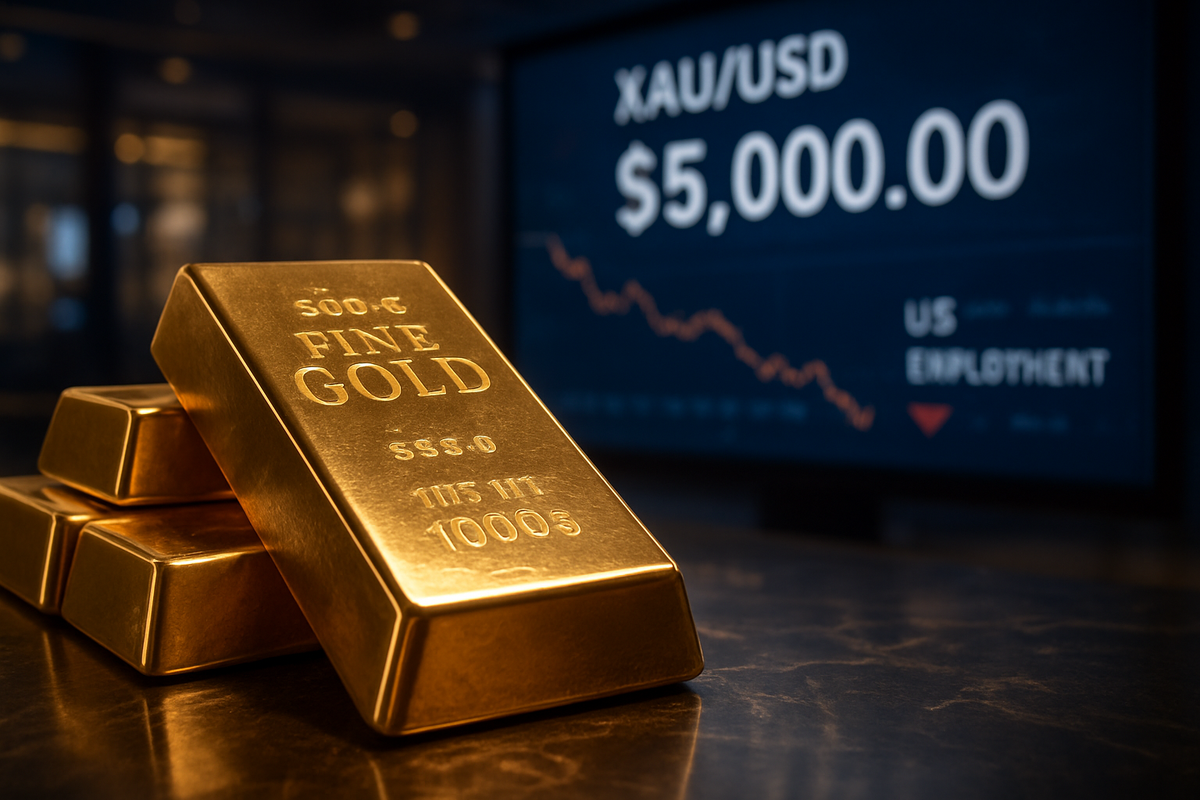
The global financial landscape reached a historic inflection point this week as gold prices shattered the psychological $5,000 per ounce ceiling in London, signaling a seismic shift in investor sentiment. Driven by a volatile cocktail of escalating military conflict in the Middle East and a shocking contraction in the American labor market, the yellow metal has reasserted its status as the ultimate "safe-haven" asset. As of today, March 12, 2026, the spot gold market continues to hover near record levels, with the London PM fix recently settling at a staggering $5,130 per ounce.
The implications of this surge are profound, reflecting a market that is increasingly pricing in "stagflation"—a toxic mix of stagnant economic growth and rampant inflation. While equity markets have shuddered under the weight of new global trade tariffs and energy supply shocks, gold has emerged as the primary beneficiary. Investors are flocking to physical bullion and exchange-traded products like the SPDR Gold Shares (NYSE Arca: GLD), seeking a shield against a geopolitical and macroeconomic environment that feels increasingly untethered from the stability of the previous decade.
A Perfect Storm: War in the Gulf and the "February Freeze"
The ascent to $5,000 was catalyzed by two major events that converged in early March 2026. First, a dramatic military escalation in the Middle East saw coordinated strikes on Iranian infrastructure following months of simmering tensions. The subsequent closure of the Strait of Hormuz—a chokepoint for roughly 20% of the world’s oil supply—sent Brent crude prices soaring toward $90 a barrel. This energy shock immediately revived fears of the 1970s-style inflation, driving institutional desks to pivot aggressively into precious metals.
Compounding the geopolitical dread was the release of the U.S. Bureau of Labor Statistics’ February employment report on March 6. Dubbed the "February Freeze" by Wall Street analysts, the data revealed a shock loss of 92,000 jobs, far below the expected gain of 59,000. This represented the first major contraction in the U.S. labor market in years, sending the national unemployment rate climbing to 4.4%. The data effectively dismantled the "soft landing" narrative that had buoyed markets through 2025, forcing investors to bet on a desperate Federal Reserve pivot toward interest rate cuts to stave off a deep recession.
Winners and Losers in a $5,000 Gold Era
In this high-priced environment, gold mining giants have seen their valuations decouple from the broader market. Newmont Corporation (NYSE: NEM) and Barrick Gold (NYSE: GOLD) have emerged as significant winners, as their profit margins expand exponentially with gold trading more than $2,500 above their average all-in sustaining costs (AISC). These companies, once plagued by high operational costs and debt, are now being viewed as "cash machines" by value investors. Conversely, the iShares Silver Trust (NYSE Arca: SLV) has also seen a secondary surge, as retail investors on platforms like Robinhood Markets, Inc. (NASDAQ: HOOD) look for "cheaper" alternatives to the now-exorbitant gold bars.
However, the "Tariff Tantrum" of early 2026 has created a complex landscape for broader sectors. The recent imposition of 10-15% global import tariffs has hammered consumer discretionary stocks and tech giants that rely on intricate global supply chains. Even the SPDR Gold Shares (NYSE Arca: GLD), which hit record highs, briefly faced a massive $2.9 billion outflow on March 7 as some institutional funds liquidated positions to cover margin calls in the collapsing tech sector. Despite this "tariff-driven selloff," GLD has rapidly recovered its footing, serving as a vital portfolio shield for those weathering the storm in the S&P 500.
The Broader Significance: A Return to Hard Assets
The breach of $5,000 per ounce is more than just a numerical milestone; it represents a fundamental loss of confidence in the traditional "60/40" portfolio and the stability of fiat currencies during times of war. Historically, gold’s rise above major psychological levels—like the $1,000 mark in 2008 or the $2,000 mark in 2020—has preceded periods of prolonged monetary expansion or structural economic shifts. Today’s surge fits into a broader trend of "de-dollarization" and a flight toward tangible assets as the world moves into a more fragmented, multipolar trade environment.
Furthermore, the London spot fix at $5,130 highlights a growing divergence between the "paper" gold market and the physical market. Sources from BullionVault indicate that physical delivery premiums have reached record highs as central banks in the East continue to hoard bullion at an unprecedented pace. This "supply squeeze" suggests that the current price level may not be a speculative bubble, but rather a permanent re-rating of the asset’s value in a world where energy security and geopolitical stability can no longer be taken for granted.
What Lies Ahead: The Road to $6,000 or a Massive Correction?
In the short term, the market's focus remains squarely on the Federal Reserve. If the Fed follows through with aggressive rate cuts to combat the jobs slump, gold could easily find the momentum to test $5,500 or even $6,000 before the end of the year. Lower interest rates decrease the "opportunity cost" of holding non-yielding gold, making it even more attractive to income-seeking investors. However, a potential de-escalation in the Middle East or a surprise "V-shaped" recovery in the jobs data could lead to a sharp correction as "fear money" exits the market.
Long-term, the strategic pivot toward gold by both retail and institutional investors appears durable. Public companies are increasingly considering "Bitcoin-style" treasury strategies that involve holding physical gold or gold-backed ETFs to hedge against currency debasement. The challenge for the coming months will be managing the extreme volatility that comes with such high price points. Investors should watch for the next London PM fix and any updates on the Strait of Hormuz for clues on whether this rally has further room to run.
Final Assessment: A New Monetary Reality
The events of March 2026 have cemented gold’s role as the indispensable asset of the current decade. With the London fix stabilized around $5,130/oz, the market has accepted a "new normal" where the safe-haven trade is the dominant theme of the 2020s. The combination of the Middle East conflict and the shock drop in U.S. employment has created a "perfect storm" that has vindicated long-term gold bulls and forced a radical rethink of risk management for global portfolios.
For the average investor, the message is clear: the era of low-inflation, low-volatility growth is on hiatus. While the heights reached by GLD and spot gold are historic, the underlying causes—war, tariffs, and economic contraction—suggest that the volatility is far from over. As we move deeper into 2026, the $5,000 mark will likely serve as the new floor in a market that is increasingly bracing for the unknown.
This content is intended for informational purposes only and is not financial advice.