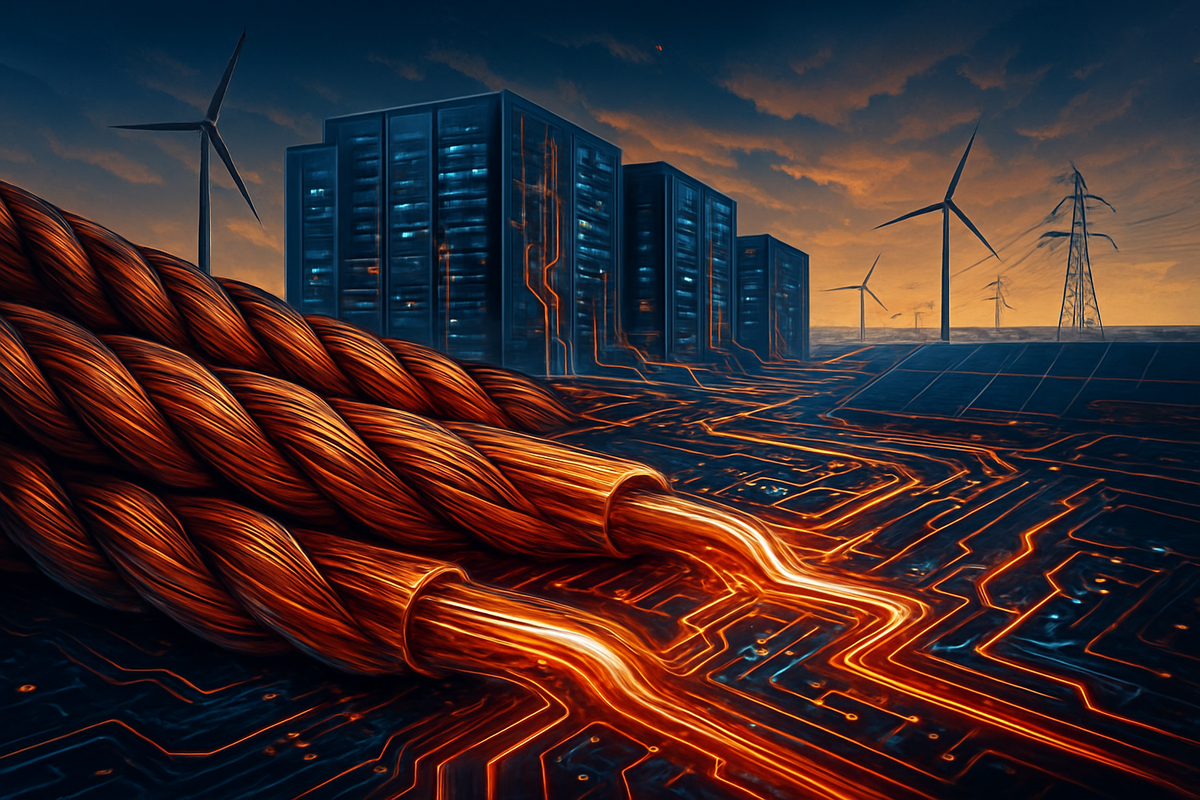
As of March 12, 2026, the global commodity markets are witnessing a generational shift as copper futures firmly hold their ground above the $5.90 per pound mark. Once a mere barometer for global industrial health, "Doctor Copper" has evolved into the indispensable backbone of the two most significant technological shifts of the 21st century: the total electrification of the global economy and the explosive build-out of artificial intelligence (AI) infrastructure. This convergence has ignited what analysts are calling a "structural supercycle," characterized by record-high prices and a desperate scramble for physical supply.
The immediate implications of this price surge are being felt across the manufacturing and energy sectors. With copper inventories at multi-year lows and smelting charges in China plummeting to near-zero levels earlier this year, the market is signaling a severe shortage of refined metal. As the global economy marches toward a projected 10 million metric ton deficit by 2040, the current $5.90 price floor represents more than just a spike; it is a fundamental re-rating of a metal that is now as critical to the digital age as silicon.
The Road to $5.90: A Timeline of Scarcity
The current supercycle did not emerge in a vacuum but is the result of a multi-year squeeze that began accelerating in late 2024. Throughout 2025, a series of supply-side shocks—including major production halts at key mines in Chile and the Democratic Republic of the Congo—collided with a massive uptick in demand for high-voltage cabling required for AI data centers. By January 2026, copper futures hit a staggering all-time high of $6.58 per pound before settling into the current consolidation phase above $5.90. This price stability, even in the face of high interest rates, underscores the inelastic nature of current demand.
Key stakeholders, including global mining giants and sovereign wealth funds, have been caught in a frantic race to secure "green copper" assets. The timeline was punctuated by the late 2025 "smelting crisis," where a shortage of copper concentrate led to a temporary shutdown of major refineries in Asia. This event served as a wake-up call for the industry, proving that the midstream infrastructure was unprepared for the sheer volume of ore required to meet net-zero and AI-driven mandates. Initial market reactions were volatile, but the narrative has since shifted toward a long-term bullish consensus.
Major investment houses and legendary macro traders have validated this trend. Billionaire investor Stan Druckenmiller’s "prescient" copper bet has become a hallmark of this cycle. Druckenmiller, who correctly identified the AI-copper nexus in early 2024, has been vocal about his preference for copper futures over traditional equities as a more direct way to capture the "inflationary growth" of the current decade. His tactical shift toward rolling front-end futures contracts has mirrored a broader trend of institutional capital flowing directly into the physical commodity.
Mining Giants and the ETF Surge: Winners of the New Era
The most visible beneficiary of this supercycle has been the Global X Copper Miners ETF (NYSE: COPX), which has seen its value skyrocket by 154% over the past year. This meteoric rise reflects the massive profit margins currently enjoyed by established miners who are benefiting from a high-price environment while operating on cost bases established years ago. For investors, COPX has functioned as a high-beta play on the electrification theme, capturing the upside of both diversified majors and pure-play copper producers.
Among the individual titans, Freeport-McMoRan (NYSE: FCX) has emerged as a primary winner, with its stock up approximately 40% year-over-year. As the company works to fully restore production at its massive Grasberg mine, it remains one of the most liquid ways for institutional investors to gain exposure to the copper price. Similarly, Southern Copper (NYSE: SCCO) has traded near all-time highs, leveraging its low-cost asset base in Peru and Mexico to generate record free cash flow. These companies are now flush with capital, leading to a new wave of consolidation in the sector.
However, not all players are equal in this environment. Traditional diversified miners like BHP Group (NYSE: BHP) and Rio Tinto (NYSE: RIO) are aggressively pivoting their portfolios. BHP’s recent multi-billion dollar acquisition of Filo Mining highlights the premium companies are willing to pay for "tier-one" copper deposits. Meanwhile, Teck Resources (NYSE: TECK) has successfully transitioned into a copper-heavy growth engine following the sale of its coal business, positioning itself as a "pure-play" favorite for ESG-conscious funds. The "losers" in this scenario are the smaller manufacturers and grid operators who are seeing their input costs balloon, threatening the pace of the very energy transition they are meant to facilitate.
The 10 Million Ton Gap: AI and the 2040 Deficit
The wider significance of the copper supercycle lies in the alarming supply-demand projections provided by J.P. Morgan and S&P Global. J.P. Morgan’s 2026 research identifies AI data centers as a "black swan" demand driver that the market had largely ignored until recently. These facilities require between 30 and 47 metric tons of copper per megawatt (MW) for specialized cooling systems and power distribution—significantly higher than traditional data centers. In 2026 alone, AI-related demand is expected to consume an additional 110,000 tons of the metal.
This "AI intensity" is a primary reason why analysts are now projecting a staggering 10 million metric ton deficit by 2040. To put this in perspective, that gap represents roughly 25% of total projected global demand. This creates a "structural scarcity" that historical precedents, such as the China-led commodity boom of the early 2000s, cannot match. Unlike that era, which was driven by urbanization, the current cycle is driven by the fundamental replacement of internal combustion engines and the physical construction of the "global brain" of AI.
Regulatory and policy implications are also coming to the forefront. Governments in the U.S. and E.U. have officially designated copper as a "critical mineral," yet the lead time to bring a new greenfield mine into production remains 10 to 15 years. This mismatch between policy goals (the energy transition) and the physical reality of mining (permitting and environmental constraints) is creating a geopolitical tug-of-war for existing resources. The ripple effects are being felt in the defense sector as well, as copper is vital for modern munitions and military electronics, making the supply crunch a matter of national security.
The 2030 Cliff and Beyond: What Lies Ahead
In the short term, market participants should expect copper prices to remain highly sensitive to inventory data and Chinese smelting activity. Any sign of a supply recovery could lead to temporary pullbacks, but the $5.90 level is increasingly viewed as a "new normal" rather than a peak. Strategic pivots are already underway; many industrial users are investigating aluminum substitution where possible, though copper’s superior conductivity makes it irreplaceable in high-efficiency AI and EV applications.
Longer-term, the "2030 Cliff" looms large. Global primary copper production is forecast to peak by the end of this decade, after which the quality of ore at existing mines will begin a steady decline. To combat this, the industry will need to see a massive investment in recycling technology and "urban mining." We are likely to see the emergence of strategic partnerships between Big Tech companies and mining firms, as companies like Google or Amazon may feel compelled to secure their own supply chains for data center components, much like automakers have done with lithium.
Summary: A Decade of Red Metal Dominance
The copper market of March 2026 is no longer just about plumbing and wires; it is about the power and data that define modern civilization. With prices holding above $5.90 and a 10 million ton deficit looming, the "Copper Supercycle" is the defining narrative of the current investment landscape. The 154% rise in the Global X Copper Miners ETF (NYSE: COPX) is a testament to the market's recognition that we are entering a period of prolonged scarcity.
Investors should watch for the next round of quarterly earnings from the likes of Freeport-McMoRan (NYSE: FCX) and BHP Group (NYSE: BHP) to see if they can maintain production targets in the face of rising operational costs. Furthermore, any shifts in the Federal Reserve’s stance on interest rates could impact the "carry cost" of holding large copper positions, though the fundamental demand from AI and electrification appears strong enough to withstand macroeconomic headwinds. For the foreseeable future, the world's most critical metal will remain painted in red.
This content is intended for informational purposes only and is not financial advice.