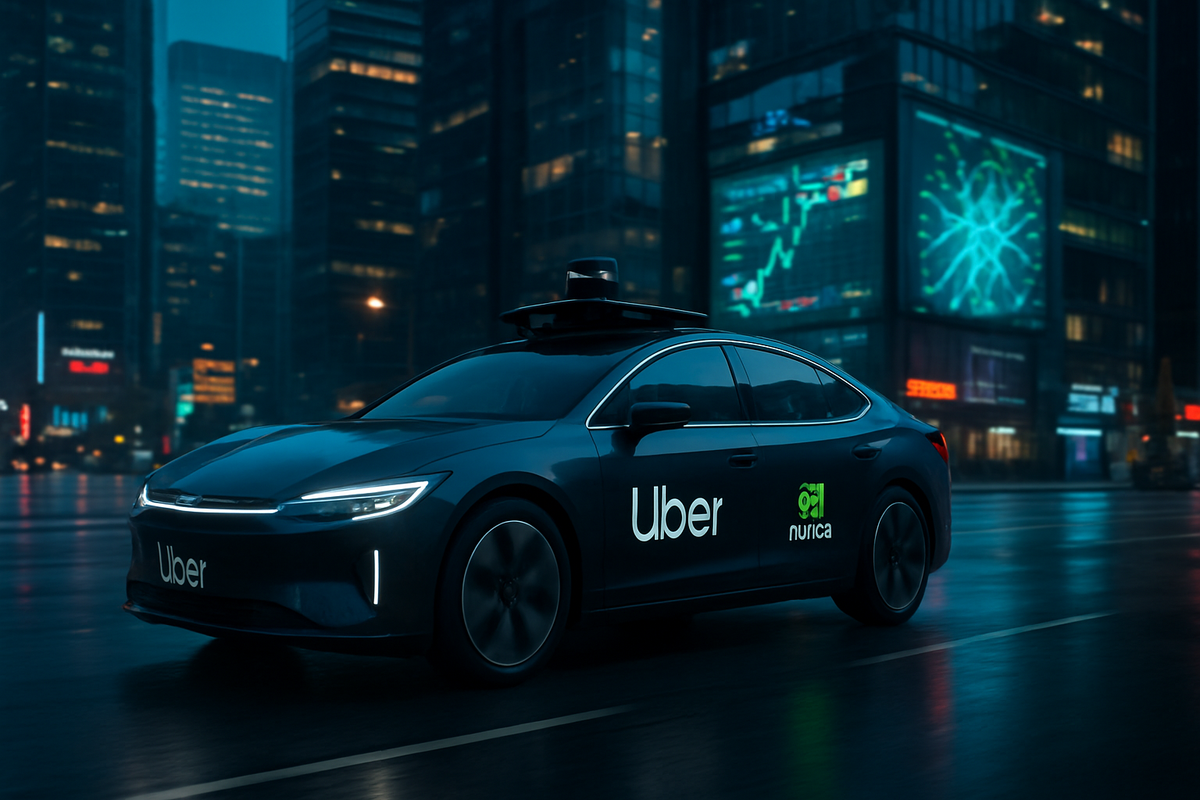
SAN FRANCISCO — Shares of Uber Technologies (NYSE: UBER) jumped 5.6% on Tuesday, March 17, 2026, closing at a multi-year high of $78.83. The rally followed a landmark announcement at Nvidia’s (NASDAQ: NVDA) annual GTC conference, where the two companies unveiled a massive expansion of their autonomous vehicle (AV) partnership. The deal outlines a plan to deploy a global fleet of 100,000 Level 4 robotaxis across 28 cities by 2028, signaling a definitive shift in the race for driverless dominance.
The market’s enthusiastic reaction reflects a growing consensus that Uber’s "asset-light" strategy—orchestrating a marketplace for third-party autonomous fleets—is winning out over the capital-intensive, vertically integrated models favored by some competitors. By leveraging Nvidia’s cutting-edge "Physical AI" and a network of global automakers, Uber is positioning itself as the indispensable operating system for the future of urban mobility.
A "ChatGPT Moment" for Autonomous Transit
The centerpiece of the announcement is the integration of Nvidia’s new "Alpamayo" AI model into Uber’s ride-hailing ecosystem. Described by Nvidia CEO Jensen Huang as the "ChatGPT moment for physical AI," Alpamayo is a reasoning-based software stack that allows vehicles to navigate complex "long-tail" scenarios—such as unpredictable road construction or chaotic pedestrian behavior—with human-like logic rather than simple pattern recognition.
The timeline for the rollout is aggressive. While pilots are already operational in cities like Phoenix and Abu Dhabi, the new Nvidia-powered fleet will begin full-scale commercial operations in Los Angeles and San Francisco in early 2027. A specialized pilot program in Tokyo is scheduled for late 2026, utilizing Nissan (OTC: NSANY) vehicles equipped with the Nvidia DRIVE Hyperion 10 platform. The partnership eventually aims to reach 28 cities across North America, Europe, Asia, and Australia, effectively commoditizing the "driver" through standardized, high-performance AI.
Key stakeholders in this deal extend beyond the two tech giants. Uber has secured commitments from several major automakers, including BYD (OTC: BYDDY), Geely, and Stellantis (NYSE: STLA), to manufacture "robotaxi-ready" vehicles pre-integrated with Nvidia’s hardware. This multi-player ecosystem allows Uber to scale without the financial burden of owning or maintaining a massive vehicle fleet, a move that analysts say "de-risks" the company's path to long-term profitability.
Winners and Losers in the Autonomous Shakeout
The surge in Uber’s stock has sent ripples through the broader transportation sector. Nvidia emerges as a primary winner, further solidifying its transition from a chip manufacturer to a full-stack AI provider. By powering Uber’s global network, Nvidia is effectively setting the industry standard for Level 4 autonomous software.
Conversely, the news has intensified pressure on Lyft (NASDAQ: LYFT). With a significantly smaller R&D budget and a market share that has remained stagnant between 24% and 32% through 2025, Lyft is increasingly viewed as a potential "loser" in the AV wars. Without a comparable global AI partner, Lyft may be forced into a defensive merger or become a mere regional subcontractor for larger AV entities like Alphabet’s (NASDAQ: GOOGL) Waymo.
Traditional car rental agencies like Hertz (NASDAQ: HTZ) and Avis (NASDAQ: CAR) are also at a crossroads. As robotaxis begin to cannibalize short-duration business travel and airport transfers, these companies are pivoting to survive. Many are reinventing themselves as "fleet managers," offering cleaning, charging, and maintenance services for the very robotaxi fleets that threaten their core rental business. Meanwhile, Tesla (NASDAQ: TSLA) remains the wildcard; while its "Cybercab" is a formidable competitor, Uber’s ability to partner with multiple manufacturers simultaneously provides a level of regional flexibility that Tesla's single-brand approach may struggle to match.
The Regulatory Green Light and Industry Shifts
The Uber-Nvidia expansion arrives as the regulatory landscape for autonomous vehicles reaches a tipping point. In early 2026, the U.S. National Highway Traffic Safety Administration (NHTSA) proposed a pivotal rule change to Federal Motor Vehicle Safety Standards, officially allowing for the mass production of vehicles without traditional steering wheels or pedals. This follows the successful implementation of the UK’s Automated Vehicles Act and the EU’s Regulation 2026/481, which harmonized safety standards across Europe.
This regulatory clarity has shifted the industry's focus from "can it work?" to "how fast can it scale?" Uber’s strategy highlights a broader trend toward "Physical AI"—the application of large-scale transformer models to real-world robotics. By moving away from the proprietary, closed-loop systems of the early 2020s, the market is embracing a more open, collaborative architecture. This shift allows tech companies to focus on software and distribution while traditional manufacturers focus on the "hardware" of the vehicle itself.
Historically, this mirrors the evolution of the personal computer and smartphone industries, where the winners were often those who controlled the software and the consumer interface, rather than the companies that built every individual component.
The Road Ahead: 2026 and Beyond
In the short term, investors will be watching for the results of the Tokyo pilot in late 2026. This will serve as a crucial test of the Alpamayo AI's ability to handle the dense, complex traffic patterns of a major international metro area outside of the United States. If successful, it could trigger a series of strategic pivots from competitors who are currently trailing in international deployment.
Longer-term, the challenge for Uber will be managing the "frenemy" relationship with Waymo and other AV providers. Uber currently acts as an aggregator, listing Waymo rides alongside its own offerings. As Uber launches more of its own Nvidia-powered vehicles, the tension between being a marketplace and being a direct operator will likely grow. Furthermore, the transition will require significant investment in "Autonomous Operations Centers"—the digital and physical infrastructure needed to monitor and troubleshoot thousands of driverless cars in real-time.
Market Outlook and Final Thoughts
The partnership between Uber and Nvidia marks the beginning of the "commercialization era" for autonomous ride-sharing. For investors, the takeaway is clear: Uber has successfully navigated the "trough of disillusionment" regarding self-driving technology and has emerged with a scalable, profitable business model. The 5.6% stock jump is not just a reaction to a single deal, but a validation of Uber's role as the central hub of the future transportation economy.
As we move toward 2027, the market will transition from counting test miles to counting paid autonomous trips. Investors should keep a close eye on Uber’s quarterly "take rate" from autonomous rides and any further regulatory hurdles in key expansion cities. While the road to 28 cities is long, the foundation laid this week suggests that the robotaxi is no longer a futuristic concept, but an imminent market reality.
This content is intended for informational purposes only and is not financial advice.