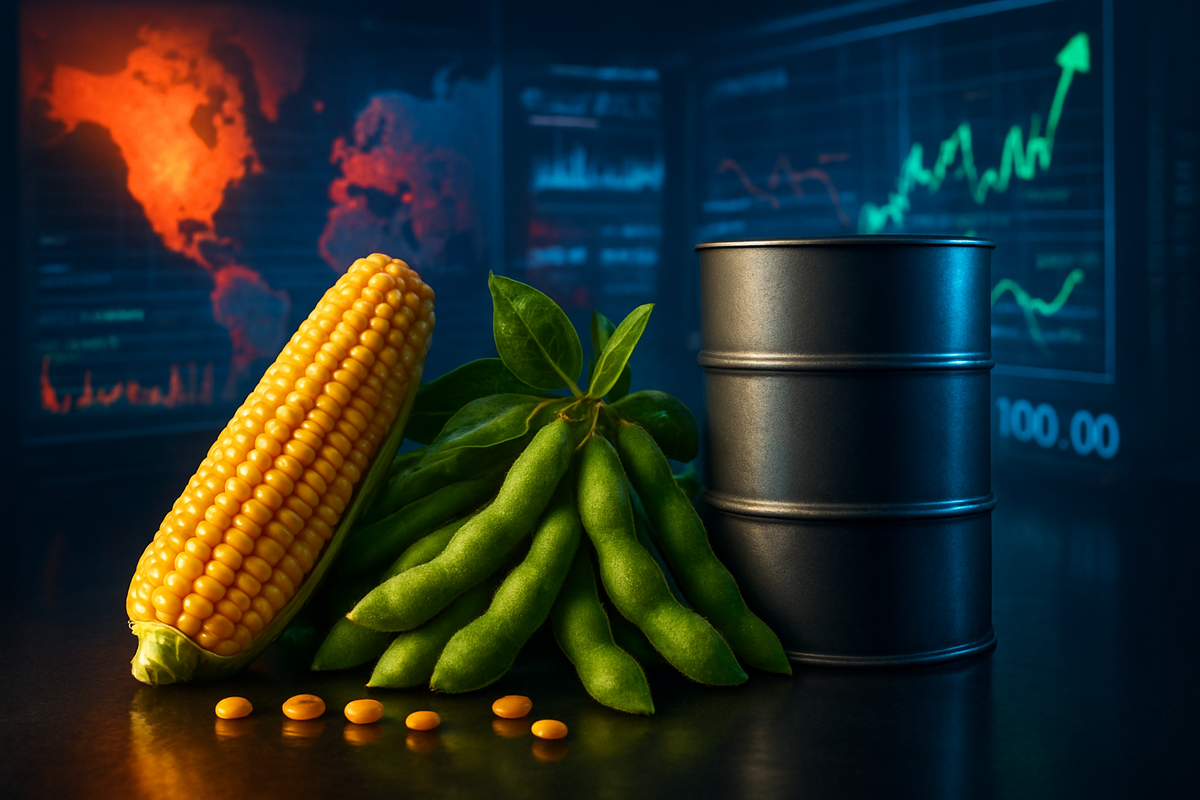
As of mid-March 2026, the global agricultural markets have entered a phase of intense volatility, with corn futures surging to new contract highs and soybeans hovering near record-breaking levels. This rally is primarily fueled by a dramatic spike in crude oil prices and escalating geopolitical instability in the Middle East, which has fundamentally altered the risk landscape for commodities. Traders and analysts are closely monitoring the interplay between energy costs and food supplies, as the "energy-ag" link reaches its strongest point in years.
The surge has seen May 2026 corn futures trade between $4.52 and $4.67 per bushel, while new-crop December contracts have flirted with the $5.00 psychological barrier. Simultaneously, soybean futures have climbed past $12.25 per bushel, driven by a massive rally in soybean oil—a critical feedstock for the burgeoning renewable diesel industry. These price movements reflect a broader market anxiety that hasn't been seen since the major disruptions of the mid-2020s, signaling a potential long-term shift in global trade dynamics.
Geopolitics and Energy: The Dual Engines of the Rally
The current market environment was catalyzed by a sharp escalation in conflict involving the United States, Israel, and Iran in late February 2026. Reports of naval disruptions in the Strait of Hormuz led Brent crude oil prices to surge past the $95 per barrel mark, which immediately trickled down into the agricultural sector. Higher petroleum costs have two major effects: they increase the cost of producing and transporting grain, and they make biofuels like ethanol and renewable diesel much more economically attractive. This "biofuel pull" has provided a solid floor for grain prices even as global supply chains face new hurdles.
The timeline of this rally is intrinsically linked to the energy market's reaction to the Middle Eastern crisis. By early March, the disruption of the Strait of Hormuz caused maritime freight rates to skyrocket by 25% to 35%, complicating the export of grains from both North and South America. Furthermore, a Russian drone strike on a grain vessel in the Black Sea earlier this month reintroduced a significant risk premium into the wheat markets. Chicago Soft Red Winter (SRW) wheat has pushed toward $6.25 per bushel as a result, despite heavy competition from cheaper Russian exports that continue to undercut Western prices.
Beyond the direct price of grain, the "input" side of the ledger has seen even more dramatic shifts. The Middle East is a global hub for nitrogen-based fertilizers, and the current conflict has caused urea prices at the U.S. Gulf to explode by 25% in a single 48-hour window. With global urea prices now ranging between $540 and $600 per tonne, the cost of the 2026 planting season is becoming prohibitively expensive for many producers, particularly in Brazil where diesel prices have recently jumped from R$ 6 to over R$ 8 per liter.
Market Winners and Losers: Agribusiness Giants Under the Microscope
The sudden volatility has created a bifurcated landscape for public companies. Major grain processors and traders such as Archer-Daniels-Midland (NYSE: ADM) and Bunge Global SA (NYSE: BG) are positioned to benefit from increased trading volumes and the volatility that traditionally boosts their merchandising margins. As farmers in the U.S. Midwest rush to sell stored grain to capitalize on the price spikes, these firms have seen their elevators reaching capacity, providing them with a steady stream of processing income.
On the manufacturing side, fertilizer giants like CF Industries Holdings (NYSE: CF) and The Mosaic Company (NYSE: MOS) have seen their stock sentiment improve as the price of nitrogen and potash-based products spikes. While the cost of natural gas—a key input for fertilizer—is also rising, the sheer magnitude of the price jump in urea and other products often allows these companies to expand their margins during supply shocks. However, the long-term sustainability of these gains depends on whether farmers can afford to maintain high application rates during the upcoming spring planting.
Conversely, downstream companies are facing significant pressure. Meat processing giants like Tyson Foods (NYSE: TSN) are seeing their input costs—primarily corn and soy-based feed—climb at a time when consumer demand is already sensitive to food inflation. Similarly, farm equipment leaders like Deere & Company (NYSE: DE) may face headwinds if the "margin squeeze" on farmers becomes too severe. Although crop prices are high, if fertilizer and fuel costs eat up the profits, farmers may delay large capital expenditures on new machinery, opting instead to repair existing fleets to preserve cash flow.
Broader Significance: The Biofuel Revolution and Policy Shifts
This rally is not an isolated event; it represents a significant chapter in the ongoing integration of the energy and agricultural sectors. The strength in soybean oil, which jumped over 2.5% in recent sessions, is a direct result of the shift toward renewable diesel. As crude oil prices remain elevated, the U.S. administration is expected to release a robust Renewable Volume Obligation (RVO) package, which would mandate higher levels of biofuel blending. This policy trend creates a "structural demand" for soybeans that makes the market less dependent on traditional export demand from China and more tied to domestic energy policy.
Historically, this period draws comparisons to the 2022 commodity spike, yet with a key difference: the dominance of the biofuel sector. In 2026, the infrastructure for renewable diesel is far more mature than it was four years ago, meaning that soy and corn are now viewed as legitimate energy hedges. This shift has regulatory implications, as policymakers must balance the goal of energy independence through biofuels with the risk of escalating food prices at the grocery store.
Furthermore, the ongoing tension in the Black Sea and the Middle East highlights the fragility of global "just-in-time" supply chains. The 25-35% increase in freight costs is a reminder that the cost of moving food is just as critical as the cost of growing it. This may lead to a broader trend of "near-shoring" agricultural trade, where countries prioritize domestic production or trade with geographically closer partners to mitigate the risks of long-haul maritime transport in volatile corridors.
The Road Ahead: Planting Decisions and Strategic Pivots
Looking ahead to the next quarter, the primary focus for the market will be the U.S. Department of Agriculture (USDA) planting intentions report. The massive spike in fertilizer costs might force a strategic pivot among farmers, who may choose to plant more soybeans—which require less nitrogen fertilizer—instead of corn. If a significant acreage shift occurs, the corn market could see even further upside as supply projections for the 2026/27 marketing year are revised downward.
In the short term, any signs of diplomatic de-escalation in the Middle East could lead to a rapid "correction" in prices as the geopolitical risk premium evaporates. However, the underlying energy costs and the push for biofuels are likely to provide a higher price floor than in previous cycles. Investors and market participants should prepare for a "new normal" where agricultural commodities are traded with the same sensitivity to global headlines as crude oil and gold.
For the agricultural sector, the immediate challenge will be managing the logistics of the current harvest in the Southern Hemisphere while preparing for the Northern Hemisphere's spring. Companies that can effectively navigate the rising freight costs and secure fertilizer supplies will likely emerge as the leaders of the 2026 fiscal year. The market's resilience will be tested by whether demand can withstand these higher price levels or if a period of demand destruction is on the horizon.
Summary and Outlook for Investors
The mid-March 2026 rally in corn and soybeans is a complex event driven by the convergence of energy scarcity, geopolitical conflict, and a maturing biofuel industry. With corn at contract highs and soybeans testing record territory, the agricultural sector has once again become a central focus for global investors. The immediate takeaway is the heightened correlation between the pump and the bin; as long as energy remains volatile, grain prices will likely follow suit.
Moving forward, the market will be defined by its ability to absorb these higher costs. Investors should keep a close watch on the upcoming RVO announcements and any shifts in the Middle Eastern conflict. While the current environment offers opportunities for grain traders and fertilizer producers, the broader economy must grapple with the inflationary pressures of "agri-energy" volatility. In the coming months, the focus will shift from the fear of supply disruptions to the reality of the 2026 planting season, which will ultimately dictate the price of food for the next year.
This content is intended for informational purposes only and is not financial advice