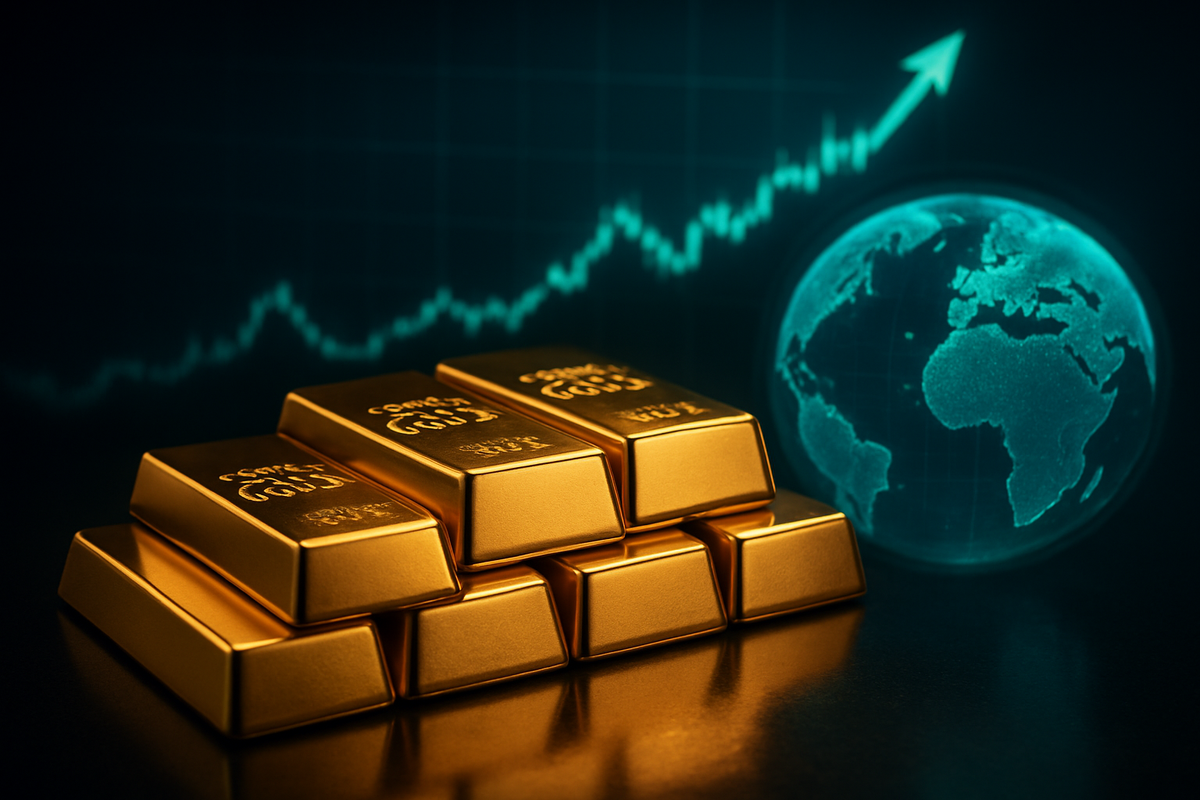
The global financial landscape reached a historic milestone this week as spot gold prices surged to an unprecedented all-time high of approximately $4,380 per ounce. This rally, which has seen the precious metal nearly double in value over a relatively short period, marks a fundamental shift in how investors and sovereign states perceive "hard assets" in an era of increasing fiscal and geopolitical uncertainty. As of March 18, 2026, the psychological barrier of $4,000 has not only been breached but firmly established as a new floor for the market.
The immediate implications of this surge are being felt across all asset classes. While equity markets have shown pockets of resilience, the massive rotation into bullion suggests a defensive posture among institutional "whales" and sovereign wealth funds. For the average consumer, the surge is manifesting in higher costs for electronics and jewelry, but for the broader market, it signals a profound lack of confidence in traditional fiat-denominated debt instruments amid a backdrop of persistent global volatility.
A Perfect Storm: The Path to $4,380
The journey to $4,380 per ounce was paved by a series of compounding global shocks that began in late 2025. A primary driver has been the relentless "hoarding" of gold by central banks, led prominently by the People’s Bank of China (PBOC). By March 2026, the PBOC extended its official gold-buying streak to 16 consecutive months, pushing its reserves to over 2,300 tonnes. This strategic "de-dollarization" effort has been mirrored by other emerging markets, including the National Bank of Poland and the Central Bank of Brazil, who together purchased over 1,000 metric tonnes in 2025 alone.
The timeline of the most recent spike can be traced back to January 2026, following a period of intense geopolitical friction. Specifically, a U.S. military operation in Venezuela and renewed escalations in the Middle East involving Iran triggered a massive "flight-to-safety" capital flow. Furthermore, a prolonged U.S. government shutdown in the final quarter of 2025 eroded international confidence in the stability of the U.S. Dollar, providing the final push needed for spot prices to crack the $4,000 resistance level.
Analysts also point to a significant report from Goldman Sachs (NYSE: GS) titled "The Next Boom," which correctly predicted this rally. The report highlighted that despite rising prices, retail investor exposure to gold remained at a historic low of just 0.06%—far below the peaks seen in 2012. As retail investors began to FOMO (fear of missing out) into the market through gold-backed ETFs and physical bullion, the "next boom" became a self-fulfilling prophecy, driving prices toward the current $4,380 mark.
Miners Prosper While Manufacturers Face Margin Pressure
The primary beneficiaries of this historic rally are the global mining giants, who are currently enjoying record-breaking margins. Newmont (NYSE: NEM), the world's largest gold miner, recently reported a staggering $7.3 billion in free cash flow for the previous fiscal year, with revenues hitting $22.67 billion. Similarly, Barrick Gold (NYSE: GOLD) saw its operating cash flow reach a record $7.7 billion, prompting the company to announce an aggressive new dividend policy and plans for a strategic North American IPO of certain high-yield assets.
Investment vehicles have also seen massive inflows. The SPDR Gold Shares (NYSE: GLD) and the iShares Gold Trust (NYSE: IAU) have recorded their strongest quarterly growth in over a decade. These ETFs have become the primary entry point for retail investors looking to capture the "Goldman Boom," adding over 500 tonnes of physical gold to their vaults in the last six months to keep pace with demand.
However, the rally is a double-edged sword for other sectors. Consumer electronics companies, such as Apple (NASDAQ: AAPL), which use gold in various components and circuitry, are beginning to feel the pinch of rising input costs. While the amount of gold per device is small, the cumulative effect of a 100% price increase in bullion over two years is forcing manufacturers to choose between shrinking margins or passing costs onto consumers. The luxury jewelry market is also seeing a cooling of demand as "investment-grade" gold becomes too expensive for casual discretionary spending.
De-Dollarization and the Great Re-Rating
The wider significance of gold’s ascent to $4,380 cannot be overstated. It represents more than just a commodity rally; it is a "Great Re-Rating" of hard assets. Historically, gold prices moved inversely to real interest rates, but that correlation has decoupled in 2026. Central banks are now purchasing gold regardless of price or interest rate environments, treating it as a permanent "base load" for their reserves. This shift suggests a structural move away from the post-WWII dominance of the U.S. Dollar in global reserves.
Comparisons are being drawn to the stagflationary period of the late 1970s and the post-2008 financial crisis bull run. However, the current event is unique due to the level of institutional and sovereign participation. Unlike previous bubbles, which were often driven by speculative retail fever, the $4,380 level is being supported by "conviction buyers" who are holding the metal as a hedge against geoeconomic fragmentation and the perceived risk of "fiscal dominance" in Western economies.
This trend has ripple effects across the entire commodities complex. Silver, platinum, and copper have all seen sympathy rallies as investors seek alternatives to the increasingly expensive yellow metal. Furthermore, the regulatory environment is shifting, with some emerging market nations considering "gold-backed" trade settlement systems to bypass traditional Western-led banking infrastructures, a move that could permanently alter the mechanics of international trade.
The Road Ahead: Will the Boom Continue?
Looking toward the remainder of 2026, the question on every analyst’s mind is whether gold has peaked or if it is merely consolidating for a run toward $5,000. In the short term, technical indicators suggest the $4,380 level may act as a zone of heavy resistance, potentially leading to a period of healthy consolidation. However, Goldman Sachs and UBS analysts have already updated their year-end targets, with some forecasting a path toward $4,900 to $5,400 if retail participation returns to 2012 levels.
Strategic pivots are already underway. Mining companies are shifting their focus from "volume" to "value," prioritizing the extraction of high-grade ores to maximize profits while the price is high, rather than expanding production capacity which could take years to come online. Meanwhile, fintech companies are rushing to launch "fractional gold" products, aiming to make the $4,380-per-ounce metal accessible to smaller retail investors who can no longer afford full coins or bars.
Potential challenges include a "peace pivot"—a sudden resolution to major geopolitical conflicts—which could see a rapid unwinding of the safe-haven premium. Additionally, if the Federal Reserve were to pivot back to an aggressively hawkish stance to combat the inflationary pressures caused by high commodity prices, the opportunity cost of holding non-yielding gold could eventually weigh on the market.
Summary and Investor Outlook
The surge of gold to $4,380 per ounce is a landmark event that defines the financial landscape of 2026. Driven by a combination of central bank de-dollarization, extreme geopolitical instability, and a long-overdue return of retail interest, the rally has transformed gold from a stagnant hedge into a high-performing growth asset. The record earnings of miners like Newmont and Barrick Gold highlight the immediate windfall, while the "Next Boom" predicted by major investment banks seems to still have room to run.
Moving forward, investors should keep a close watch on two key metrics: the monthly gold-buying reports from the PBOC and the flow of capital into Western gold ETFs. These will be the primary indicators of whether the current price level is sustainable. While the "Shiny 7" mining stocks are currently outperforming the tech sector, the market remains sensitive to geopolitical shifts. For now, gold has re-established itself as the ultimate arbiter of value in an increasingly volatile world.
This content is intended for informational purposes only and is not financial advice.