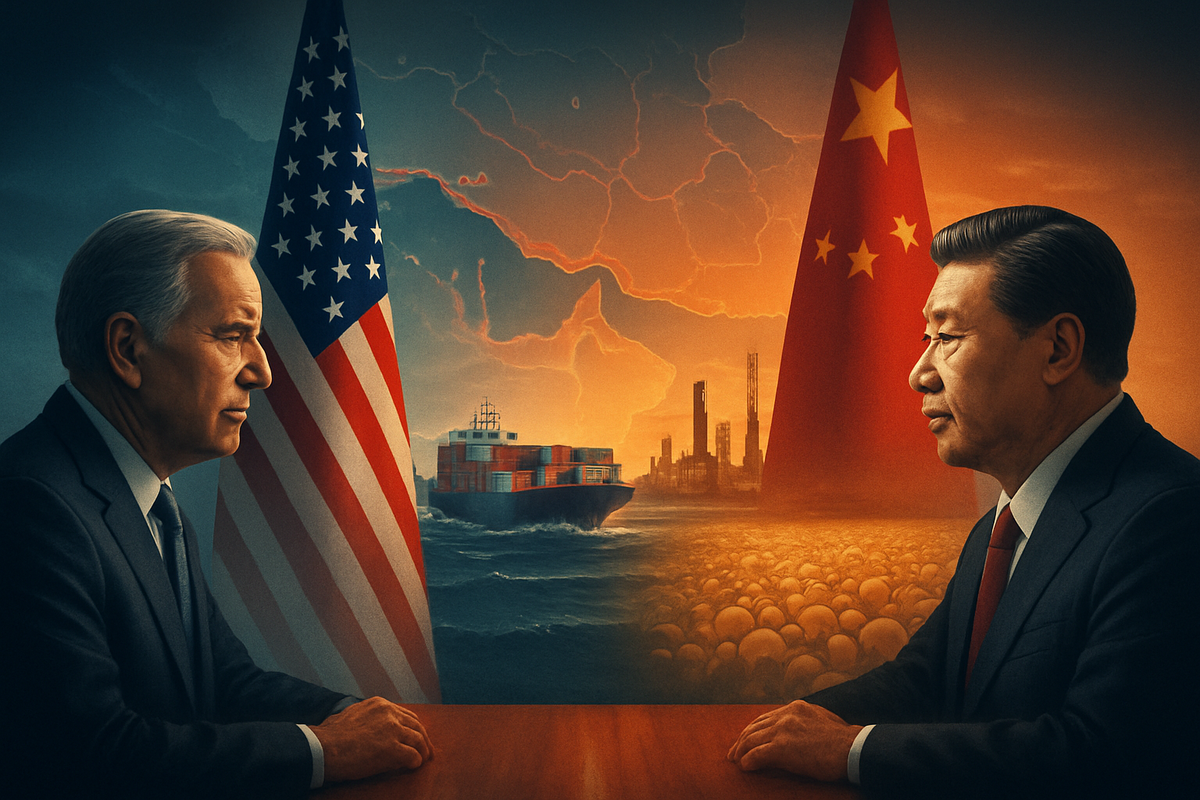
As of March 18, 2026, the global geopolitical landscape has shifted dramatically, forcing a recalibration of the highly anticipated diplomatic engagement between the United States and China. Originally scheduled for late March, the summit between President Donald Trump and Chinese President Xi Jinping has been pushed back to late April, as the White House focuses on the escalating "Operation Epic Fury"—the joint U.S.-Israeli military campaign against Iran. In the interim, high-stakes negotiations have shifted to a "working summit" framework involving U.S. Treasury Secretary Scott Bessent and Chinese Vice Premier He Lifeng, where the "Paris Pivot" trade talks have taken on a new urgency.
The immediate implications are profound for global markets. With the Strait of Hormuz effectively closed and the Red Sea once again a combat zone, the diplomatic agenda has been stripped of peripheral issues. Today, the conversation is dominated by four critical pillars: energy security, secondary sanctions, shipping stability, and the massive soybean purchase commitments that serve as the primary currency of U.S.-China relations. As oil prices hover stubbornly above $100 per barrel, the ability of these two superpowers to find a "Trade-for-Security" swap has become the single most important variable for global economic stability.
A Timeline of Escalation and Diplomacy
The current crisis traces its roots to February 28, 2026, when a series of maritime skirmishes in the Persian Gulf led to the official launch of "Operation Epic Fury." By March 2, Iran responded by deploying advanced sea mines and anti-ship missiles, effectively shutting down the Strait of Hormuz. This chokepoint, which historically handles 20% of the world's daily oil supply and a significant portion of global Liquefied Natural Gas (LNG), saw tanker traffic plummet by 90% in a matter of days. The disruption was compounded by a resurgence of Houthi rebel attacks in the Red Sea, forcing major carriers to abandon the Suez Canal in favor of the arduous route around the Cape of Good Hope.
In response to this chaos, the Trump administration has utilized the upcoming summit as both a carrot and a stick. On March 11, the U.S. Trade Representative (USTR) launched 16 new Section 301 investigations into Chinese manufacturing overcapacity, signaling that trade concessions are off the table unless Beijing takes a more active role in stabilizing the Middle East. The "Paris Pivot" talks held last week between He Lifeng and Secretary Bessent focused on a proposed deal: the U.S. would delay or soften its newly announced 25% "secondary sanctions" on countries trading with Iran in exchange for China using its significant leverage in Tehran to reopen the Strait and committing to a guaranteed 25 million metric tons (MMT) of U.S. soybean purchases for the 2026 season.
The market reaction has been one of extreme volatility mixed with a flight to safety. Commodity traders are closely watching the "Soybean Lever," as China has recently slowed its U.S. purchases in favor of record-breaking harvests from Brazil. The Trump administration’s insistence on an immediate 12 MMT "good faith" purchase before the rescheduled summit has created a floor for agricultural prices, even as shipping costs soar.
Winners and Losers in the Commodity and Shipping Sectors
The energy sector has seen a stark divergence in performance. ExxonMobil (NYSE: XOM) has emerged as a relative "winner" in this high-risk environment. With its massive footprint in the Permian Basin and Guyana, XOM is less exposed to Middle Eastern volatility than its peers, though it faces logistical challenges regarding its personnel in Qatar. Conversely, Chevron (NYSE: CVX) has faced headwinds following the mandatory shutdown of the Leviathan gas field off the coast of Israel due to security risks, highlighting the regional vulnerabilities of Western supermajors.
The shipping industry is undergoing a radical restructuring. A.P. Møller - Mærsk A/S (CPH: MAERSK-B) has suspended all services through the Red Sea and Hormuz, implementing emergency surcharges ranging from $1,800 to $3,800 per container. While these surcharges pad top-line revenue, the increased fuel costs and 14-day transit delays around Africa are squeezing margins. Meanwhile, ZIM Integrated Shipping Services Ltd. (NYSE: ZIM) has been thrust into a unique position; as it mobilizes its fleet for Israel’s national defense, it has become the subject of a massive $4.2 billion acquisition bid by Hapag-Lloyd (ETR: HLAG), as global carriers scramble for strategic assets in a fragmented maritime world.
In the agricultural space, the "battle for volume" is intensifying. Giants like Archer-Daniels-Midland (NYSE: ADM) and Bunge Global SA (NYSE: BG) are navigating a treacherous path. While a successful U.S.-China summit would guarantee massive export volumes for ADM and BG, the current high cost of shipping and the competitive threat from South American suppliers are pressuring margins. If the summit fails to produce a "Grand Bargain," these companies could see a significant pivot by China toward non-U.S. suppliers, potentially leading to a long-term structural decline in U.S. ag-export dominance.
Broader Industry Trends and Historical Precedents
This event marks a definitive shift toward "managed trade," a framework the Trump administration has championed through the Reciprocal Trade Act. Unlike the broad "decoupling" efforts of the early 2020s, the 2026 approach is one of "transactional pragmatism." Energy security has become the new global currency, replacing technology transfers as the primary focus of trade diplomacy. The U.S. is essentially using its military and energy independence as a bargaining chip to force China into a reciprocal trade relationship that favors American farmers and manufacturers.
The current situation echoes the 1970s oil shocks but with a modern, high-tech twist. In 1973, energy was the weapon; in 2026, the weapon is the access to energy transport. The use of secondary sanctions against any nation "doing business" with Iran—announced by the Trump administration on January 13, 2026—serves as a powerful deterrent that forces China to choose between its energy imports from Tehran and its access to the U.S. consumer market. This "binary choice" diplomacy is a hallmark of the current administration’s foreign policy.
Furthermore, a February 20, 2026, Supreme Court ruling that struck down certain executive-branch tariff authorities has forced the administration to pivot back to Section 301 and Section 122 of the Trade Act of 1974. This move has standardized the trade war, making it more predictable for lawyers but more volatile for markets, as every investigation serves as a potential trigger for new surcharges.
The Path Forward: April and Beyond
The next 45 days will be critical. If the working-level talks between Vice Premier He Lifeng and Secretary Bessent yield a preliminary agreement, we may see a "Cooling Off" period where China begins to fulfill its 25 MMT soybean commitment and the U.S. offers a 90-day waiver on secondary sanctions for major Chinese state-owned enterprises. Such a move would likely stabilize Brent crude prices back into the $85–$90 range and provide a much-needed reprieve for global shipping lanes.
However, the risk of a "Strategic Pivot" remains high. Should China decide that the price of U.S. cooperation is too high, they may accelerate their "Silk Road 2.0" initiatives, deepening ties with Russia and Iran to bypass U.S.-controlled maritime chokepoints entirely. For the market, this would mean a permanent increase in the "geopolitical risk premium" for all commodities. Investors should watch for the results of the USTR's shipbuilding investigation, as any new tariffs on Chinese vessels could further disrupt a global shipping industry already pushed to its limits.
Wrapping Up the 2026 Summit Outlook
The upcoming Trump-Xi summit, and the preliminary meetings between He Lifeng and U.S. officials, represent more than just a trade meeting; they are a negotiation over the future of the global supply chain. The Iran conflict has acted as a catalyst, merging energy security and agricultural trade into a single diplomatic objective. The market is currently pricing in a "managed tension" scenario, but the closure of the Strait of Hormuz remains a black swan that could upend even the best-laid plans.
Key takeaways for the months ahead include the resilience of domestic energy producers like ExxonMobil, the continued volatility in shipping rates led by Maersk, and the pivotal role of U.S. soybean exports as a barometer for diplomatic success. Moving forward, the market will be looking for concrete "buy" orders from Beijing as a sign that the April summit will proceed as planned. Investors should remain vigilant, watching for any signs of a "Grand Bargain" that could reopen the world's most vital waterways and restore a semblance of order to the commodity markets.
This content is intended for informational purposes only and is not financial advice.