Axon Enterprise (NASDAQ: AXON) has once again redefined the landscape of public safety technology, reporting a blockbuster fourth quarter for 2025 that blew past Wall Street estimates. The company announced a staggering 39% year-over-year revenue surge to $797 million, fueled by a strategic pivot toward high-margin software services and a massive influx of orders for its latest hardware iterations. This performance cements Axon’s position as the dominant force in the "AI-first" era of law enforcement, transitioning from a hardware manufacturer to a comprehensive digital ecosystem provider.
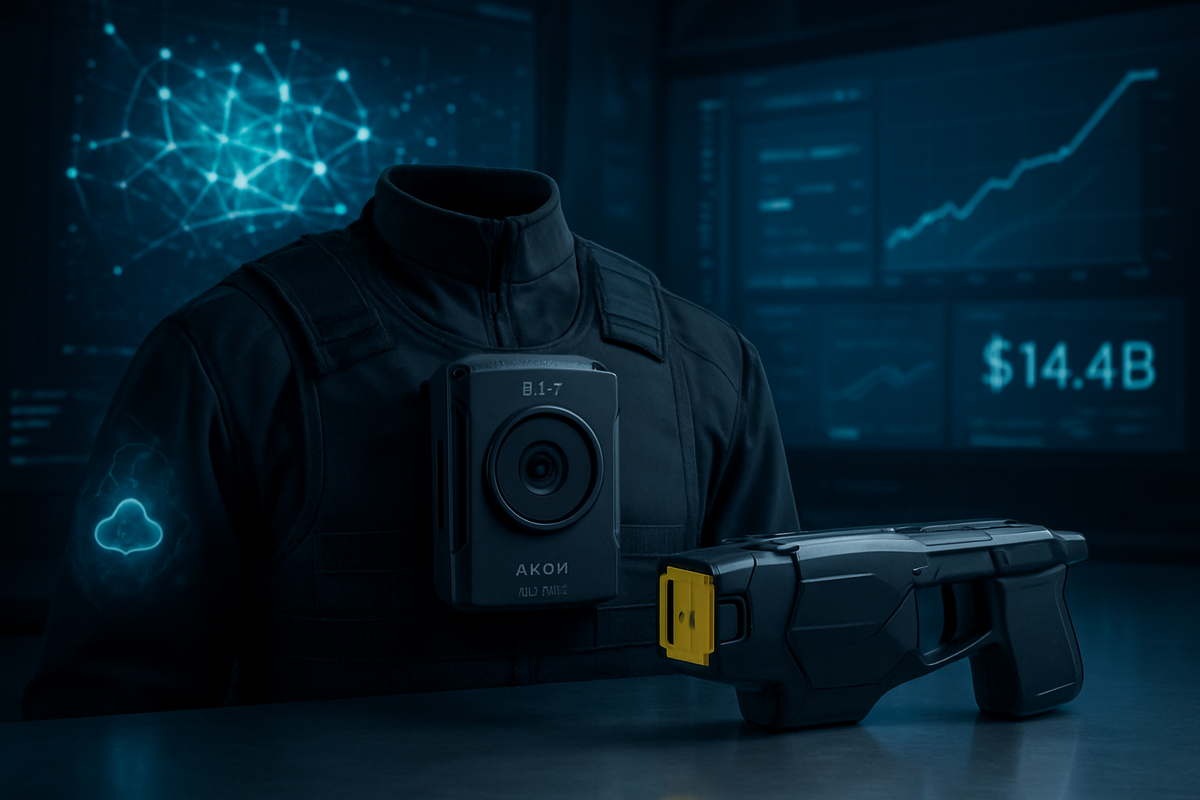
The implications of this report extend far beyond a single quarter’s earnings. With a contracted backlog that has ballooned to $14.4 billion—a 43% increase from the previous year—Axon has secured a predictable revenue stream that spans the next decade. This financial moat, combined with the rapid adoption of AI-driven tools like Draft One, suggests that Axon is not just selling tools to police departments, but is becoming the essential operating system for modern governance and public safety.
The Numbers Behind the Surge: A Breakdown of the Q4 Performance
The financial results released on February 24, 2026, showcase a company firing on all cylinders. Beyond the headline revenue of $797 million, the most striking figure was the performance of the Axon Cloud & Services segment. Revenue from this high-margin software division grew by 40% to $343 million, reflecting the success of Axon’s "land-and-expand" strategy. By placing Body 4 cameras and TASER 10 devices into the hands of officers, the company has effectively funneled agencies into its lucrative Evidence.com ecosystem and new AI reporting suites.
The demand for physical hardware remains the primary engine for this software growth. The TASER segment saw a 32% increase in revenue to $264 million, driven almost entirely by the TASER 10, which features extended range and increased effectiveness. Simultaneously, the "Connected Devices" segment, which houses the Axon Body 4, grew 38% to $454 million. These hardware sales are increasingly bundled with premium software tiers, leading to a record net revenue retention rate of 125%, meaning existing customers are spending 25% more with Axon each year.
The market reaction was swift and overwhelmingly positive. Following the earnings call, Axon’s shares surged nearly 18% as investors digested the non-GAAP adjusted EPS of $2.15, which crushed the consensus estimate of $1.60. While GAAP net income remained modest at $3 million due to heavy R&D spending and stock-based compensation, the market focused on the company’s massive cash flow and the long-term visibility provided by the $14.4 billion backlog.
Winners and Losers: A Widening Gap in Public Safety Tech
Axon Enterprise is the clear victor in the current market environment, leveraging its first-mover advantage in body camera cloud storage to build an unassailable data advantage. Shareholders who have weathered the stock’s high valuation have been rewarded with a valuation that reflects Axon’s status as a "mission-critical" SaaS provider rather than a cyclical hardware vendor. The company’s ability to upsell AI tools like Draft One—which can save officers hours of paperwork—has turned Axon into a productivity partner for understaffed police departments.
On the other side of the ledger, legacy competitors like Motorola Solutions (NYSE: MSI) are facing increased pressure to accelerate their own software transformations. While Motorola remains a powerhouse in land mobile radio (LMR) systems and reported steady growth of roughly 12%, it has struggled to match Axon’s explosive pace in the body-worn camera and digital evidence management space. Smaller, niche hardware manufacturers are finding it increasingly difficult to compete as the market moves toward integrated ecosystems; those without a robust cloud and AI component risk being relegated to "dumb hardware" status with thinning margins.
The "AI-First" Evolution and Broader Industry Trends
Axon’s results highlight a broader shift in the defense and public safety industry toward automation and data-driven decision-making. The 40% growth in Axon Cloud is indicative of a trend where data management is more valuable than the device capturing it. Historically, law enforcement technology was fragmented, but Axon has successfully consolidated these silos into a single platform. This mirrors trends seen in other sectors, such as healthtech and fintech, where the platform with the most integrated data wins.
However, this dominance brings regulatory and ethical scrutiny. As Axon’s AI tools begin to generate police reports and analyze body camera footage automatically, the company finds itself at the center of the debate over AI bias and transparency. There are already calls for clearer policy frameworks regarding how generative AI is used in judicial evidence. Axon’s move to preemptively establish an ethics board has provided some cover, but the sheer scale of their $14.4 billion backlog ensures they will remain a primary target for regulatory oversight as their influence over the justice system grows.
Looking Ahead: The Road to $6 Billion
The short-term horizon for Axon looks exceptionally clear, bolstered by the 20-25% of the backlog expected to be realized in the next 12 months. Management has set an ambitious target of reaching $6 billion in annual revenue by 2028, a goal that seems increasingly attainable if current growth rates hold. The next strategic pivot likely involves deeper expansion into international markets and the "Enterprise" sector, where Axon is beginning to market its cameras and evidence software to private security firms and commercial enterprises.
Investors should watch for potential challenges in the form of supply chain scaling and the continued cost of innovation. Maintaining a 40% growth rate in software requires constant feature releases and could lead to significant "feature creep" or technical debt. Furthermore, as Axon pushes further into AI, any high-profile failure of its automated reporting tools could lead to a sudden cooling of department enthusiasm or restrictive local legislation.
Closing Thoughts: A Juggernaut in Motion
Axon’s record-breaking Q4 results represent a watershed moment for the company. By successfully navigating the transition from a specialized hardware firm to a diversified AI and SaaS giant, Axon has effectively decoupled its growth from the standard municipal budget cycles that plague many of its peers. The $14.4 billion backlog acts as a massive shock absorber, providing the stability needed to continue aggressive R&D investments in drones, robotics, and advanced AI.
Moving forward, the primary metric for investors will not just be total revenue, but the continued growth of software margins and the adoption rates of AI-specific subscriptions. While the stock’s premium valuation may give some value investors pause, the company’s "inescapable" ecosystem and role as a critical infrastructure provider suggest that Axon’s momentum is far from spent. In the coming months, all eyes will be on the company’s ability to convert its massive backlog into realized profits while navigating the complex ethical landscape of automated policing.
This content is intended for informational purposes only and is not financial advice.