By: MarketMinute
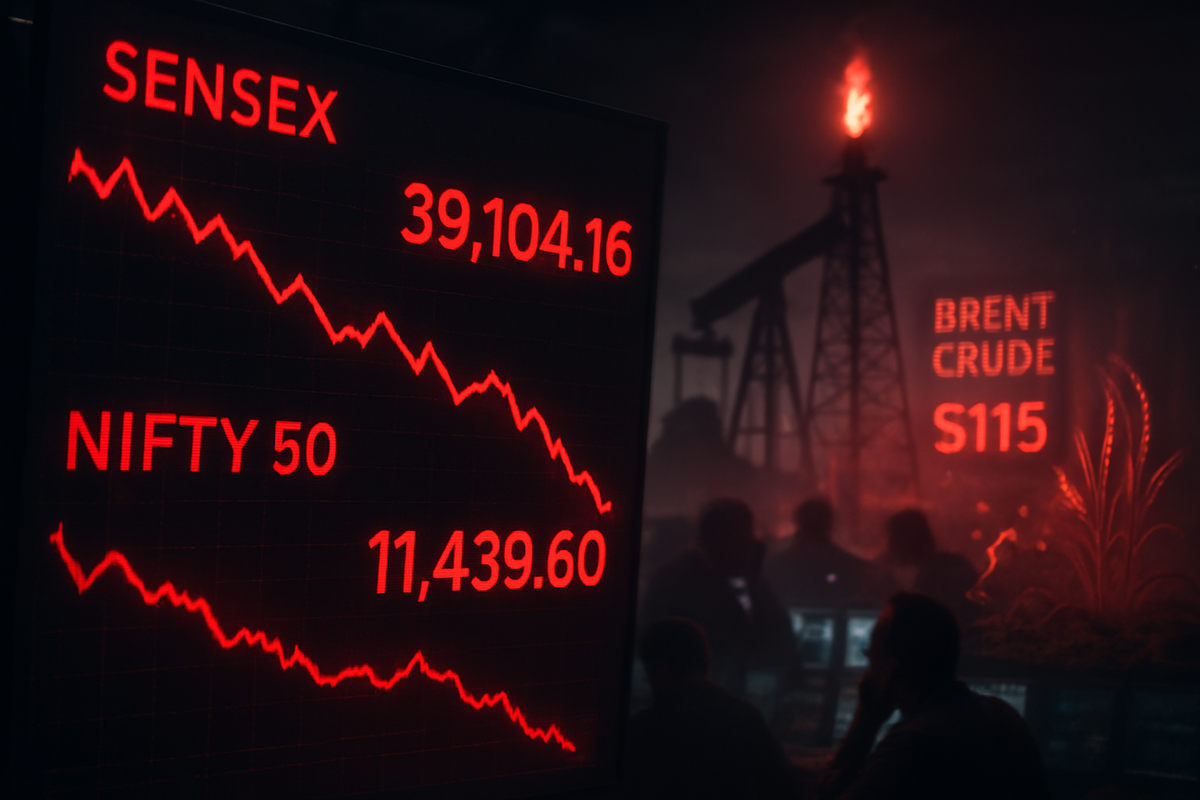
March 9, 2026 — Global financial markets descended into a state of coordinated panic on Monday, as a "perfect storm" of geopolitical conflict, energy scarcity, and agricultural supply shocks triggered a brutal sell-off across major indices. The Indian markets bore the brunt of the "commodity-driven carnage," with the BSE Sensex (INDEXBOM: SENSEX) plummeting 2,400 points, while the Nifty 50 (INDEXNSE: NIFTY_50) crashed through the psychological support level of 24,000 to close at 23,820.
The immediate catalyst for the rout is a sudden, violent spike in Brent crude oil prices, which surged past $115 per barrel following the effective closure of the Strait of Hormuz. This maritime blockade has not only throttled 20% of the world's seaborne oil but has also paralyzed nearly one-third of the global fertilizer trade. As inflation fears reach a fever pitch, investors are engaging in a massive capital rotation, fleeing "risk-on" growth sectors in favor of "real economy" defensive plays, even as traditional safe-havens like gold face counter-intuitive selling pressure driven by liquidity-starved margin calls.
The Strait of Hormuz Blockade: A Timeline of the Crisis
The current market "bloodbath" is the culmination of three weeks of escalating tensions in the Middle East. Following "Operation Epic Fury"—a targeted military offensive against regional nuclear facilities in late February—Iran’s Revolutionary Guard followed through on threats to disable the Strait of Hormuz. By early March, over 20 million barrels per day (mbpd) of crude and LNG were effectively trapped, causing Brent prices to jump 74% from their February baseline.
For India, the world’s third-largest oil consumer, the $115 oil price is an existential threat to its fiscal stability. The Indian Rupee hit a historic low of ₹92.30 against the US dollar today, as oil importers scrambled for greenbacks. The "Black Monday" crash was further exacerbated by a staggering ₹21,800 crore withdrawal by Foreign Institutional Investors (FIIs) in just the first week of March. Adding to the domestic misery, a simultaneous "AI shock" hit the IT sector, with investors dumping heavyweights like Infosys (NSE: INFY) and Tata Consultancy Services (NSE: TCS) following news of advanced autonomous coding tools that threaten to automate the industry’s core service models.
Winners and Losers in the "Real Economy" Rotation
As the broader markets cratered, a stark bifurcation emerged between companies positioned for a high-cost environment and those crushed by rising inputs. Upstream energy producers and fertilizer giants have become the reluctant winners of this volatility. ONGC (NSE: ONGC) saw heavy buying as its domestic production remains insulated from the Middle Eastern blockade, while North American giants like CF Industries (NYSE: CF) and Nutrien (NYSE: NTR) surged on their ability to supply critical nitrogen and potash at record-high spot prices.
Conversely, the losers are numerous and deeply impacted. The aviation sector, led by InterGlobe Aviation (NSE: INDIGO), saw shares plummet as jet fuel prices doubled overnight and international flight paths were forcibly rerouted. Consumer-facing giants like Asian Paints (NSE: ASIANPAINT) and Hindustan Unilever (NSE: HUL) faced intense selling pressure as analysts modeled a "margin massacre" due to rising packaging and chemical derivative costs. Even the financial sector was not spared; HDFC Bank (NSE: HDFCBANK) and ICICI Bank (NSE: ICICIBANK) saw heavy outflows as investors feared a rise in Non-Performing Assets (NPAs) from fuel-sensitive sectors like logistics and MSMEs.
The Great Convergence: Energy, Agriculture, and Equity Risk
The current crisis represents what economists are calling the "Great Convergence"—a moment where energy insecurity, food supply chains, and equity valuations collide. Unlike previous market corrections driven by interest rates or credit defaults, this 2026 crash is rooted in physical scarcity. The fertilizer supply shock is particularly alarming; with 33% of global urea and ammonia trade halted at the Strait, the 2026 spring planting season faces a "silent crisis" that could translate into global food price spikes by late summer.
Historically, this event mirrors the 1973 oil embargo or the 2022 energy crisis, but with the added complexity of high-frequency algorithmic trading. The technical selling witnessed in gold today provides a window into this volatility. While gold is theoretically a safe haven, it fell sharply alongside equities as leveraged traders were forced to liquidate their most profitable "gold paper" positions to cover margin calls on their crashing tech stocks. This "liquidity cascade" suggests that the initial phase of the crash is driven more by forced deleveraging than by fundamental re-valuation.
Navigating the Volatile Road Ahead
In the short term, market participants should prepare for continued turbulence as the world awaits a diplomatic or military resolution to the Hormuz blockade. Central banks, particularly the Reserve Bank of India (RBI), are now in a precarious position. While the economy requires support, the threat of "imported inflation" from $115 oil may force the RBI into an emergency rate hike, further dampening growth prospects for the remainder of 2026.
Strategic pivots are already underway. Forward-thinking investors are looking toward "supply-chain-secure" companies—those with domestic manufacturing footprints and low reliance on Middle Eastern inputs. Scenarios for the next quarter range from a "V-shaped" recovery if the Strait is reopened quickly, to a protracted "stagflationary winter" if the energy and fertilizer supply chains remain fractured into the planting season.
Market Outlook and Final Assessment
The March 9 "bloodbath" marks a definitive end to the era of low-volatility growth. The key takeaway for investors is that the "Great Convergence" has fundamentally altered the risk profile of nearly every asset class. Commodity volatility is no longer a peripheral concern for equity markets; it is now the primary driver of capital flows.
Moving forward, the market will be hyper-sensitive to any news regarding energy transit and fertilizer logistics. Investors should closely monitor the Brent crude price floor and the Rupee’s stability as lead indicators for the next leg of the market. While the "real economy" defensive plays offer some shelter, the lasting impact of this decade-high volatility will likely be a structural shift in how we value global supply chain resilience versus raw growth potential.
This content is intended for informational purposes only and is not financial advice.