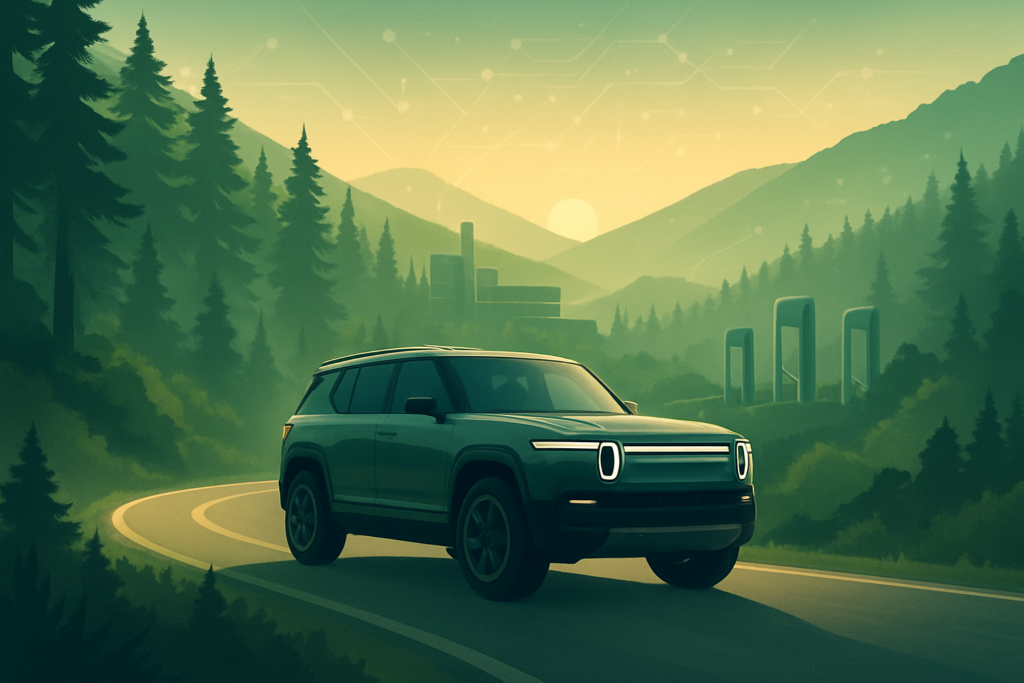
As of December 22, 2025, the narrative surrounding the electric vehicle (EV) sector has shifted from one of unbridled optimism to a gritty, high-stakes battle for survival and efficiency. Standing at the center of this transition is Rivian Automotive (NASDAQ: RIVN). After a tumultuous 2024 that saw its stock price dip into the single digits, Rivian has engineered a remarkable turnaround over the past twelve months.
Entering the final days of 2025, Rivian is no longer viewed merely as a "Tesla-wannabe" but as a sophisticated technology and automotive powerhouse that has successfully navigated the "Valley of Death." With its stock price enjoying a sustained 40% year-to-date rally and a landmark joint venture with Volkswagen (XETRA: VOW3) bearing fruit, the company is positioning itself as the definitive #2 player in the North American EV market. This feature explores the mechanics of Rivian’s recovery, its strategic pivot toward profitability, and the looming challenges of a shifting regulatory landscape.
Historical Background
Founded in 2009 by Dr. RJ Scaringe, Rivian spent its first decade in "stealth mode." Originally conceived as a sports car company (the "A16"), Scaringe pivoted the mission in 2012 to focus on the utility and adventure segments—specifically trucks and SUVs—where he saw a massive void in the nascent EV market.
The company gained global prominence through massive pre-IPO investments from Amazon (NASDAQ: AMZN) and Ford (NYSE: F). Its November 2021 IPO was one of the largest in U.S. history, valuing the company at nearly $100 billion before it had delivered a significant number of vehicles. However, the subsequent years were a trial by fire. Supply chain bottlenecks, the global semiconductor shortage, and the "Great Inflation" of 2022-2023 forced Rivian to raise prices and burn through billions in cash. By early 2024, the "IPO euphoria" had vanished, replaced by skepticism about the company’s ability to survive without constant capital raises. The turnaround began in mid-2024 with the "Gen 2" platform refresh and the $5.8 billion Volkswagen partnership, which provided the financial runway needed to reach the current 2025 milestone.
Business Model
Rivian’s business model is vertically integrated, mimicking the "Apple-esque" approach pioneered by Tesla. It controls everything from vehicle design and software to direct sales and service. The company operates across three primary segments:
- Consumer Vehicles: High-end, adventure-focused EVs, including the R1T (pickup) and R1S (SUV).
- Commercial Vehicles: The Electric Delivery Van (EDV), built on the Rivian Commercial Van (RCV) platform. While Amazon remains the primary customer, 2025 saw the successful expansion to third-party fleets like HelloFresh and Canada Post.
- Software and Services: A growing high-margin revenue stream. Rivian generates income through its "Rivian Adventure Network" (charging), insurance, and increasingly, licensing its software stack to Volkswagen through their 50/50 joint venture.
The company’s shift in 2024-2025 toward "zonal architecture" has redefined its business model. By reducing the number of Electronic Control Units (ECUs) and miles of wiring, Rivian has transitioned from a traditional hardware-heavy manufacturer to a software-defined vehicle (SDV) provider.
Stock Performance Overview
Rivian’s journey on the NASDAQ has been a roller coaster.
- 1-Year Performance (2025): The stock has been a standout performer, rising approximately 42% year-to-date. Shares began the year around $15.80 and are trading near $22.50 as of today.
- 3-Year Performance (2022–2025): Despite the recent rally, the stock is still down significantly from its 2021-2022 highs. However, it has decoupled from the "EV startup" pack (e.g., Lucid, Fisker), which saw many competitors face delisting or bankruptcy.
- Performance Drivers: The 2025 rally was primarily driven by the achievement of positive gross margins in Q4 2024 and Q1 2025, as well as the excitement surrounding the R2 platform reservations, which reportedly crossed the 150,000 mark in the second half of this year.
Financial Performance
Financially, 2025 has been the year Rivian "stopped the bleeding."
- Gross Margins: After losing over $30,000 per vehicle sold in early 2024, Rivian reported a positive gross margin of 10% in late 2024, which expanded to 17% by the third quarter of 2025. This was achieved through the "Gen 2" architecture, which reduced the bill of materials (BOM) by an estimated 20%.
- Revenue Growth: 2025 revenue is projected to hit $6.8 billion, a 35% increase year-over-year, driven by the popularity of the R1S SUV.
- Liquidity: Thanks to the multi-billion dollar infusions from Volkswagen, Rivian ended Q3 2025 with $9.2 billion in cash and equivalents.
- Cash Burn: While still negative on a free-cash-flow basis (estimated -$3.2 billion for 2025), the burn is now "controlled" and directed specifically toward the R2 assembly lines in Normal, Illinois.
Leadership and Management
RJ Scaringe remains the visionary face of the company. In October 2025, Scaringe deepened his control by assuming the role of interim Chief Marketing Officer, following several high-profile departures in the communications department.
The leadership team has been bolstered by the influence of the Volkswagen partnership. Wassym Bensaid, the Chief Software Officer, has become a pivotal figure, overseeing the integration of Rivian’s software into VW’s upcoming global fleet. This "leadership export" is seen by analysts as a massive vote of confidence in Rivian’s internal engineering talent. However, some critics point to the "key man risk" associated with Scaringe, whose compensation package was recently aligned with aggressive market-cap and profitability milestones.
Products, Services, and Innovations
Rivian’s current lineup is the most technologically advanced it has ever been:
- Gen 2 R1S and R1T: These vehicles, launched in mid-2024, utilize a new zonal architecture that removed 1.6 miles of copper wiring and simplified the vehicle's "brain."
- The R2 Platform: The "North Star" for the company. The R2, a mid-sized SUV priced at roughly $45,000, is currently in pilot production in Illinois, with full commercial delivery slated for 1H 2026.
- R3 and R3X: These compact crossovers, revealed in early 2024, are currently the "hype engines" for the brand, though they remain in the R&D phase with a 2027/28 launch window.
- Innovation: Rivian’s proprietary "Enduro" drive units and in-house battery pack assembly have allowed it to maintain higher performance standards than legacy competitors while simultaneously lowering costs.
Competitive Landscape
The EV landscape in late 2025 is divided into three tiers:
- The Leader: Tesla (NASDAQ: TSLA) remains the dominant force with roughly 41% of the U.S. EV market.
- The Contenders: Rivian, Ford (NYSE: F), and General Motors (NYSE: GM) are locked in a battle for the #2 spot. In 2025, Rivian has consistently outsold Ford’s F-150 Lightning in the premium lifestyle segment.
- The Legacy Laggards: Brands like Toyota and Honda are still playing catch-up, while smaller startups have mostly faded into niche roles.
Rivian’s competitive edge lies in its "Adventure" branding. While Tesla is viewed as a tech company and Ford as a work-truck company, Rivian has successfully captured the high-income "outdoor enthusiast" demographic, which has shown greater price resilience.
Industry and Market Trends
The "EV Winter" of 2024 has thawed into a "Rational Spring." Consumers in 2025 are no longer buying EVs just because they are electric; they are buying them based on software experience, charging reliability, and design.
- Charging Standardization: Rivian’s full adoption of the North American Charging Standard (NACS) and the opening of its own network to other brands has simplified the ownership experience.
- Zonal Architecture: This is the new industry buzzword. Rivian’s success in reducing ECUs has forced legacy manufacturers like GM and Stellantis to accelerate their own software-defined vehicle programs.
- Supply Chain: 2025 has been marked by a shift toward LFP (Lithium Iron Phosphate) batteries for standard-range models, a move Rivian has embraced to lower entry-level prices.
Risks and Challenges
Despite the stock’s recent run, Rivian is not without peril:
- Execution Risk: The transition of R2 production to the Normal, Illinois plant must be flawless. Any delay in the 2026 launch could evaporate investor confidence.
- Tariff Pressures: New 2025 tariffs on Chinese-sourced battery materials have added an estimated $2,500 to the cost of each vehicle. Rivian is racing to localize its supply chain to mitigate this.
- Commoditization: As more EVs enter the $40k-$50k price bracket, Rivian's premium brand status will be tested.
- Amazon Concentration: While expanding to other fleets, Amazon still accounts for a massive portion of the commercial backlog.
Opportunities and Catalysts
- R2 Launch (2026): The most significant catalyst. If the R2 can achieve high volumes with positive margins, Rivian’s valuation could double.
- Software Licensing: The VW deal is likely just the beginning. Other legacy automakers struggling with software (e.g., Japanese or European firms) could look to license Rivian’s stack.
- Global Expansion: After a successful pilot in Canada, Rivian is eyeing the European market for its EDV and potentially the R3 in late 2026.
Investor Sentiment and Analyst Coverage
Wall Street has turned cautiously bullish.
- Ratings: As of December 2025, the consensus rating is a "Moderate Buy."
- Institutional Support: Amazon remains the largest shareholder, providing a "halo of stability." Vanguard and BlackRock have increased their positions throughout 2025.
- Analyst Views: Firms like Wedbush and Baird have set price targets in the $25-$28 range, citing the "Gen 2" margin improvements as proof that Rivian has solved its manufacturing woes. Retail sentiment, as tracked on platforms like Reddit and X, remains fiercely loyal, often compared to the "cult-like" following of early-stage Tesla.
Regulatory, Policy, and Geopolitical Factors
The political landscape in late 2025 is the greatest wildcard. Following the 2024 U.S. election, there is ongoing debate in Washington regarding the repeal of the Inflation Reduction Act (IRA) tax credits.
- The $7,500 Credit: There is a high probability that these credits may be phased out or severely restricted for high-income earners by 2026. Rivian has proactively adjusted its "R2" pricing strategy to remain competitive even without the full subsidy.
- Trade Wars: Rising tensions with China have made battery component sourcing more expensive, but Rivian’s domestic assembly in Illinois helps it qualify for certain remaining "Made in America" incentives that many competitors lack.
Conclusion
As 2025 draws to a close, Rivian Automotive stands as a testament to the power of strategic pivoting and high-quality engineering. By securing its financial future through the Volkswagen partnership and fundamentally re-engineering its vehicles for profitability, the company has silenced many of its loudest critics.
However, the road ahead is far from easy. The 2026 launch of the R2 platform will be the ultimate test of Rivian’s ability to scale. For investors, the current $22.50 price point represents a bet on Rivian’s transition from a luxury niche player to a mass-market volume leader. While the risks of regulatory shifts and high cash burn remain, Rivian has finally proven that it has the staying power to be more than just a footnote in the history of the electric revolution.
This content is intended for informational purposes only and is not financial advice.