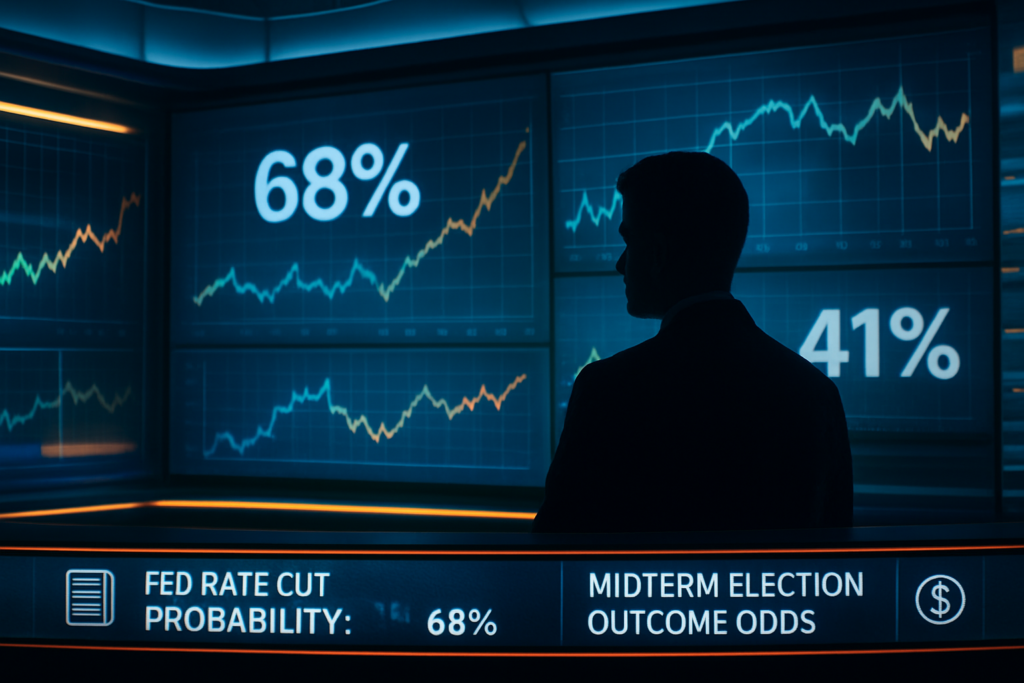
On any given night in early 2026, a viewer tuning into prime-time news is less likely to see a panel of political consultants arguing over "vibes" and more likely to see a glowing, fluctuating percentage at the bottom of the screen. As of January 16, 2026, the traditional news ticker has been permanently altered. The price of Brent Crude and the S&P 500 now share screen real estate with the "Probability of a Fed Rate Cut in March" and the "Odds of the 2026 Midterm House Flip," powered by real-money prediction markets like Kalshi and Polymarket.
This seismic shift represents the mainstreaming of "Information Finance"—a term coined to describe the use of financial incentives to aggregate truth. Currently, prediction markets are pricing the likelihood of a major legislative breakthrough on AI regulation at 64%, a figure that has surged 15% in the last 48 hours following a series of closed-door committee meetings. This "market-driven signal" is no longer a fringe curiosity; it has become the definitive barometer for reality, treated by networks with the same institutional weight as the Nielsen ratings or the morning's jobs report.
The Market: What's Being Predicted
The integration of prediction market data into mainstream news has reached a fever pitch. In late 2025, CNBC, owned by Comcast (NASDAQ: CMCSA), signed a landmark multi-year deal with Kalshi to serve as its exclusive data provider for on-air prediction widgets. This partnership has birthed the "CNBC Prediction Hub," where viewers can track live probabilities on everything from corporate merger approvals to the likelihood of the next CEO of Apple (NASDAQ: AAPL). These markets are currently seeing record volumes, with the "March Fed Meeting" contract alone regularly exceeding $500 million in open interest.
Meanwhile, CNN, a subsidiary of Warner Bros. Discovery (NASDAQ: WBD), has completely overhauled its data segments. Chief Data Analyst Harry Enten’s famous "Poll of Polls" has been largely replaced by a segment titled "Market Signals." On these broadcasts, the "price" of an event is treated as the consensus probability. If a contract for a specific candidate to win an election is trading at $0.62, the network reports a "62% probability of victory," providing a real-time, 24/7 pulse that traditional polling—which often takes weeks to conduct and release—simply cannot match.
The primary platforms driving this data are Kalshi, the first CFTC-regulated prediction market exchange in the U.S., and Polymarket, the decentralized giant that recently secured a $2 billion investment from the Intercontinental Exchange (NYSE: ICE). While Kalshi focuses on U.S.-regulated financial and political events, Polymarket provides a broader look at global geopolitical shifts and cultural milestones. Together, they have created a dual-engine of "Consensus Pricing" that newsrooms now use to fact-check their own reporting.
Why Traders Are Betting
The migration of news media toward market data was born out of a crisis of confidence in traditional forecasting. The 2024 election cycle served as the ultimate proof of concept: while traditional pollsters often showed a "dead heat" or slight lead for various candidates, prediction markets consistently priced in a Donald Trump victory with 60%+ confidence throughout October 2024. More importantly, markets called the "swing state sweep" on election night by 10:00 PM ET, hours before network pundits were willing to commit to the data.
Traders are putting their money where their mouths are because prediction markets reward accuracy and punish "cheap talk." Unlike a pundit who retains their salary regardless of the accuracy of their predictions, a trader on Kalshi or Polymarket faces a direct financial penalty for being wrong. This "skin in the game" creates a high-fidelity signal that filters out noise. Recent surges in the probability of a "Soft Landing" for the U.S. economy, currently trading at 78% on Kalshi, are being driven by institutional desks at firms like Interactive Brokers (NASDAQ: IBKR), which integrated Kalshi's API for its professional clients in 2025.
Furthermore, the rise of "Information Finance" has attracted a new class of "news-traders." These individuals use advanced sentiment analysis and real-time social media scraping to identify information asymmetries before they hit the wire services. When a major news event breaks—such as the recent Golden Globes, where Polymarket correctly predicted 26 out of 28 winners—the market often moves seconds before the host opens the envelope, providing a "spoiler effect" that has made live prediction trackers must-watch television.
Broader Context and Implications
The institutionalization of prediction markets marks the end of the "polling industrial complex" as we knew it. For decades, media organizations relied on statistical sampling that struggled with declining response rates and "shy voter" syndromes. In 2026, the industry has embraced the philosophy that a market of 100,000 incentivized participants is a more accurate "truth engine" than a survey of 1,000 disengaged households. This shift was accelerated by the CFTC’s 2025 legal defeat in the Ninth Circuit Court of Appeals, which permanently legalized election and event betting in the United States, removing the final regulatory shadow over the industry.
This trend has profound real-world implications for how corporate America operates. Companies like Robinhood (NASDAQ: HOOD) and Coinbase (NASDAQ: COIN) have launched their own "Prediction Hubs," allowing retail investors to hedge against political or economic outcomes. If a trader believes a new tax bill will hurt their tech stocks, they can now "buy" the probability of that bill passing as a form of insurance. Prediction markets have effectively turned the news into a tradable asset class.
Historically, prediction markets have boasted a significantly lower "Brier Score"—a measure of the accuracy of probabilistic forecasts—than expert panels. As this data becomes more pervasive, it is revealing a new type of public sentiment: one that is pragmatic and forward-looking rather than ideological. However, critics argue that this "commodification of truth" could lead to market manipulation or "prediction loops," where the market's high probability of an event actually helps cause that event to happen.
What to Watch Next
As we move deeper into 2026, the next major milestone for the integration of prediction markets into media will be the "Local News Expansion." Several regional news groups are reportedly in talks with Kalshi to launch localized markets on state-level legislation and local mayoral races. This would bring "Information Finance" to the grassroots level, potentially providing a more accurate look at community sentiment than the dwindling number of local political reporters can provide.
The 2026 Midterm Elections will also serve as the next "Super Bowl" for these platforms. Expect to see networks like CNN and CNBC debut fully interactive "Probability Maps," where viewers can see the live market-cap of each congressional race in real-time. Additionally, the role of AI in these markets is expected to grow. We are already seeing the emergence of "AI Traders" that can process legislative text and court filings in milliseconds, often moving the markets before a human reporter can even finish reading the headline.
Finally, keep an eye on the potential for a "National Prediction Exchange" ticker to be added to the NYSE floor. With the Intercontinental Exchange’s heavy backing of the sector, the boundary between a "stock" and an "event contract" is blurring. By the end of this year, we may see a world where the "Probability of World Peace" is a standard index listed right next to the Dow Jones Industrial Average.
Bottom Line
The transition from traditional punditry to "Information Finance" represents one of the most significant shifts in the history of journalism. By replacing subjective opinions with real-money probabilities, news organizations like CNN and CNBC are attempting to reclaim their role as "arbiters of truth" in a fragmented media landscape. The success of these markets in 2024 and 2025 has proven that when money is on the line, the "wisdom of the crowd" usually outweighs the "wisdom of the expert."
As a tool, prediction markets are now indispensable for anyone trying to navigate a volatile world. They provide a clear, quantified signal amidst the noise of the 24-hour news cycle. While they are not infallible, their track record for speed and accuracy has made them the gold standard for forecasting the future.
In this new era, the question for the average news consumer is no longer "What do you think will happen?" but "What does the market say?" As of early 2026, the market is speaking louder than ever, and for the first time, the entire world is finally listening.
This article is for informational purposes only and does not constitute financial or betting advice. Prediction market participation may be subject to legal restrictions in your jurisdiction.
PredictStreet focuses on covering the latest developments in prediction markets. Visit the PredictStreet website at https://www.predictstreet.ai/.