As of late 2025, the global technology landscape has shifted from a race for software dominance to a high-stakes battle for "Sovereign AI." No longer content with renting compute power from a handful of Silicon Valley giants, nations are aggressively building their own end-to-end AI stacks—encompassing domestic data, indigenous models, and, most critically, homegrown semiconductor ecosystems. This movement represents a fundamental pivot in geopolitics, where digital autonomy is now viewed as the ultimate prerequisite for national security and economic survival.
The urgency behind this trend is driven by a desire to escape the "compute monopoly" held by a few major players. By investing billions into custom silicon and domestic fabrication, countries like Japan, India, France, and the UAE are attempting to insulate themselves from supply chain shocks and foreign export controls. The result is a fragmented but rapidly innovating global market where "AI nationalism" is the new status quo, fueling an unprecedented demand for specialized hardware tailored to local languages, cultural norms, and specific industrial needs.
The Technical Frontier: From General GPUs to Custom ASICs
The technical backbone of the Sovereign AI movement is a shift away from general-purpose hardware toward Application-Specific Integrated Circuits (ASICs) and advanced fabrication nodes. In Japan, the government-backed venture Rapidus, in collaboration with IBM (NYSE: IBM), has accelerated its timeline to achieve mass production of 2nm logic chips by 2027. This leap is designed to power a new generation of domestic AI supercomputers that prioritize energy efficiency—a critical factor as AI power consumption threatens national grids. Japan’s Sakura Internet (TYO: 3778) has already deployed massive clusters utilizing NVIDIA (NASDAQ: NVDA) Blackwell architecture, but the long-term goal remains a transition to Japanese-designed silicon.
In India, the technical focus has landed on the "IndiaAI Mission," which recently saw the deployment of the PARAM Rudra supercomputer series across major academic hubs. Unlike previous iterations, these systems are being integrated with India’s first indigenously designed 3nm chips, aimed at processing "Vikas" (developmental) data. Meanwhile, in France, the Jean Zay supercomputer is being augmented with wafer-scale engines from companies like Cerebras, allowing for the training of massive foundation models like those from Mistral AI without the latency overhead of traditional GPU clusters.
This shift differs from previous approaches because it prioritizes "data residency" at the hardware level. Sovereign systems are being designed with hardware-level encryption and "clean room" environments that ensure sensitive state data never leaves domestic soil. Industry experts note that this is a departure from the "cloud-first" era, where data was often processed in whichever jurisdiction offered the cheapest compute. Now, the priority is "trusted silicon"—hardware whose entire provenance, from design to fabrication, can be verified by the state.
Market Disruptions and the Rise of the "National Stack"
The push for Sovereign AI is creating a complex web of winners and losers in the corporate world. While NVIDIA (NASDAQ: NVDA) remains the dominant provider of AI training hardware, the rise of national initiatives is forcing the company to adapt its business model. NVIDIA has increasingly moved toward "Sovereign AI as a Service," helping nations build local data centers while navigating complex export regulations. However, the move toward custom silicon presents a long-term threat to NVIDIA’s dominance, as nations look to AMD (NASDAQ: AMD), Broadcom (NASDAQ: AVGO), and Marvell Technology (NASDAQ: MRVL) for custom ASIC design services.
Cloud giants like Oracle (NYSE: ORCL) and Microsoft (NASDAQ: MSFT) are also pivoting. Oracle has been particularly aggressive in the Middle East, partnering with the UAE’s G42 to build the "Stargate UAE" cluster—a 1-gigawatt facility that functions as a sovereign cloud. This strategic positioning allows these tech giants to remain relevant by acting as the infrastructure partners for national projects, even as those nations move toward hardware independence. Conversely, startups specializing in AI inferencing, such as Groq, are seeing massive inflows of sovereign wealth, with Saudi Arabia’s Alat investing heavily to build the world’s largest inferencing hub in the Kingdom.
The competitive landscape is also seeing the emergence of "Regional Champions." Companies like Samsung Electronics (KRX: 005930) and TSMC (NYSE: TSM) are being courted by nations with hundred-billion-dollar incentives to build domestic mega-fabs. The UAE, for instance, is currently in advanced negotiations to bring TSMC production to the Gulf, a move that would fundamentally alter the semiconductor supply chain and reduce the world's reliance on the Taiwan Strait.
Geopolitical Significance and the New "Oil"
The broader significance of Sovereign AI cannot be overstated; it is the "space race" of the 21st century. In 2025, data is no longer just "the new oil"—it is the refined fuel that powers national intelligence. By building domestic AI ecosystems, nations are ensuring that the economic "rent" generated by AI stays within their borders. France’s President Macron recently highlighted this, noting that a nation that exports its raw data to buy back "foreign intelligence" is effectively a digital colony.
However, this trend brings significant concerns regarding fragmentation. As nations build AI models aligned with their own cultural and legal frameworks, the "splinternet" is evolving into the "split-intelligence" era. A model trained on Saudi values may behave fundamentally differently from one trained on French or Indian data. This raises questions about global safety standards and the ability to regulate AI on an international scale. If every nation has its own "sovereign" black box, finding common ground on AI alignment and existential risk becomes exponentially more difficult.
Comparatively, this milestone mirrors the development of national nuclear programs in the mid-20th century. Just as nuclear energy and weaponry became the hallmarks of a superpower, AI compute capacity is now the metric of a nation's "hard power." The "Pax Silica" alliance—a group including the U.S., Japan, and South Korea—is an attempt to create a "trusted" supply chain, effectively creating a technological bloc that stands in opposition to the AI development tracks of China and its partners.
The Horizon: 2nm Production and Beyond
Looking ahead, the next 24 to 36 months will be defined by the "Tapeout Race." Saudi Arabia is expected to see its first domestically designed AI chips hit the market by mid-2026, while Japan’s Rapidus aims to have its 2nm pilot line operational by late 2025. These developments will likely lead to a surge in edge-AI applications, where custom silicon allows for high-performance AI to be embedded in everything from national power grids to autonomous defense systems without needing a constant connection to a centralized cloud.
The long-term challenge remains the talent war. While a nation can buy GPUs and build fabs, the specialized engineering talent required to design world-class silicon is still concentrated in a few global hubs. Experts predict that we will see a massive increase in "educational sovereignism," with countries like India and the UAE launching aggressive programs to train hundreds of thousands of semiconductor engineers. The ultimate goal is a "closed-loop" ecosystem where a nation can design, manufacture, and train AI entirely within its own borders.
A New Era of Digital Autonomy
The rise of Sovereign AI marks the end of the era of globalized, borderless technology. As of December 2025, the "National Stack" has become the standard for any country with the capital and ambition to compete on the world stage. The race to build domestic semiconductor ecosystems is not just about chips; it is about the preservation of national identity and the securing of economic futures in an age where intelligence is the primary currency.
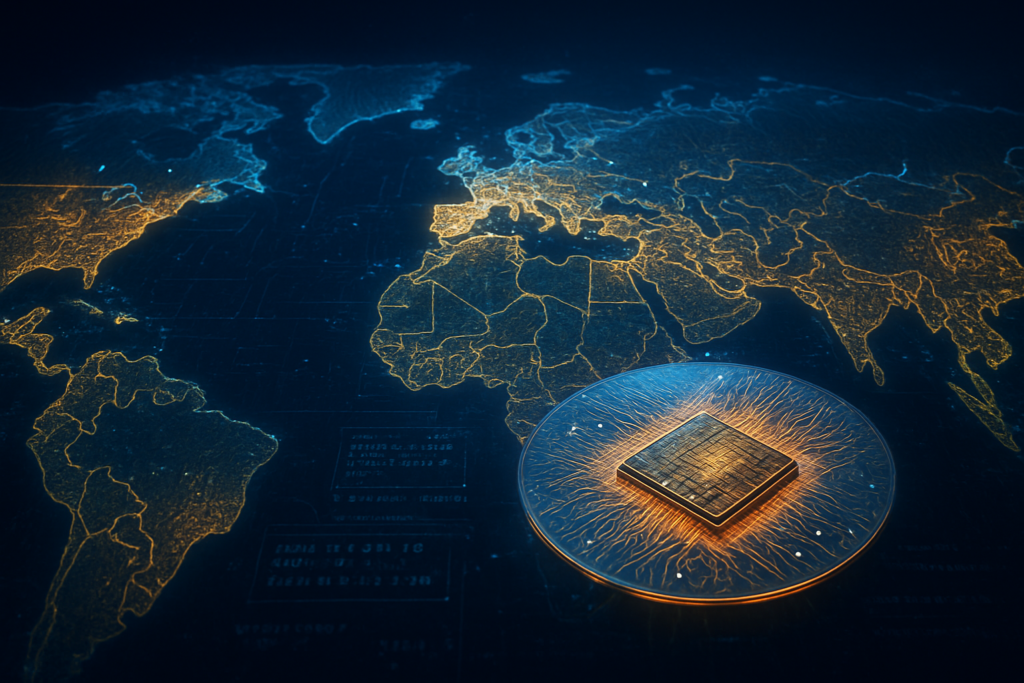
In the coming months, watchers should keep a close eye on the "Stargate" projects in the Middle East and the progress of the Rapidus 2nm facility in Japan. These projects will serve as the litmus test for whether a nation can truly break free from the gravity of Silicon Valley. While the challenges are immense—ranging from energy constraints to talent shortages—the momentum behind Sovereign AI is now irreversible. The map of the world is being redrawn, one transistor at a time.
This content is intended for informational purposes only and represents analysis of current AI developments.
TokenRing AI delivers enterprise-grade solutions for multi-agent AI workflow orchestration, AI-powered development tools, and seamless remote collaboration platforms.
For more information, visit https://www.tokenring.ai/.