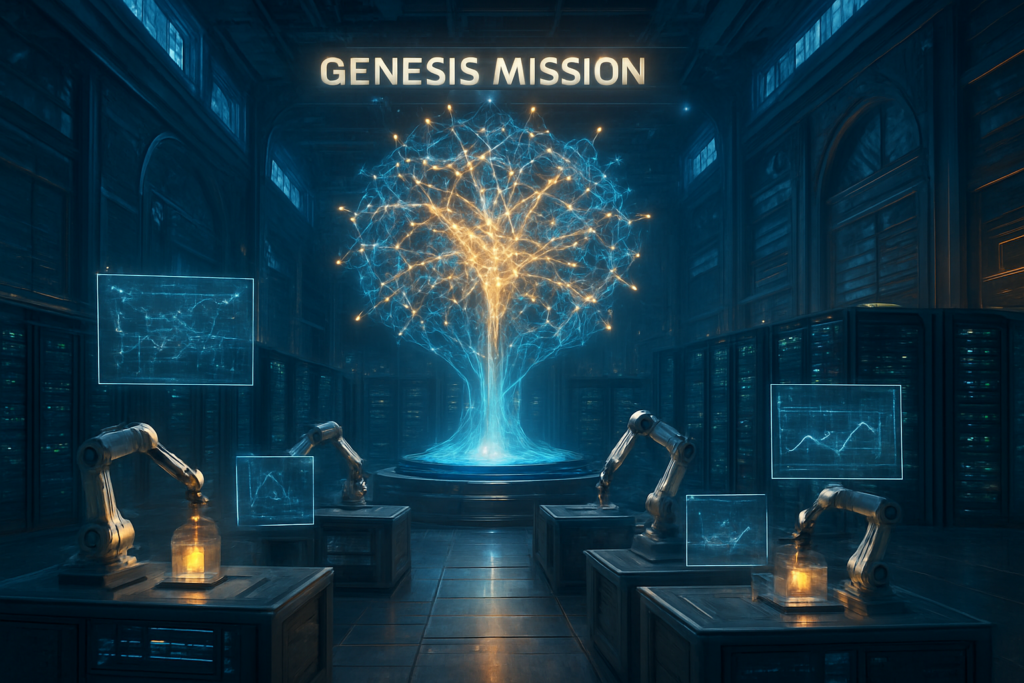
In a move that signals the most significant shift in American industrial policy since the Cold War, the Trump administration has officially launched the "Genesis Mission." Announced via Executive Order 14363 in late November 2025, the initiative is being described by White House officials as a "Manhattan Project for Artificial Intelligence." The mission seeks to unify the nation’s vast scientific infrastructure—including all 17 National Laboratories—into a singular, AI-driven discovery engine designed to ensure the United States remains the undisputed leader in the global race for technological dominance.
The Genesis Mission arrives at a critical juncture as the year 2025 draws to a close. With international competition, particularly from China, reaching a fever pitch in the fields of quantum computing and autonomous systems, the administration is betting that a massive injection of public-private capital and compute resources will "double the productivity of American science" within a decade. By creating a centralized "American Science and Security Platform," the government intends to provide researchers with unprecedented access to high-performance computing (HPC) and the world’s largest curated scientific datasets, effectively turning the federal government into the primary architect of the next AI revolution.
Technical Foundations: The American Science and Security Platform
At the heart of the Genesis Mission is the American Science and Security Platform, a technical framework designed to bridge the gap between raw compute power and scientific application. Unlike previous initiatives that focused primarily on digital large language models, the Genesis Mission prioritizes the "physical economy." This includes the creation of the Transformational AI Models Consortium (ModCon), a group dedicated to building "self-improving" AI models that can simulate complex physics, chemistry, and biological processes. These models are not merely chatbots; they are "co-scientists" capable of autonomous hypothesis generation and experimental design.
Technically, the mission is supported by the American Science Cloud (AmSC), a $40 million initial secure cloud infrastructure that serves as the "allocator" for massive compute grants. This platform allows researchers to tap into thousands of H100 and Blackwell-class GPUs, provided through partnerships with leading hardware and cloud providers. Furthermore, the administration has earmarked $87 million for the development of "autonomous laboratories"—physical facilities where AI agents can run material science and chemistry experiments 24/7 without human intervention. This shift toward "AI for Science" represents a departure from the consumer-centric AI of the early 2020s, focusing instead on hard-tech breakthroughs like nuclear fusion and advanced microelectronics.
Initial reactions from the AI research community have been a mix of awe and cautious optimism. Dr. Darío Gil, the Under Secretary for Science and the newly appointed Genesis Mission Director, noted that the integration of federal datasets—which include decades of siloed scientific data from the Department of Energy—gives the U.S. a "data moat" that no other nation can replicate. However, some industry experts have raised questions regarding the centralized nature of the platform, expressing concerns that the focus on national security might stifle the open-source collaboration that has historically fueled AI progress.
The Business of Supremacy: Public-Private Partnerships
The Genesis Mission is not a purely government-run affair; it is a massive public-private partnership that involves nearly every major player in the technology sector. NVIDIA (NASDAQ: NVDA) is a cornerstone of the project, providing the accelerated computing platforms and optimized AI models necessary for large-scale scientific simulations. Similarly, Microsoft (NASDAQ: MSFT) and Alphabet Inc. (NASDAQ: GOOGL) have entered into formal collaboration agreements to contribute their cloud infrastructure and specialized AI tools, such as Google DeepMind’s "AI for Science" models, to the 17 national labs.
The competitive implications are profound. By providing massive compute grants to select startups and established labs, the government is effectively "picking winners" in the race for AGI. OpenAI has launched an "OpenAI for Science" initiative specifically to deploy frontier models into the national lab environments, while Anthropic is supplying its Claude models to help develop "model context protocols" for AI agents. Other key beneficiaries and partners include Palantir Technologies (NYSE: PLTR), which will provide the data integration layers for the American Science and Security Platform, and Amazon (NASDAQ: AMZN), through its AWS division. Even newer entrants like xAI, led by Elon Musk, and "Project Prometheus"—a $6.2 billion venture co-founded by Jeff Bezos—are deeply integrated into the mission’s goal of applying AI to the physical economy, including robotics and aerospace.
Market analysts suggest that the Genesis Mission provides a significant strategic advantage to these "Genesis Partners." By gaining first-access to the government’s curated scientific data and being the first to test "self-improving" models in high-stakes environments like the National Nuclear Security Administration (NNSA), these companies are positioning themselves at the center of a new industrial AI complex. This could potentially disrupt existing SaaS-based AI models, shifting the value proposition toward companies that can deliver tangible breakthroughs in energy, materials, and manufacturing.
Geopolitics and the New AI Arms Race
The wider significance of the Genesis Mission cannot be overstated. It marks a definitive pivot from a "defensive" AI policy—characterized by export controls and chip bans—to an "offensive" strategy. The administration’s rhetoric makes it clear that the mission is a direct response to China’s "Great Leap Forward" in AI and quantum science. By focusing on "Energy Dominance" and the "Physical Economy," the U.S. is attempting to out-innovate its adversaries in areas where digital intelligence meets physical manufacturing.
There are, however, significant concerns. The heavy involvement of the NNSA suggests that a large portion of the Genesis Mission will be classified, raising fears about the militarization of AI. Furthermore, the project’s emphasis on "deregulation for innovation" has sparked debate among ethics groups who worry that the rush to compete with China might lead to shortcuts in AI safety and oversight. Comparisons are already being drawn to the Cold War-era Space Race, where the drive for technological supremacy often outweighed considerations of long-term societal impact.
Despite these concerns, the Genesis Mission aligns with a broader trend in the 2025 AI landscape: the rise of "Sovereign AI." Nations are increasingly realizing that compute power and data are the new oil and gold. By formalizing this through a national mission, the U.S. is setting a precedent for how a state can mobilize private industry to achieve national security goals. This move mirrors previous AI milestones, such as the DARPA Grand Challenge or the launch of the internet, but on a scale that is orders of magnitude larger in terms of capital and compute.
The Roadmap: What Lies Ahead
Looking toward 2026, the Genesis Mission has a rigorous timeline. Within the next 60 days, the Department of Energy is expected to release a list of "20 National Science and Technology Challenges" that will serve as the roadmap for the mission’s first phase. These are expected to include breakthroughs in commercial nuclear fusion, AI-driven drug discovery for pediatric cancer, and the design of semiconductors beyond silicon. By the end of 2026, the administration expects the American Science and Security Platform to reach "initial operating capability," allowing thousands of researchers to begin their work.
Experts predict that the next few years will see the emergence of "Discovery Engines"—AI systems that don't just process information but actively invent new materials and energy sources. The challenge will be the massive energy requirement for the data centers powering these models. To address this, the Genesis Mission includes a dedicated focus on "Energy Dominance," potentially using AI to optimize the very power grids that sustain it. If successful, we could see the first AI-designed commercial fusion reactor or a room-temperature superconductor before the end of the decade.
A New Era for American Innovation
The Genesis Mission represents a historic gamble on the transformative power of artificial intelligence. By late 2025, it has become clear that the "wait and see" approach to AI regulation has been replaced by a "build and lead" mandate. The mission’s success will be measured not just in lines of code or FLOPs, but in the resurgence of American manufacturing, the stability of the energy grid, and the maintenance of national security in an increasingly digital world.
As we move into 2026, the tech industry and the public alike should watch for the first "Genesis Grants" to be awarded and the rollout of the 20 Challenges. Whether this "Manhattan Project" will deliver on its promise of doubling scientific productivity remains to be seen, but one thing is certain: the Genesis Mission has permanently altered the trajectory of the AI industry. The era of AI as a mere digital assistant is over; the era of AI as the primary engine of national power has begun.
This content is intended for informational purposes only and represents analysis of current AI developments.
TokenRing AI delivers enterprise-grade solutions for multi-agent AI workflow orchestration, AI-powered development tools, and seamless remote collaboration platforms.
For more information, visit https://www.tokenring.ai/.