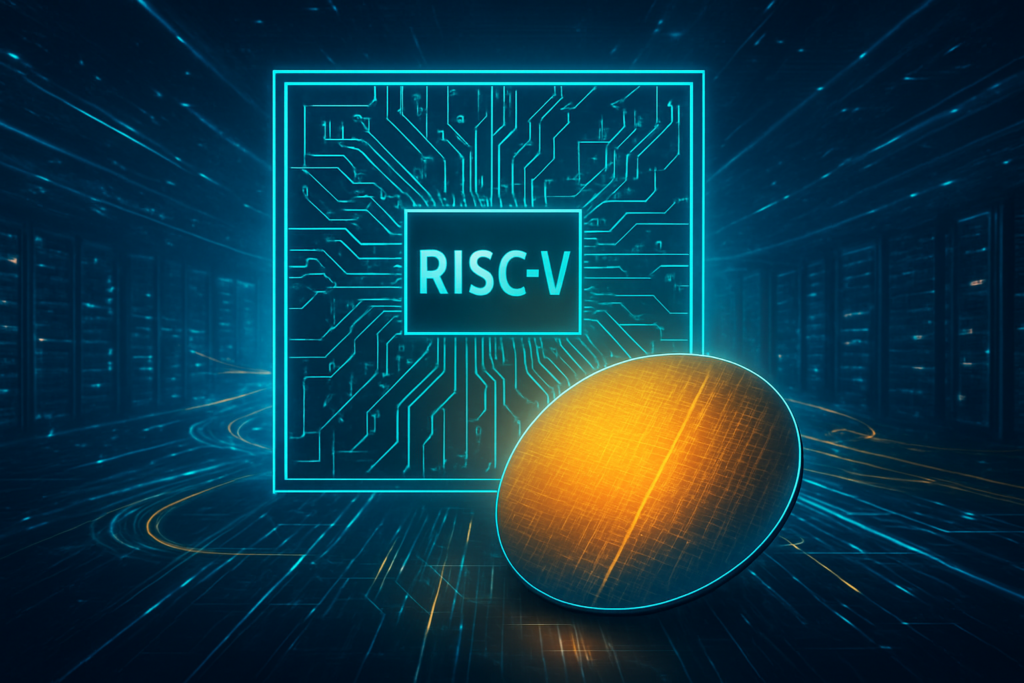
The open-standard RISC-V architecture has officially reached a historic turning point in the global semiconductor market, now accounting for 25% of all new silicon designs as of January 2026. This milestone signals a definitive shift from RISC-V being a niche experimental project to its status as a foundational "third pillar" alongside the long-dominant x86 and ARM architectures. The surge is driven by a massive influx of investment in high-performance computing and a collective industry push toward royalty-free, customizable hardware that can keep pace with the voracious demands of modern artificial intelligence.
In a move that has sent shockwaves through the industry, manufacturing giant GlobalFoundries (NASDAQ: GFS) recently accelerated this momentum by acquiring the extensive RISC-V and ARC processor IP portfolio from Synopsys (NASDAQ: SNPS). This strategic consolidation, paired with the launch of the first true server-class RISC-V processors from startups like SpacemiT, confirms that the ecosystem is no longer confined to low-power microcontrollers. By offering a viable path to high-performance "Physical AI" and data center acceleration without the restrictive licensing fees of legacy incumbents, RISC-V is reshaping the geopolitical and economic landscape of the chip industry.
Technical Milestones: The Rise of High-Performance Open Silicon
The technical validation of RISC-V’s maturity arrived this week with the unveiling of the Vital Stone V100 by the startup SpacemiT. As the industry's first true server-class RISC-V processor, the V100 features a 64-core interconnect utilizing the advanced X100 core—a 4-issue, 12-stage out-of-order design. Compliant with the RVA23 profile and RISC-V Vector 1.0, the processor delivers over 9 points/GHz on SPECINT2006 benchmarks. While its single-thread performance rivals legacy server chips from Intel (NASDAQ: INTC), its Intelligence Matrix Extension (IME) provides specialized AI inference efficiency that significantly outclasses standard ARM-based cores lacking dedicated neural hardware.
This breakthrough is underpinned by the RVA23 standard, which has unified the ecosystem by ensuring software compatibility across different high-performance implementations. Furthermore, the GlobalFoundries (NASDAQ: GFS) acquisition of Synopsys’s (NASDAQ: SNPS) ARC-V IP provides a turnkey solution for companies looking to integrate RISC-V into complex "Physical AI" systems, such as autonomous vehicles and industrial robotics. By folding these assets into its MIPS division, GlobalFoundries can now offer a seamless transition from design to fabrication on its specialized manufacturing nodes, effectively lowering the barrier to entry for custom AI silicon.
Initial reactions from the research community suggest that the inclusion of native RISC-V support in the Android Open Source Project (AOSP) was the final catalyst needed for mainstream adoption. Experts note that because RISC-V is modular, designers can strip away unnecessary instructions to optimize for specific AI workloads—a level of granularity that is difficult to achieve with the fixed instruction sets of ARM (NASDAQ: ARM) or x86. This "architectural freedom" allows for significant improvements in power efficiency, which is critical as Edge AI applications move from simple voice recognition to complex, real-time computer vision.
Market Disruption and the Competitive Shift
The rise of RISC-V represents a direct challenge to the "ARM Tax" that has long burdened mobile and embedded device manufacturers. As licensing fees for ARM (NASDAQ: ARM) have continued to fluctuate, hyperscalers like Meta (NASDAQ: META) and Google (NASDAQ: GOOGL) have increasingly turned toward RISC-V to design proprietary AI accelerators for their internal data centers. By avoiding the multi-million dollar upfront costs and per-chip royalties associated with proprietary architectures, these companies can reduce their total development costs by as much as 50%, allowing for more rapid iteration of generative AI hardware.
For GlobalFoundries, the acquisition of Synopsys’s processor IP signals a pivot toward becoming a vertically integrated service provider for custom silicon. In an era where "Physical AI" requires sensors and processors to be tightly coupled, GFS is positioning itself as the primary partner for automotive and industrial giants who want to own their technology stack. This puts traditional IP providers in a difficult position; as foundries begin to offer their own optimized open-standard IP, the value proposition of standalone licensing companies may begin to erode, forcing a shift toward more service-oriented business models.
The competitive implications extend deep into the data center market, where Intel (NASDAQ: INTC) and AMD (NASDAQ: AMD) have historically held a duopoly. While x86 remains the leader in legacy enterprise software, the transition toward cloud-native and AI-centric workloads has opened the door for ARM and now RISC-V. With SpacemiT proving that RISC-V can handle server-class tasks, the "third pillar" is now a credible threat in the high-margin server space. Startups and mid-sized tech firms are particularly well-positioned to benefit, as they can now access high-end processor designs without the gatekeeping of traditional licensing deals.
Geopolitics and the Quest for Silicon Sovereignty
Beyond the balance sheets of tech giants, RISC-V has become a critical tool for technological sovereignty, particularly in China and India. In China, the architecture has been integrated into the 15th Five-Year Plan, with over $1.4 billion in R&D funding allocated to ensure that 25% of domestic semiconductor reliance is based on RISC-V by 2030. For Chinese firms like Alibaba’s T-Head and SpacemiT, RISC-V is more than just a cost-saving measure; it is a safeguard against potential Western export restrictions on ARM or x86 technologies, providing a path to self-reliance in the critical AI sector.
India has followed a similar trajectory through its Digital India RISC-V (DIR-V) program. By developing indigenous processor families like SHAKTI and VEGA, India is attempting to build a completely local electronics ecosystem from the ground up. The recent announcement of a planned 7nm RISC-V processor in India marks a significant leap in the country’s manufacturing ambitions. For these nations, an open standard means that no single foreign entity can revoke their access to the blueprints of the modern world, making RISC-V the centerpiece of a new, multipolar tech landscape.
However, this global fragmentation also raises concerns about potential "forking" of the standard. If different regions begin to adopt incompatible extensions for their own strategic reasons, the primary benefit of RISC-V—its unified ecosystem—could be compromised. The RISC-V International foundation is currently working to prevent this through strict compliance testing and the promotion of global standards like RVA23. The stakes are high: if the organization can maintain a single global standard, it will effectively democratize high-performance computing; if it fails, the hardware world could split into disparate, incompatible silos.
The Horizon: 7nm Scaling and Ubiquitous AI
Looking ahead, the next 24 months will likely see RISC-V move into even more advanced manufacturing nodes. While the current server-class chips are fabricated on 12nm-class processes, the roadmap for late 2026 includes the first 7nm and 5nm RISC-V designs. These advancements will be necessary to compete directly with the top-tier performance of Apple’s M-series or NVIDIA’s Grace Hopper chips. As these high-end designs hit the market, expect to see RISC-V move into the consumer laptop and high-end workstation segments, areas where it has previously had little presence.
The near-term focus will remain on "Physical AI" and the integration of neural processing units (NPUs) directly into the RISC-V fabric. We are likely to see a surge in "AI-on-Chip" solutions for autonomous drones, surgical robots, and smart city infrastructure. The primary challenge remains the software ecosystem; while Linux and Android support are robust, the vast library of enterprise x86 software still requires sophisticated emulation or recompilation. Experts predict that the next wave of innovation will not be in the hardware itself, but in the AI-driven compilers that can automatically optimize legacy code for the RISC-V architecture.
A New Era for Computing
The rise of RISC-V to 25% design share is a watershed moment that marks the end of the era of proprietary instruction set dominance. By providing a royalty-free foundation for innovation, RISC-V has unleashed a wave of creativity in silicon design that was previously stifled by high entry costs and restrictive licensing. The acquisition of key IP by GlobalFoundries and the arrival of server-class hardware from SpacemiT are the final pieces of the puzzle, providing the manufacturing and performance benchmarks needed to convince the world's largest companies to make the switch.
As we move through 2026, the industry should watch for the expansion of RISC-V into the automotive sector and the potential for a major smartphone manufacturer to announce a flagship device powered by the architecture. The long-term impact will be a more competitive, more diverse, and more resilient global supply chain. While challenges in software fragmentation and geopolitical tensions remain, the momentum behind RISC-V appears unstoppable. The "third pillar" has not just arrived; it is quickly becoming the foundation upon which the next generation of artificial intelligence will be built.
This content is intended for informational purposes only and represents analysis of current AI developments.
TokenRing AI delivers enterprise-grade solutions for multi-agent AI workflow orchestration, AI-powered development tools, and seamless remote collaboration platforms.
For more information, visit https://www.tokenring.ai/.