As of January 5, 2026, the artificial intelligence hardware landscape has reached a definitive turning point with the formal commencement of the HBM4 era. After nearly two years of playing catch-up in the high-bandwidth memory (HBM) sector, Samsung Electronics (KRX: 005930) has signaled a resounding return to form. Industry analysts and supply chain insiders are now echoing a singular sentiment: "Samsung is back." This resurgence is punctuated by recent customer validation milestones that have cleared the path for Samsung to begin mass production of its HBM4 modules, aimed squarely at the next generation of AI superchips.
The immediate significance of this development cannot be overstated. As AI models grow exponentially in complexity, the "memory wall"—the bottleneck where data processing speed outpaces memory bandwidth—has become the primary hurdle for silicon giants. The transition to HBM4 represents the most significant architectural overhaul in the history of the standard, promising to double the interface width and provide the massive data throughput required for 2026’s flagship accelerators. With Samsung’s successful validation, the market is shifting from a near-monopoly to a fierce duopoly, promising to stabilize supply chains and accelerate the deployment of the world’s most powerful AI systems.
Technical Breakthroughs and the 2048-bit Interface
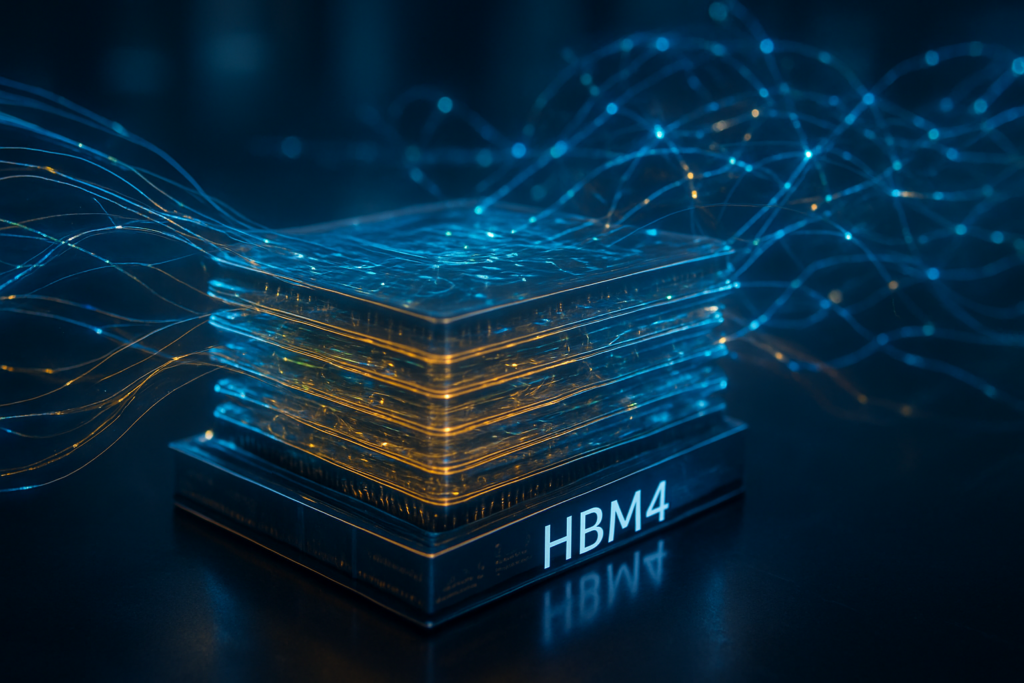
The technical specifications of HBM4 mark a departure from the incremental improvements seen in previous generations. The most striking advancement is the doubling of the memory interface from 1024-bit to a massive 2048-bit width. This wider "bus" allows for a staggering aggregate bandwidth of 13 TB/s in standard configurations, with high-performance bins reportedly reaching up to 20 TB/s. This leap is achieved by moving to the sixth-generation 10nm-class DRAM (1c) and utilizing 16-high (16-Hi) stacking, which enables capacities of up to 64GB per individual memory cube.
Unlike HBM3e, which relied on traditional DRAM manufacturing processes for its base die, HBM4 introduces a fundamental shift toward foundry logic processes. In this new architecture, the base die—the foundation of the memory stack—is manufactured using advanced 4nm or 5nm logic nodes. This allows for "Custom HBM," where specific AI logic or controllers can be embedded directly into the memory. This integration significantly reduces latency and power consumption, as data no longer needs to travel as far between the memory cells and the processor's logic.
Initial reactions from the AI research community and hardware engineers have been overwhelmingly positive. Experts at the 2026 International Solid-State Circuits Conference noted that the move to a 2048-bit interface was a "necessary evolution" to prevent the upcoming class of GPUs from being starved of data. The industry has particularly praised the implementation of Hybrid Bonding (copper-to-copper direct contact) in Samsung’s 16-Hi stacks, a technique that allows more layers to be packed into the same physical height while dramatically improving thermal dissipation—a critical factor for chips running at peak AI workloads.
The Competitive Landscape: Samsung vs. SK Hynix
The competitive landscape of 2026 is currently a tale of two titans. SK Hynix (KRX: 000660) remains the market leader, commanding a 53% share of the HBM market. Their "One-Team" alliance with Taiwan Semiconductor Manufacturing Company (TPE: 2330), also known as TSMC (NYSE: TSM), has allowed them to maintain a first-mover advantage, particularly as the primary supplier for the initial rollout of NVIDIA (NASDAQ: NVDA) Rubin architecture. However, Samsung’s surge toward a 35% market share target has disrupted the status quo, creating a more balanced competitive environment that benefits end-users like cloud service providers.
Samsung’s strategic advantage lies in its "All-in-One" turnkey model. While SK Hynix must coordinate with external foundries like TSMC for its logic dies, Samsung handles the entire lifecycle—from the 4nm logic base die to the 1c DRAM stacks and advanced packaging—entirely in-house. This vertical integration has allowed Samsung to claim a 20% reduction in supply chain lead times, a vital metric for companies like AMD (NASDAQ: AMD) and NVIDIA that are racing to meet the insatiable demand for AI compute.
For the "Big Tech" players, this rivalry is a welcome development. The increased competition between Samsung, SK Hynix, and Micron Technology (NASDAQ: MU) is expected to drive down the premium pricing of HBM4, which had threatened to inflate the cost of AI infrastructure. Startups specializing in niche AI ASICs also stand to benefit, as the "Custom HBM" capabilities of HBM4 allow them to order memory stacks tailored to their specific architectural needs, potentially leveling the playing field against larger incumbents.
Broader Significance for the AI Industry
The rise of HBM4 is a critical component of the broader 2026 AI landscape, which is increasingly defined by "Trillion-Parameter" models and real-time multimodal reasoning. Without the bandwidth provided by HBM4, the next generation of accelerators—specifically the NVIDIA Rubin (R100) and the AMD Instinct MI450 (Helios)—would be unable to reach their theoretical performance peaks. The MI450, for instance, is designed to leverage HBM4 to enable up to 432GB of on-chip memory, allowing entire large language models to reside within a single GPU’s memory space.
This milestone mirrors previous breakthroughs like the transition from DDR3 to DDR4, but at a much higher stake. The "Samsung is back" narrative is not just about market share; it is about the resilience of the global semiconductor supply chain. In 2024 and 2025, the industry faced significant bottlenecks due to HBM3e yield issues. Samsung’s successful pivot to HBM4 signifies that the world’s largest memory maker has solved the complex manufacturing hurdles of high-stacking and hybrid bonding, ensuring that the AI revolution will not be stalled by hardware shortages.
However, the shift to HBM4 also raises concerns regarding power density and thermal management. With bandwidth hitting 13 TB/s and beyond, the heat generated by these stacks is immense. This has forced a shift in data center design toward liquid cooling as a standard requirement for HBM4-equipped systems. Comparisons to the "Blackwell era" of 2024 show that while the compute power has increased fivefold, the cooling requirements have nearly tripled, presenting a new set of logistical and environmental challenges for the tech industry.
Future Outlook: Beyond HBM4
Looking ahead, the roadmap for HBM4 is already extending into 2027 and 2028. Near-term developments will focus on the perfection of 20-Hi stacks, which could push memory capacity per GPU to over 512GB. We are also likely to see the emergence of "HBM4e," an enhanced version that will push pin speeds beyond 12 Gbps. The convergence of memory and logic will continue to accelerate, with predictions that future iterations of HBM might even include small "AI-processing-in-memory" (PIM) cores directly on the base die to handle data pre-processing.
The primary challenge remains the yield rate for hybrid bonding. While Samsung has achieved validation, scaling this to millions of units remains a formidable task. Experts predict that the next two years will see a "packaging war," where the winner is not the company with the fastest DRAM, but the one that can most reliably bond 16 or more layers of silicon without defects. As we move toward 2027, the industry will also have to address the sustainability of these high-power chips, potentially leading to a new focus on "Energy-Efficient HBM" for edge AI applications.
Conclusion
The arrival of HBM4 in early 2026 marks the end of the "memory bottleneck" era and the beginning of a new chapter in AI scalability. Samsung Electronics has successfully navigated a period of intense scrutiny to reclaim its position as a top-tier innovator, challenging SK Hynix's recent dominance and providing the industry with the diversity of supply it desperately needs. With technical specs that were considered theoretical only a few years ago—such as the 2048-bit interface and 13 TB/s bandwidth—HBM4 is the literal foundation upon which the next generation of AI will be built.
As we watch the rollout of NVIDIA’s Rubin and AMD’s MI450 in the coming months, the focus will shift from "can we build it?" to "how fast can we scale it?" Samsung’s 35% market share target is an ambitious but increasingly realistic goal that reflects the company's renewed technical vigor. For the tech industry, the "Samsung is back" sentiment is more than just a headline; it is a signal that the infrastructure for the next decade of artificial intelligence is finally ready for mass deployment.
This content is intended for informational purposes only and represents analysis of current AI developments.
TokenRing AI delivers enterprise-grade solutions for multi-agent AI workflow orchestration, AI-powered development tools, and seamless remote collaboration platforms.
For more information, visit https://www.tokenring.ai/.