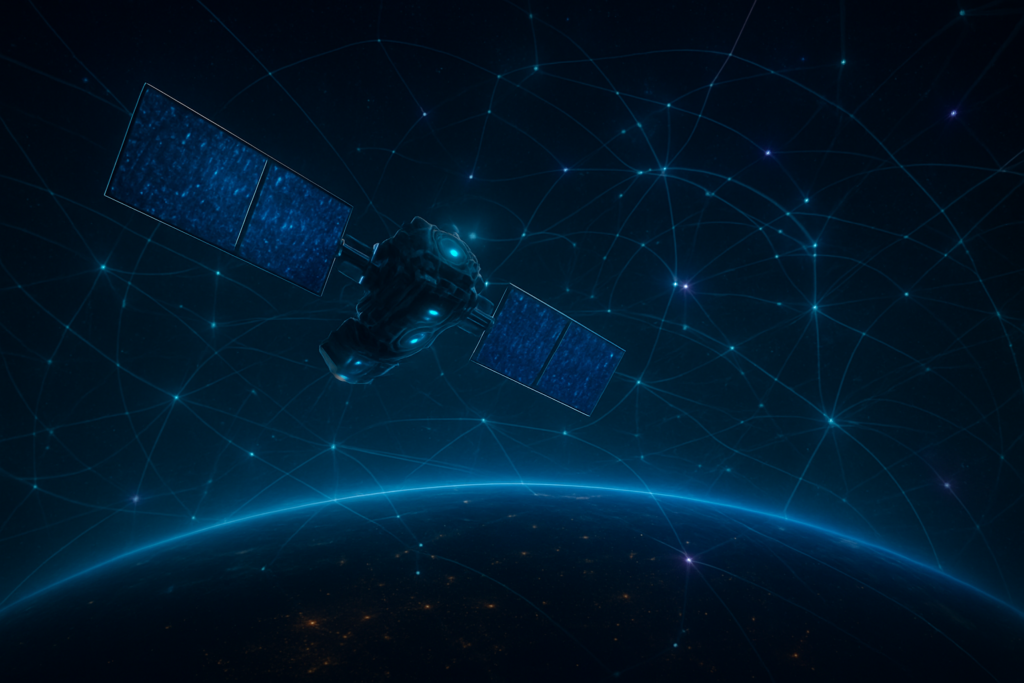
In a landmark achievement for the aerospace and artificial intelligence industries, Orbit AI (also known as Smartlink AI) and PowerBank Corporation (NASDAQ: SUUN) have officially confirmed the successful operation of the Genesis-1 satellite. As of January 8, 2026, the satellite is fully functional in low Earth orbit (LEO), marking the first time a high-performance AI model has been operated entirely in space, effectively bypassing the power and cooling constraints that have long plagued terrestrial data centers.
The Genesis-1 mission represents a paradigm shift in how computational workloads are handled. By moving AI inference directly into orbit, the partnership has demonstrated that the "Orbital Cloud" is no longer a theoretical concept but a working reality. This development allows for real-time data processing without the latency or bandwidth bottlenecks associated with downlinking massive raw datasets to Earth-based servers, potentially revolutionizing industries ranging from environmental monitoring to global security.
Technical Specifications and the Orbital Advantage
The technical architecture of Genesis-1 is a marvel of modern engineering, centered around a 2.6 billion parameter AI model designed for high-fidelity infrared remote sensing. At the heart of the satellite’s "brain" are NVIDIA Corporation (NASDAQ: NVDA) DGX Spark compute cores, which provide approximately 1 petaflop of AI performance. This hardware allows the satellite to process imagery locally to detect anomalies—such as burgeoning wildfires or illegal maritime activity—and deliver critical alerts to ground stations in seconds rather than hours.
Unlike previous attempts at space-based computing, which relied on low-power, radiation-hardened microcontrollers with limited logic, Genesis-1 utilizes advanced gallium-arsenide solar arrays provided by PowerBank to generate a peak power of 1.2 kW. This robust energy supply enables the use of commercial-grade GPU architectures that have been adapted for the harsh vacuum of space. Furthermore, the satellite leverages radiative cooling, dissipating heat directly into the ambient environment of space. This eliminates the need for the millions of liters of water and massive electricity consumption required by terrestrial cooling towers.
The software stack is equally innovative, employing a specialized variant of Kubernetes designed for intermittent orbital connectivity and decentralized orchestration. Initial reactions from the AI research community have been overwhelmingly positive, with experts noting that the successful integration of a 128 GB unified memory system in a satellite bus is a "hardware milestone." However, some skeptics in the industry, including analysts from AI CERTs, have raised questions regarding the long-term durability of these high-performance chips against cosmic radiation, a challenge the Orbit AI team claims to have addressed with proprietary shielding and redundant logic paths.
Market Disruption and the Corporate Space Race
The success of Genesis-1 places PowerBank Corporation and Orbit AI in a dominant position within the burgeoning $700 billion "Orbital Cloud" market. For PowerBank, the mission validates their pivot from terrestrial clean energy to space-based infrastructure, showcasing their ability to manage complex thermal and power systems in extreme environments. For NVIDIA, this serves as a high-profile proof-of-concept for their "Spark" line of space-optimized chips, potentially opening a new revenue stream as other satellite operators look to upgrade their constellations with edge AI capabilities.
The competitive implications for major tech giants are profound. Companies like Alphabet Inc. (NASDAQ: GOOGL) and Amazon.com, Inc. (NASDAQ: AMZN), which have invested heavily in terrestrial cloud infrastructure, may now face a new form of "sovereign compute" that operates outside of national land-use regulations and local power grids. While SpaceX’s Starlink has hinted at adding AI compute to its v3 satellites, the Orbit AI-PowerBank partnership has successfully "leapfrogged" the competition by being the first to demonstrate a fully operational, high-parameter model in LEO.
Startups in the Earth observation and climate tech sectors are expected to be the immediate beneficiaries. By utilizing the Genesis-1 API, these companies can purchase "on-orbit inference," allowing them to receive processed insights directly from space. This disrupts the traditional model of satellite data providers, who typically charge high fees for raw data transfer. The strategic advantage of "stateless" digital infrastructure—where data is processed in international territory—also offers unique benefits for decentralized finance (DeFi) and secure communications.
Broader Significance and Ethical Considerations
This milestone fits into a broader trend of "Space Race 2.0," where the focus has shifted from mere launch capabilities to the deployment of intelligent, autonomous infrastructure. The Genesis-1 operation is being compared to the 2012 "AlexNet moment" for AI, but for the aerospace sector. It proves that the "compute-energy-cooling" triad can be solved more efficiently in the vacuum of space than on the surface of a warming planet.
However, the wider significance also brings potential concerns. The deployment of high-performance AI in orbit raises questions about space debris and the "Kessler Syndrome," as more companies rush to launch compute-heavy satellites. Furthermore, the "stateless" nature of these satellites could create a regulatory vacuum, making it difficult for international bodies to govern how AI is used for surveillance or data processing when it occurs outside of any specific country’s jurisdiction.
Despite these concerns, the environmental impact cannot be ignored. Terrestrial data centers are projected to consume up to 10% of the world’s electricity by 2030. Moving even a fraction of that workload to solar-powered orbital nodes could significantly reduce the carbon footprint of the AI industry. The integration of an Ethereum node on Genesis-1 also marks a significant step toward "Space-DeFi," where transactions can be verified by a neutral, off-planet observer.
Future Horizons: The Growth of the Mesh Network
Looking ahead, Orbit AI and PowerBank have already announced plans to expand the Genesis constellation. A second node is scheduled for launch in Q1 2026, with the goal of establishing a mesh network of 5 to 8 satellites by the end of the year. This network will feature 100 Mbps optical downlinks, facilitating high-speed data transfer between nodes and creating a truly global, decentralized supercomputer.
Future applications are expected to extend beyond remote sensing. Experts predict that orbital AI will soon be used for autonomous satellite-to-satellite refueling, real-time debris tracking, and even hosting "black box" data storage for sensitive global information. The primary challenge moving forward will be the miniaturization of even more powerful hardware and the refinement of autonomous thermal management as models scale toward the 100-billion-parameter range.
Industry analysts expect that by 2027, "Orbital AI as a Service" (OAaaS) will become a standard offering for government and enterprise clients. As launch costs continue to fall thanks to reusable rocket technology, the barrier to entry for space-based computing will lower, potentially leading to a crowded but highly innovative orbital ecosystem.
A New Era for Artificial Intelligence
The successful operation of Genesis-1 by Orbit AI and PowerBank is a defining moment in the history of technology. By proving that AI can thrive in the harsh environment of space, the partnership has effectively broken the "terrestrial ceiling" that has limited the growth of high-performance computing. The combination of NVIDIA’s processing power, PowerBank’s energy solutions, and Orbit AI’s software orchestration has created a blueprint for the future of the digital economy.
The key takeaway for the industry is that the constraints of Earth—land, water, and local power—are no longer absolute barriers to AI advancement. As we move further into 2026, the tech community will be watching closely to see how the Genesis mesh network evolves and how terrestrial cloud providers respond to this "extraterrestrial" disruption. For now, the successful operation of Genesis-1 stands as a testament to human ingenuity and a precursor to a new era of intelligent space exploration.
This content is intended for informational purposes only and represents analysis of current AI developments.
TokenRing AI delivers enterprise-grade solutions for multi-agent AI workflow orchestration, AI-powered development tools, and seamless remote collaboration platforms.
For more information, visit https://www.tokenring.ai/.