The era of the general-purpose chatbot is rapidly fading, replaced by a new paradigm of autonomous, task-specific "Agentic AI" that is fundamentally reshaping the corporate landscape. While 2023 and 2024 were defined by employees "chatting" with Large Language Models (LLMs) to draft emails or summarize meetings, 2026 has ushered in the age of the "AI Intern"—specialized agents that don't just talk about work, but execute it. Leading this charge is Nexos.ai, a startup that recently emerged from stealth with a €35 million Series A to provide the "connective tissue" for these digital colleagues.
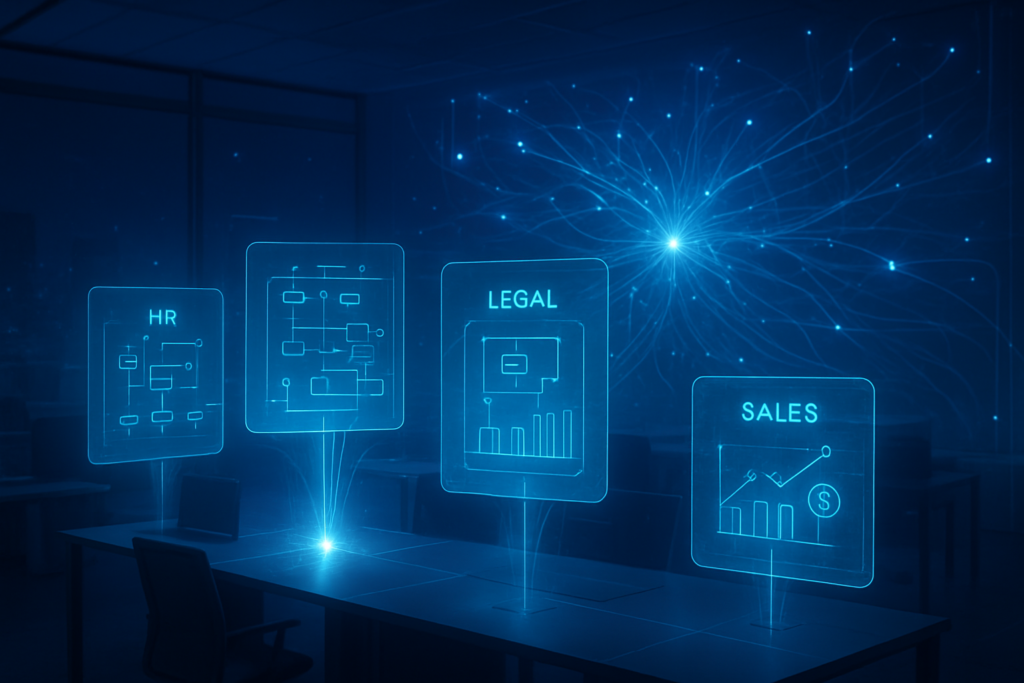
This shift marks a critical turning point for the enterprise. Instead of a single, monolithic interface, companies are now deploying fleets of named, assigned AI agents embedded directly into HR, Legal, and Sales workflows. These agents operate with a level of agency previously reserved for human employees, monitoring live data streams, triggering multi-step processes across different software platforms, and adhering to strict Standard Operating Procedures (SOPs). The significance is immediate: businesses are moving from "AI as an assistant" to "AI as infrastructure," where the value is measured not by words generated, but by tasks completed.
From Reactive Chat to Proactive Agency
The technical evolution from a standard chatbot to an "AI Intern" involves a shift from reactive text prediction to proactive reasoning and tool use. Unlike the early iterations of ChatGPT or Claude, which required a human prompt to initiate any action, the agents developed by Nexos.ai and others are built on "agentic loops." These loops allow the AI to perceive a trigger—such as a new candidate application in a recruitment portal or a red-line in a contract—and then plan a series of actions to resolve the task. This is powered by the latest generation of reasoning models, such as GPT-5 from OpenAI (NASDAQ: MSFT) and Claude 4 from Anthropic, which have transitioned from "predicting the next word" to "predicting the next logical action."
Central to this transition are two major technical breakthroughs: the Model Context Protocol (MCP) and the Agent-to-Agent (A2A) protocol. MCP, championed by Anthropic, has become the "USB-C" of the AI world, allowing agents to safely discover and interact with enterprise tools like SharePoint, Jira, and various CRMs without custom coding for every integration. Meanwhile, the A2A protocol allows an HR agent to "talk" to a Legal agent to verify compliance before sending an offer letter. This interoperability allows for a "multi-agent orchestration" layer where the AI can navigate the complex web of enterprise software autonomously.
This approach differs significantly from previous "Co-pilot" models. While a Co-pilot sits beside a human and waits for instructions, an AI Intern is "onboarded" with specific permissions and data access. For example, a Nexos.ai Sales Intern doesn't just suggest a follow-up email; it monitors a salesperson’s Gmail and Salesforce (NYSE: CRM) account, identifies a "buyer signal" in an incoming message, checks the inventory in an ERP system, and drafts a personalized quote—all before the human salesperson has even had their morning coffee. Initial reactions from the AI research community, including pioneers like Andrew Ng, suggest that this move toward agentic workflows is the most significant leap in productivity since the introduction of the cloud.
The Great Agent War: MSFT, CRM, and NOW
The transition to agentic AI has sparked a "Great Agent War" among the world’s largest software providers, as they vie to become the "Agentic Operating System" for the enterprise. Salesforce (NYSE: CRM) has pivoted its entire strategy around "Agentforce," utilizing its Atlas Reasoning Engine to allow agents to "think" through complex customer service and sales tasks. By moving from advice-giving to execution, Salesforce is aggressively encroaching on territory traditionally held by back-office specialists, aiming to replace manual data entry and lead qualification with autonomous loops.
Microsoft (NASDAQ: MSFT) has taken a different approach, leveraging its dominance in productivity software to embed agents directly into the Windows and Office ecosystems. In early 2026, Microsoft launched its "Agentic Retail Suite," which allows store managers to delegate inventory management and supply chain logistics to autonomous agents. To maintain a competitive edge, Microsoft is also ramping up production of its custom Maia 200 AI accelerators, seeking to lower the "intelligence tax"—the high computational cost of running autonomous agents—and making it more affordable for enterprises to run hundreds of agents simultaneously.
Meanwhile, ServiceNow (NYSE: NOW) is positioning itself as the "Control Tower" for this new era. With its "Zurich" update in early 2026, ServiceNow introduced a governance layer that allows Chief Information Officers (CIOs) to monitor every decision made by an autonomous agent across their organization. This includes "kill switches" and audit logs to ensure that as agents from different vendors (Microsoft, Salesforce, Nexos) begin to interact, they do so within the bounds of corporate policy. This strategic positioning as the "platform of platforms" aims to make ServiceNow indispensable for the secure management of a non-human workforce.
The Societal Impact of the Digital Colleague
The wider significance of the "AI Intern" goes beyond corporate efficiency; it represents a fundamental shift in the white-collar labor market. Gartner (NYSE: IT) predicts that by the end of 2026, 40% of enterprise applications will have embedded autonomous agents. This "White-Collar Shockwave" is already being felt in the entry-level job market. As AI interns take over the "junior" tasks—data cleaning, initial legal research, and candidate screening—the traditional pathway for recent college graduates is being disrupted. There is a growing concern that the "internship" phase of a human career is being automated away, leading to a potential "AI Talent Shortage" where there are no experienced seniors because there were no entry-level roles for them to learn in.
Security and accountability also remain top-tier concerns. As agents are granted "Non-Human Identities" (NHI) and the permissions required to execute tasks—such as accessing sensitive financial records or HR files—they become high-value targets for cyberattacks. Security experts warn of the "Superuser Problem," where an over-empowered AI intern could be manipulated into leaking data or bypassing internal controls. Furthermore, the legal landscape is still catching up to the "The Model Did It" paradox: if an autonomous agent from Nexos.ai makes a multi-million dollar error in a contract, the industry is still debating whether the liability lies with the model provider, the software platform, or the enterprise that deployed it.
Despite these concerns, the move to agentic AI is seen as an inevitable evolution of the digital transformation that began decades ago. Much like the transition from paper to spreadsheets, the transition from manual workflows to agentic ones is expected to create a massive productivity dividend. However, this dividend comes with a price: a widening "intelligence gap" between companies that can effectively orchestrate these agents and those that remain stuck in the "chatbot" era of 2024.
Future Horizons: The Rise of Agentic Infrastructure
Looking ahead to the remainder of 2026 and into 2027, experts predict the emergence of "Cross-Company Agents." These are agents that can negotiate and execute transactions between different organizations without any human intervention. For instance, a procurement agent at a manufacturing firm could autonomously negotiate pricing and delivery schedules with a logistics agent at a shipping company, effectively automating the entire B2B supply chain. This would require a level of trust and standardization in A2A protocols that is currently being debated in international standards bodies.
Another frontier is the development of "Physical-Digital Hybrid Agents." As AI models gain better "world models"—a concept championed by Meta (NASDAQ: META) Chief AI Scientist Yann LeCun—agents will move beyond digital screens to interact with the physical world via IoT-connected sensors and robotics in warehouses and hospitals. The challenge will be ensuring these agents can handle the "edge cases" of the physical world as reliably as they handle the structured data of a CRM.
Conclusion: A New Chapter in Human-AI Collaboration
The transition from general-purpose chatbots to task-specific AI interns marks the end of the "Generative AI" hype cycle and the beginning of the "Agentic AI" utility era. The success of companies like Nexos.ai and the aggressive pivots by giants like Microsoft and Salesforce signal that the enterprise has moved past the novelty of AI-generated text. We are now in a period where AI is judged by its ability to act as a reliable, autonomous, and secure member of a professional team.
As we move through 2026, the key takeaway is that the "AI Intern" is no longer a futuristic concept—it is a current reality. For businesses, the challenge is no longer just "using AI," but building the governance, security, and cultural frameworks to manage a hybrid workforce of humans and autonomous agents. The coming months will likely see a wave of consolidation as the "Great Agent War" intensifies, and the first major legal and security tests of these autonomous systems will set the precedents for the decade to come.
This content is intended for informational purposes only and represents analysis of current AI developments.
TokenRing AI delivers enterprise-grade solutions for multi-agent AI workflow orchestration, AI-powered development tools, and seamless remote collaboration platforms.
For more information, visit https://www.tokenring.ai/.