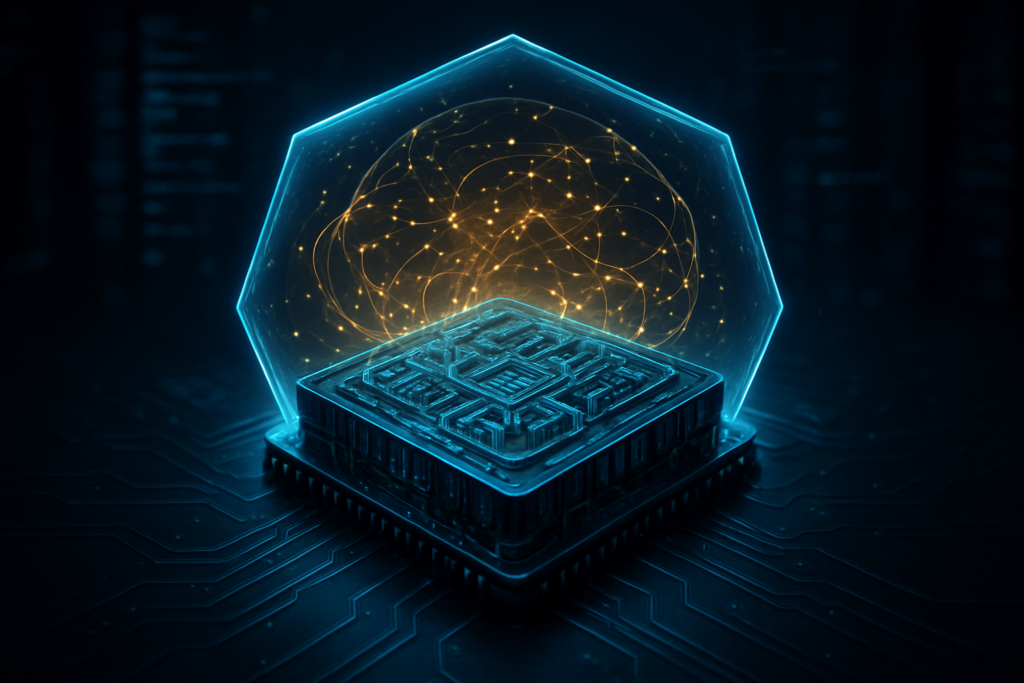
The artificial intelligence revolution has reached a critical inflection point where the value of model weights—the "secret sauce" of LLMs—now represents trillions of dollars in research and development. As of January 9, 2026, the industry has shifted its focus from mere performance to "Confidential Computing," a hardware-first security paradigm that ensures sensitive data and proprietary AI models remain encrypted even while they are being processed. This breakthrough effectively turns silicon into a fortress, allowing enterprises to deploy their most valuable intellectual property in public clouds without the risk of exposure to cloud providers, hackers, or even state-sponsored actors.
The emergence of these hardware-level protections marks the end of the "trust but verify" era in cloud computing. With the release of next-generation architectures from industry leaders, the "black box" of AI inference has become a literal secure vault. By isolating AI workloads within hardware-based Trusted Execution Environments (TEEs), companies can now run frontier models like GPT-5 and Llama 4 with the mathematical certainty that their weights cannot be scraped or leaked from memory, even if the underlying operating system is compromised.
The Architecture of Trust: Rubin, MI400, and the Rise of TEEs
At the heart of this security revolution is NVIDIA’s (NASDAQ: NVDA) newly launched Vera Rubin platform. Succeeding the Blackwell architecture, the Rubin NVL72 introduces the industry’s first rack-scale Trusted Execution Environment. Unlike previous generations that secured individual chips, the Rubin architecture extends protection across the entire NVLink domain. This is critical for 2026’s trillion-parameter models, which are too large for a single GPU and must be distributed across dozens of chips. Through the BlueField-4 Data Processing Unit (DPU) and the Advanced Secure Trusted Resource Architecture (ASTRA), NVIDIA provides hardware-accelerated attestation, ensuring that model weights are only decrypted within the secure memory space of the Rubin GPU.
AMD (NASDAQ: AMD) has countered with its Instinct MI400 series and the Helios platform, positioning itself as the primary choice for "Sovereign AI." Built on the CDNA 5 architecture, the MI400 leverages AMD’s SEV-SNP (Secure Encrypted Virtualization-Secure Nested Paging) technology to provide rigorous memory isolation. The MI400 features up to 432GB of HBM4 memory, where every byte is encrypted at the controller level. This prevents "cold boot" attacks and memory scraping, which were theoretical vulnerabilities in earlier AI hardware. AMD’s Helios rack-scale security pairs these GPUs with EPYC "Venice" CPUs, which act as a hardware root of trust to verify the integrity of the entire software stack before any processing begins.
Intel (NASDAQ: INTC) has also redefined its roadmap with the introduction of Jaguar Shores, a next-generation AI accelerator designed specifically for secure enterprise inference. Jaguar Shores utilizes Intel’s Trust Domain Extensions (TDX) and a new feature called TDX Connect. This technology provides a secure, encrypted PCIe/CXL 3.1 link between the Xeon processor and the accelerator, ensuring that data moving between the CPU and GPU is never visible to the system bus in plaintext. This differs significantly from previous approaches that relied on software-level encryption, which added massive latency and was susceptible to side-channel attacks. Initial reactions from the research community suggest that these hardware improvements have finally closed the "memory gap" that previously left AI models vulnerable during high-speed computation.
Strategic Shifts: The New Competitive Landscape for Tech Giants
This shift toward hardware-level security is fundamentally altering the competitive dynamics of the cloud and semiconductor industries. Cloud giants like Microsoft (NASDAQ: MSFT), Amazon (NASDAQ: AMZN), and Alphabet (NASDAQ: GOOGL) are no longer just selling compute cycles; they are selling "zero-trust" environments. Microsoft’s Azure AI Foundry now offers Confidential VMs powered by NVIDIA Rubin GPUs, allowing customers to deploy proprietary models with "Application Inference Profiles" that prevent model scraping. This has become a major selling point for financial institutions and healthcare providers who were previously hesitant to move their most sensitive AI workloads to the public cloud.
For semiconductor companies, security has become as important a metric as TeraFLOPS. NVIDIA’s integration of ASTRA across its rack-scale systems gives it a strategic advantage in the enterprise market, where the loss of a proprietary model could bankrupt a company. However, AMD’s focus on open-standard security through the UALink (Ultra Accelerator Link) and its Helios architecture is gaining traction among governments and "Sovereign AI" initiatives that are wary of proprietary, locked-down ecosystems. This competition is driving a rapid standardization of attestation protocols, making it easier for startups to switch between hardware providers while maintaining a consistent security posture.
The disruption is also hitting the AI model-as-a-service (MaaS) market. As hardware-level security becomes ubiquitous, the barrier to "bringing your own model" (BYOM) to the cloud has vanished. Startups that once relied on providing API access to their models are now facing pressure to allow customers to run those models in their own confidential cloud enclaves. This shifts the value proposition from simple access to the integrity and privacy of the execution environment, forcing AI labs to rethink how they monetize and distribute their intellectual property.
Global Implications: Sovereignty, Privacy, and the New Regulatory Era
The broader significance of hardware-level AI security extends far beyond corporate balance sheets; it is becoming a cornerstone of national security and regulatory compliance. With the EU AI Act and other global frameworks now in full effect as of 2026, the ability to prove that data remains private during inference is a legal requirement for many industries. Confidential computing provides a technical solution to these regulatory demands, allowing for "Privacy-Preserving Machine Learning" where multiple parties can train a single model on a shared dataset without any party ever seeing the others' raw data.
This development also plays a crucial role in the concept of AI Sovereignty. Nations are increasingly concerned about their citizens' data being processed on foreign-controlled hardware. By utilizing hardware-level TEEs and local attestation, countries can ensure that their data remains within their jurisdiction and is processed according to local laws, even when using chips designed in the U.S. or manufactured in Taiwan. This has led to a surge in "Sovereign Cloud" offerings that use Intel TDX and AMD SEV-SNP to provide a verifiable guarantee of data residency and isolation.
However, these advancements are not without concerns. Some cybersecurity experts warn that as security moves deeper into the silicon, it becomes harder for independent researchers to audit the hardware for backdoors or "undocumented features." The complexity of these 2026-era chips—which now include dedicated security processors and encrypted interconnects—means that we are placing an immense amount of trust in a handful of semiconductor manufacturers. Comparisons are being drawn to the early days of the internet, where the shift to HTTPS secured the web; similarly, hardware-level AI security is becoming the "HTTPS for intelligence," but the stakes are significantly higher.
The Road Ahead: Edge AI and Post-Quantum Protections
Looking toward the late 2020s, the next frontier for confidential computing is the edge. While 2026 has focused on securing massive data centers and rack-scale systems, the industry is already moving toward bringing these same silicon-level protections to smartphones, autonomous vehicles, and IoT devices. We expect to see "Lite" versions of TEEs integrated into consumer-grade silicon, allowing users to run personal AI assistants that process sensitive biometric and financial data entirely on-device, with the same level of security currently reserved for trillion-dollar frontier models.
Another looming challenge is the threat of quantum computing. While today’s hardware encryption is robust against classical attacks, the industry is already beginning to integrate post-quantum cryptography (PQC) into the hardware root of trust. Experts predict that by 2028, the "harvest now, decrypt later" strategy used by some threat actors will be neutralized by chips that use lattice-based cryptography to secure the attestation process. The challenge will be implementing these complex algorithms without sacrificing the extreme low-latency required for real-time AI inference.
The next few years will likely see a push for "Universal Attestation," a cross-vendor standard that allows a model to be verified as secure regardless of whether it is running on an NVIDIA, AMD, or Intel chip. This would further commoditize AI hardware and shift the focus back to the efficiency and capability of the models themselves. As the hardware becomes a "black box" that no one—not even the owner of the data center—can peer into, the very definition of "the cloud" will continue to evolve.
Conclusion: A New Standard for the AI Era
The transition to hardware-level AI security in 2026 represents one of the most significant milestones in the history of computing. By moving the "root of trust" from software to silicon, the industry has solved the fundamental paradox of the cloud: how to share resources without sharing secrets. The architectures introduced by NVIDIA, AMD, and Intel this year have turned the high-bandwidth memory and massive interconnects of AI clusters into a unified, secure environment where the world’s most valuable digital assets can be safely processed.
The long-term impact of this development cannot be overstated. It paves the way for a more decentralized and private AI ecosystem, where individuals and corporations maintain total control over their data and intellectual property. As we move forward, the focus will shift to ensuring these hardware protections remain unbreachable and that the benefits of confidential computing are accessible to all, not just the tech giants.
In the coming weeks and months, watch for the first "Confidential-only" cloud regions to be announced by major providers, and keep an eye on how the first wave of GPT-5 enterprise deployments fares under these new security protocols. The silicon-level fortress is now a reality, and it will be the foundation upon which the next decade of AI innovation is built.
This content is intended for informational purposes only and represents analysis of current AI developments.
TokenRing AI delivers enterprise-grade solutions for multi-agent AI workflow orchestration, AI-powered development tools, and seamless remote collaboration platforms.
For more information, visit https://www.tokenring.ai/.