As of early 2026, the global landscape of artificial intelligence infrastructure has undergone a seismic shift, transitioning from a single-vendor dominance to a high-stakes duopoly. Advanced Micro Devices (NASDAQ: AMD) has successfully executed a multi-year strategic pivot, transforming from a traditional processor manufacturer into a "full-stack" AI powerhouse. Under the relentless leadership of CEO Dr. Lisa Su, the company has spent the last 18 months aggressively closing the gap with NVIDIA (NASDAQ: NVDA), leveraging a combination of rapid-fire hardware releases, massive strategic acquisitions, and a "software-first" philosophy that has finally begun to erode the long-standing CUDA moat.
The immediate significance of this pivot is most visible in the data center, where AMD’s Instinct GPU line has moved from a niche alternative to a core component of the world’s largest AI clusters. By delivering the Instinct MI350 series in 2025 and now rolling out the groundbreaking MI400 series in early 2026, AMD has provided the industry with exactly what it craved: a viable, high-performance second source of silicon. This emergence has not only stabilized supply chains for hyperscalers but has also introduced price competition into a market that had previously seen margins skyrocket under NVIDIA's singular control.
Technical Prowess: From CDNA 3 to the Unified UDNA Frontier
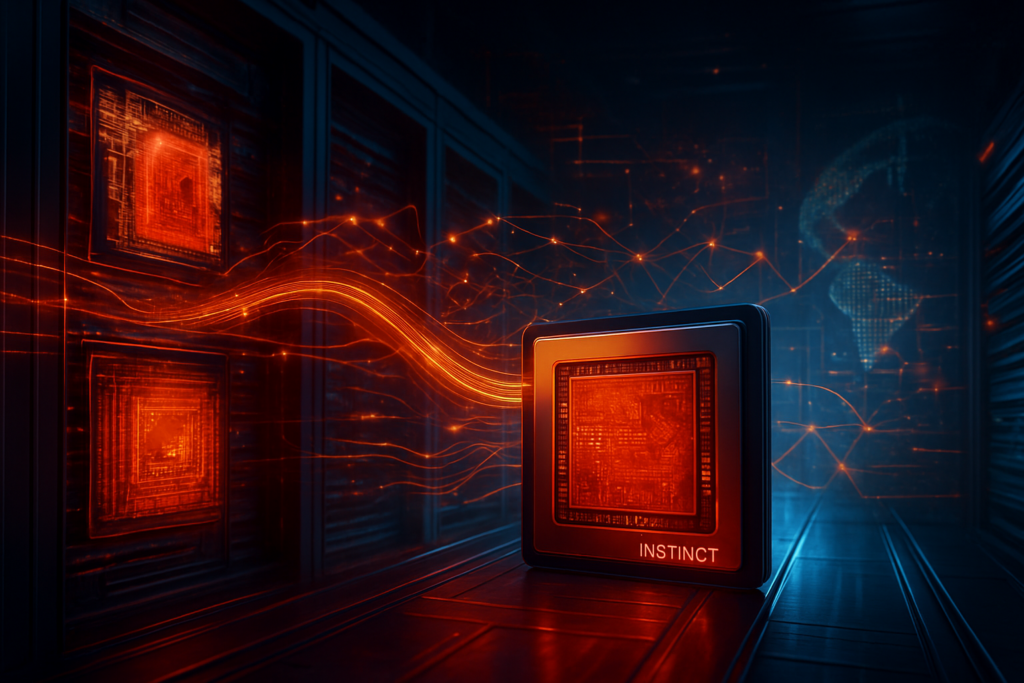
The technical cornerstone of AMD’s resurgence is the accelerated cadence of its Instinct GPU roadmap. While the MI300X set the stage in 2024, the late-2025 release of the MI355X marked a turning point in raw performance. Built on the 3nm CDNA 4 architecture, the MI355X introduced native support for FP4 and FP6 data types, enabling a staggering 35-fold increase in inference performance compared to the previous generation. With 288GB of HBM3E memory and 6 TB/s of bandwidth, the MI355X became the first non-NVIDIA chip to consistently outperform the Blackwell B200 in specific large language model (LLM) workloads, such as Llama 3.1 405B inference.
Entering January 2026, the industry's attention has turned to the MI400 series, which represents AMD’s most ambitious architectural leap to date. The MI400 is the first to utilize the "UDNA" (Unified DNA) architecture, a strategic merger of AMD’s gaming-focused RDNA and data-center-focused CDNA branches. This unification simplifies the development environment for engineers who work across consumer and enterprise hardware. Technically, the MI400 is a behemoth, boasting 432GB of HBM4 memory and a memory bandwidth of nearly 20 TB/s. This allows trillion-parameter models to be housed on significantly fewer nodes, drastically reducing the energy overhead associated with data movement between chips.
Crucially, AMD has addressed its historical "Achilles' heel"—software. Through the integration of the Silo AI acquisition, AMD has deployed over 300 world-class AI scientists to refine the ROCm 7.x software stack. This latest iteration of ROCm has achieved a level of maturity that industry experts call "functionally equivalent" to NVIDIA’s CUDA for the vast majority of PyTorch and TensorFlow workloads. The introduction of "zero-code" migration tools has allowed developers to port complex AI models from NVIDIA to AMD hardware in days rather than months, effectively neutralizing the proprietary lock-in that once protected NVIDIA’s market share.
The Systems Shift: Challenging the Full-Stack Dominance
AMD’s strategic evolution has moved beyond individual chips to encompass entire "rack-scale" systems, a move necessitated by the $4.9 billion acquisition of ZT Systems in 2025. By retaining over 1,000 of ZT’s elite design engineers while divesting the manufacturing arm to Sanmina, AMD gained the internal expertise to design complex, liquid-cooled AI server clusters. This resulted in the launch of "Helios," a turnkey AI rack featuring 72 MI400 GPUs interconnected with EPYC "Venice" CPUs. Helios is designed to compete head-to-head with NVIDIA’s GB200 NVL72, offering a comparable 3 ExaFLOPS of AI compute but with an emphasis on open networking standards like Ultra Ethernet.
This systems-level approach has fundamentally altered the competitive landscape for tech giants like Microsoft (NASDAQ: MSFT), Meta (NASDAQ: META), and Oracle (NYSE: ORCL). These companies, which formerly relied almost exclusively on NVIDIA for high-end training, have now diversified their capital expenditures. Meta, in particular, has become a primary advocate for AMD, utilizing MI350X clusters to power its latest generation of Llama models. For these hyperscalers, the benefit is twofold: they gain significant leverage in price negotiations with NVIDIA and reduce the systemic risk of being beholden to a single hardware provider’s roadmap and supply chain constraints.
The impact is also being felt in the emerging "Sovereign AI" sector. Countries in Europe and the Middle East, wary of being locked into a proprietary American software ecosystem like CUDA, have flocked to AMD’s open-source approach. By partnering with AMD, these nations can build localized AI infrastructure that is more transparent and easier to customize for national security or specific linguistic needs. This has allowed AMD to capture approximately 10% of the total addressable market (TAM) for data center GPUs by the start of 2026—a significant jump from the 5% share it held just two years prior.
A Global Chessboard: Lisa Su’s International Offensive
The broader significance of AMD’s pivot is deeply intertwined with global geopolitics and supply chain resilience. Dr. Lisa Su has spent much of late 2024 and 2025 in high-level diplomatic and commercial engagements across Asia and Europe. Her strategic alliance with TSMC (NYSE: TSM) has been vital, securing early access to 2nm process nodes for the upcoming MI500 series. Furthermore, Su’s meetings with Samsung (KRX: 005930) Chairman Lee Jae-yong in late 2025 signaled a major shift toward dual-sourcing HBM4 memory, ensuring that AMD’s production remains insulated from the supply bottlenecks that have historically plagued the industry.
AMD’s positioning as the "Open AI" champion stands in stark contrast to the closed ecosystem model. This philosophical divide is becoming a central theme in the AI industry's development. By backing open standards and providing the hardware to run them at scale, AMD is fostering an environment where innovation is not gated by a single corporation. This "democratization" of high-end compute is particularly important for AI startups and research labs that require extreme performance but lack the multi-billion dollar budgets of the "Magnificent Seven" tech companies.
However, this rapid expansion is not without its concerns. As AMD moves into the systems business, it risks competing with some of its own traditional partners, such as Dell and HPE, who also build AI servers. Additionally, while ROCm has improved significantly, NVIDIA’s decade-long head start in software libraries for specialized scientific computing remains a formidable barrier. The broader industry is watching closely to see if AMD can maintain its current innovation velocity or if the immense capital required to stay at the leading edge of 2nm fabrication will eventually strain its balance sheet.
The Road to 2027: UDNA and the AI PC Integration
Looking ahead, the near-term focus for AMD will be the full-scale deployment of the MI400 and the continued integration of AI capabilities into its consumer products. The "AI PC" is the next major frontier, where AMD’s Ryzen processors with integrated NPUs (Neural Processing Units) are expected to dominate the enterprise laptop market. Experts predict that by late 2026, the distinction between "data center AI" and "local AI" will begin to blur, with AMD’s UDNA architecture allowing for seamless model handoffs between a user’s local device and the cloud-based Instinct clusters.
The next major milestone on the horizon is the MI500 series, rumored to be the first AI accelerator built on a 2nm process. If AMD can hit its target release in 2027, it could potentially achieve parity with NVIDIA’s "Rubin" architecture in terms of transistor density and energy efficiency. The challenge will be managing the immense power requirements of these next-generation chips, which are expected to exceed 1500W per module, necessitating a complete industry shift toward liquid cooling at the rack level.
Conclusion: A Formidable Number Two
As we move through the first month of 2026, AMD has solidified its position as the indispensable alternative in the AI hardware market. While NVIDIA remains the revenue leader and the "gold standard" for the most demanding training tasks, AMD has successfully broken the monopoly. The company’s transformation—from a chipmaker to a systems and software provider—is a testament to Lisa Su’s vision and the flawless execution of the Instinct roadmap. AMD has proven that with enough architectural innovation and a commitment to an open ecosystem, even the most entrenched market leaders can be challenged.
The long-term impact of this "Red Renaissance" will be a more competitive, resilient, and diverse AI industry. For the coming months, observers should keep a close eye on the volume of MI400 shipments and any further acquisitions in the AI networking space, as AMD looks to finalize its "full-stack" vision. The era of the AI monopoly is over; the era of the AI duopoly has officially begun.
This content is intended for informational purposes only and represents analysis of current AI developments.
TokenRing AI delivers enterprise-grade solutions for multi-agent AI workflow orchestration, AI-powered development tools, and seamless remote collaboration platforms.
For more information, visit https://www.tokenring.ai/.