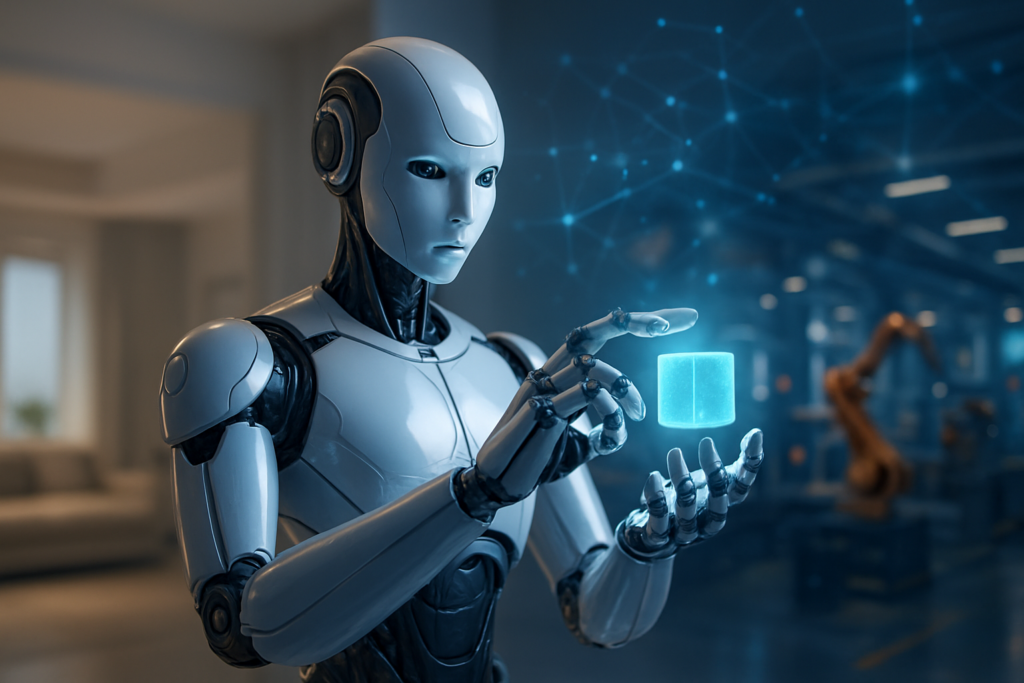
The landscape of artificial intelligence underwent a tectonic shift following Tesla’s (NASDAQ: TSLA) landmark "We, Robot" event, a spectacle that transitioned the company from a mere automaker into a vanguard of embodied AI. While the event initially faced scrutiny over its theatrical nature, the intervening months leading into early 2026 have proven it to be the starting gun for a new era. What was once seen as a series of controlled demonstrations has evolved into a tangible industrial reality, with humanoid robots now beginning to populate factory floors and prepare for their eventual entry into the suburban home.
The "We, Robot" event, held at the Warner Bros. Discovery (NASDAQ: WBD) lot, wasn't just about showing off a machine; it was about selling a vision of a post-labor society. Attendees watched in awe as Optimus robots served drinks, played games, and interacted with guests with a fluidity that seemed to defy current robotics limitations. Today, as we look back from February 2026, those early steps have culminated in the deployment of over 1,000 Optimus Gen 3 units within Tesla’s own Gigafactories, signaling that the "buddy" Musk promised is no longer a prototype, but a production-line peer.
From Controlled Demos to Autonomous Reality
The technical leap from the Optimus Gen 2 shown in October 2024 to the current Gen 3 models is staggering. During the "We, Robot" showcase, the robotics community was quick to point out that many of the most impressive feats—such as complex verbal banter and precise drink pouring—were "human-in-the-loop" teleoperations. Critics argued that the autonomy was a facade. However, Tesla has spent the last 15 months closing the gap between human control and neural network independence. The current iteration of Optimus utilizes the FSD v15 architecture, a specialized branch of the software powering Tesla's vehicles, which allows the robot to navigate unmapped, dynamic environments like busy factory floors without pre-programmed paths.
Mechanically, the advancement in the robot’s "End-Effector" (the hand) remains the crowning achievement. The latest Gen 3 hands feature 22 degrees of freedom, an upgrade from the 11 degrees seen in earlier versions. This allows for tactile sensitivity that rivals human dexterity; these robots can now handle everything from fragile battery cells to heavy kitting crates with equal finesse. Integrated tactile sensors in every fingertip provide a feedback loop to the AI, allowing the robot to "feel" the weight and friction of an object, a necessity for Musk’s promised tasks like folding laundry or even the delicate work of babysitting.
This transition marks a departure from the "coded" robotics of the past, where every movement was a line of math. Instead, Tesla’s approach relies on end-to-end neural networks trained on massive datasets of human movement. By observing thousands of hours of human labor, Optimus has learned to mimic natural motion, reducing the "uncanny valley" effect and increasing the efficiency of its caloric (battery) consumption. This differentiates Tesla from competitors who often rely on more rigid, rule-based systems, positioning Optimus as a truly general-purpose platform.
A Disruptive Force in the Tech Ecosystem
The ripple effects of Optimus’s progress are being felt across the entire tech sector. Tesla’s pivot has forced major AI labs and robotics firms to accelerate their timelines. Companies like NVIDIA (NASDAQ: NVDA), which provides the underlying hardware for much of the world's AI, have seen a massive surge in demand for the Thor and Blackwell chips required to train these massive "embodied" models. Meanwhile, startups like Figure AI and established giants like Boston Dynamics have been forced to shift their focus from specialized industrial machines to general-purpose humanoids to keep pace with Tesla’s aggressive scaling.
The strategic advantage for Tesla lies in its vertical integration and existing manufacturing prowess. In January 2026, the company made the bold move to begin decommissioning legacy production lines at its Fremont factory to make room for dedicated high-volume Optimus manufacturing. This move signals a belief that the market for robots—estimated by Musk to be in the billions of units—will eventually dwarf the market for passenger vehicles. For the broader AI industry, this represents a shift from "Chatbots" to "Actionbots," where the real value lies in an AI's ability to manipulate the physical world.
This disruption extends beyond hardware. The software ecosystem is bracing for the "Optimus App Store" equivalent. As third-party developers begin to gain access to the Optimus API, we are seeing the birth of a new software vertical dedicated to "Skills." Just as one might download an app today, future owners will likely purchase "Skill Packs" for specialized tasks like plumbing, specialized elderly care, or advanced gardening. This creates a secondary market that could be worth trillions, fundamentally altering the service economy.
The Socio-Economic Horizon and Ethical Concerns
Elon Musk’s vision for Optimus is nothing short of a total re-engineering of the human experience. By proposing a price point of $20,000 to $30,000—roughly the cost of a compact car—Tesla is aiming for a world where a personal robot is as common as a washing machine. Musk’s claims that Optimus will eventually mow lawns, fetch groceries, and act as a domestic companion suggest a future where "boring, repetitive, and dangerous" tasks are entirely offloaded. This has significant implications for the global labor market, particularly in sectors like logistics, custodial services, and low-tier manufacturing.
However, the rapid ascent of Optimus is not without its detractors. Ethical concerns regarding the "babysitting" vision have sparked heated debates in regulatory circles. Can a neural-network-driven machine truly handle the unpredictable nature of childcare? The potential for algorithmic bias or technical malfunction in a domestic setting presents risks that are far different from those found in a controlled factory environment. Privacy advocates are also raising alarms; a robot equipped with 360-degree cameras and high-fidelity microphones wandering through a private home represents a data-collection nexus that could be vulnerable to breaches or corporate overreach.
Despite these concerns, the momentum behind humanoid robotics seems irreversible. We are witnessing the same transition that occurred during the Industrial Revolution, but at the speed of silicon. The "We, Robot" event was the moment the public was invited to imagine this future, but the current deployment in Gigafactories is the proof that the vision is grounded in industrial reality. The comparison to previous milestones—like the introduction of the Model T or the iPhone—is frequent, but Optimus may prove to be even more significant as it represents the first time AI has been given a truly capable physical form.
The Road to the Consumer Home
Looking toward the remainder of 2026 and into 2027, the focus is shifting from "Can it work?" to "Can it scale?" Tesla's goal of reaching a production capacity of one million units per year is an audacious target that requires a total overhaul of the global supply chain for actuators, sensors, and high-density batteries. Near-term, we expect to see the first external sales of Optimus to industrial partners in the construction and hospitality sectors, where the robots will serve as a testbed for wider consumer release.
The primary challenges remain safety and battery longevity. While Optimus can now "jog" at over 5 mph and operate for roughly 8 hours on a single charge, a domestic environment requires 24/7 reliability and fail-safe protocols that prevent any possibility of human injury. Experts predict that the first "home" versions of Optimus will likely be tethered to specific, low-risk chores before they are granted the full autonomy required for child or elderly care. The regulatory framework for "Personal Robotics" is still being written, and its outcome will dictate how quickly these machines move from the factory to the foyer.
Final Reflections on a Robotic Revolution
The "We, Robot" event will likely be remembered as the moment the humanoid robot moved from the realm of science fiction into the corporate roadmap. While the 2024 demonstrations were criticized for their theatricality, they served the vital purpose of normalizing the presence of human-shaped machines in our social spaces. Tesla’s progress over the last year has validated Musk's thesis: that the same computer vision and battery technology used to solve autonomous driving can be used to solve the "labor problem."
As we watch the first thousand robots take their place on the production line this year, the long-term impact on society is difficult to overstate. We are approaching a threshold where the cost of physical labor could drop toward the cost of electricity. For now, the world remains in a state of watchful anticipation. In the coming months, keep a close eye on Tesla's production updates and the inevitable regulatory response as the first industrial partners begin their public deployments. The age of the robot is no longer coming; it is already here.
This content is intended for informational purposes only and represents analysis of current AI developments.
TokenRing AI delivers enterprise-grade solutions for multi-agent AI workflow orchestration, AI-powered development tools, and seamless remote collaboration platforms.
For more information, visit https://www.tokenring.ai/.